
How to Use Analogous Estimating for Creative Project Quotes
A new creative brief often arrives before the work is clear enough to price task by task. You may know the broad shape of the project, but not yet the revision path, decision-makers, supplied assets, or specialist work it will require.
Analogous estimating gives you a disciplined starting point. It uses actual information from a sufficiently similar completed project, then adjusts for the differences that matter in the new one. It is a top-down method for forming an early range, not a final price to send without review. NASA PP&C Glossary and NASA Cost Estimating Handbook, Appendix C
The useful pattern is simple: draft an early range, review the comparison, adjust the assumptions, then compare the estimate with actuals as work progresses. The number matters, but the record behind it matters just as much.
When analogous estimating fits - and when it does not
Analogous estimating can be useful when detailed task information is limited, but the new brief is defined enough to support a reasoned comparison. The reference project needs to be genuinely similar in the areas that drive the work, not merely share a label such as "brand project" or "campaign." NASA Cost Estimating Handbook, Appendix C and Project Management Institute
It is a weaker fit when the project is novel, the reference work no longer reflects current conditions, the decision needs detailed traceability, or the scope is already ready for task-level estimating. In those cases, the comparison may still provide context, but it should not carry the whole quote. NASA Cost Estimating Handbook, Appendix C and U.S. GAO Cost Estimating and Assessment Guide
| Situation | Useful next move |
|---|---|
| The brief has a clear parallel in completed work, but task detail is still limited. | Use an analogous estimate to form an early range and record assumptions. |
| The deliverable sounds similar, but stakeholders, approvals, or production needs are materially different. | Treat those differences as adjustment prompts before sharing a range. |
| The work is new or the reference is stale. | Avoid relying on the analogy as the primary estimate. |
| The scope has enough detail to define activities and responsibilities. | Move to a bottom-up work breakdown. |

Build an analogous estimate you can explain
The question is not "Which old project looks closest?" It is "Which completed project gives me a defensible basis for this new decision?"
Start by recording why the reference project is comparable. That record should cover the work itself, the team involved, and the conditions that shaped the estimate. NASA and PMI guidance both stress that an analogy needs a strong parallel and documented rationale for its adjustments. NASA Cost Estimating Handbook, Appendix C and Project Management Institute
Then turn differences into an adjustment log. These are not fixed formulas or universal percentage changes. They are questions that help you decide what the new range needs to account for.
| Review prompt | Why it matters to the comparison | Assumption to record |
|---|---|---|
| Deliverable count | More versions or formats can change the work that needs to be broken down. | Which deliverables are included in the early range. |
| Approval stakeholders | More reviewers can change the decision path and revision discussion. | Who is expected to review and how approvals will be handled. |
| Revision rounds | Revision expectations affect what the range needs to make visible. | The revision assumption used for the preliminary estimate. |
| Deadline pressure | A different delivery constraint may change the work that needs review. | The delivery condition assumed in the range. |
| Supplied assets or content | Client-provided inputs can change what remains to be produced. | What the client is expected to supply. |
| Specialist handoffs | A different mix of roles can change the work breakdown. | Which specialist work is included or excluded. |
| Direct expenses | Costs outside labor should not disappear inside a historical total. | Which direct costs need separate review. |
The goal is not to make the estimate look more certain than it is. The goal is to make the range explainable: what it is based on, what changed, and what still needs a decision. That is consistent with guidance to document scope, assumptions, methods, and the basis of an estimate. NASA Cost Estimating Handbook, Appendix C and U.S. GAO Cost Estimating and Assessment Guide
A fictional packaging-production illustration
Imagine a mixed studio that completed packaging work for one product line. A new brief covers a related product range, but the new project involves more formats, a different approval group, and a specialist handoff.
This is a fictional illustration of the method, not a benchmark for prices, timelines, or creative-industry outcomes.
| Comparison point | What changed in the new brief | What the team records for review |
|---|---|---|
| Deliverables | The new range includes additional packaging formats. | Which formats belong in the preliminary range. |
| Approvals | The review group is different from the reference project. | The approval assumption and the next question to resolve. |
| Revisions | The brief does not yet settle the revision expectation. | A stated revision assumption, subject to later review. |
| Supplied content | Some inputs are expected from the client. | Which inputs are assumed to be supplied and which are not. |
| Specialist handoff | The work may need a role not used in the reference project. | Whether that role is included in the early range or needs separate scoping. |
| Direct expenses | The brief raises a possible non-labor cost. | Whether that cost is excluded pending confirmation. |
The resulting range is not a formula that settles the quote. It is a documented comparison that tells the client and team what must be clarified next. Using a comparable reference and recording the rationale for adjustments is the relevant method discipline here. NASA Cost Estimating Handbook, Appendix C
Analogous versus bottom-up estimating
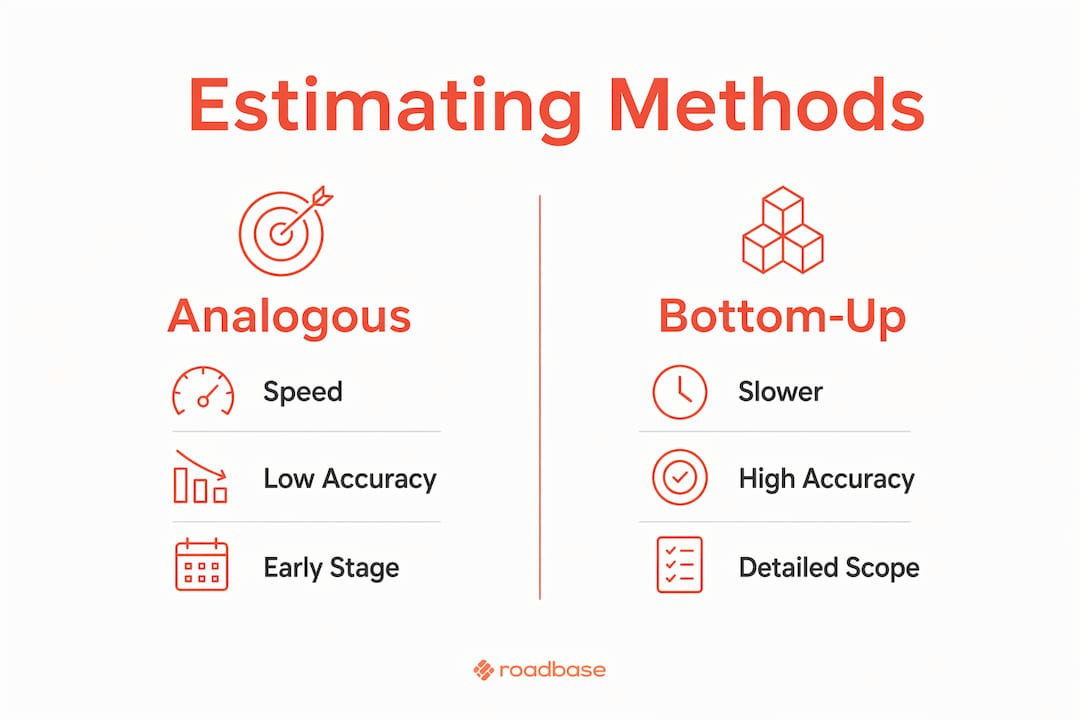
Analogous estimating begins with a completed project and adjusts from there. Bottom-up estimating starts with the activities in a work breakdown and sums those activity-level estimates. They solve different decision problems.
| Method | Useful level of definition | Output | Next review step |
|---|---|---|---|
| Analogous estimating | The brief supports a meaningful comparison, but task detail is limited. | An early range with a comparison basis and assumptions. | Clarify the differences that could change the work. |
| Bottom-up estimating | The scope is defined enough to identify activities and responsibilities. | A task-level work breakdown that can be reviewed and summed. | Review task inputs, responsibilities, and assumptions. |
Do not treat this as a fixed speed or accuracy ranking. Bottom-up estimating creates more task-level visibility, but it still depends on sound inputs and review. As your brief matures, it can help to estimate project hours before you send a quote from a clearer work breakdown. NASA Cost Estimating Handbook, Appendix C and U.S. GAO Cost Estimating and Assessment Guide
Share a preliminary range with the right context
A range is more useful when the reader can see what it rests on. Before you present one, make the following visible:
- The completed project used as the comparison.
- The differences you adjusted for.
- The assumptions included in the range.
- The exclusions that still need a decision.
- The next scoping step that would let you refine the quote.
This is a transparency practice, not contract or legal advice, and it does not guarantee that the scope will not change. It simply gives the next conversation a clearer starting point. NASA Cost Estimating Handbook, Appendix C and U.S. GAO Cost Estimating and Assessment Guide
If the next decision is about work that falls outside the early range, an out-of-scope cost calculator can help keep that conversation separate from the original comparison.
Review estimate versus actual
A historical estimate becomes more useful when you can review it against relevant actuals. Compare tracked hours and other applicable actual information with the estimate while work is underway, then keep the result with the project record for later review. Updating an estimate with actual information is part of credible estimate discipline. U.S. GAO Cost Estimating and Assessment Guide
This is not an automatic-improvement loop. A later draft can only benefit from relevant, correctly linked history, and it still needs review. The value is in making differences visible so the next comparison starts with a better record.
Turn a reviewed brief into a quote draft with Roadbase
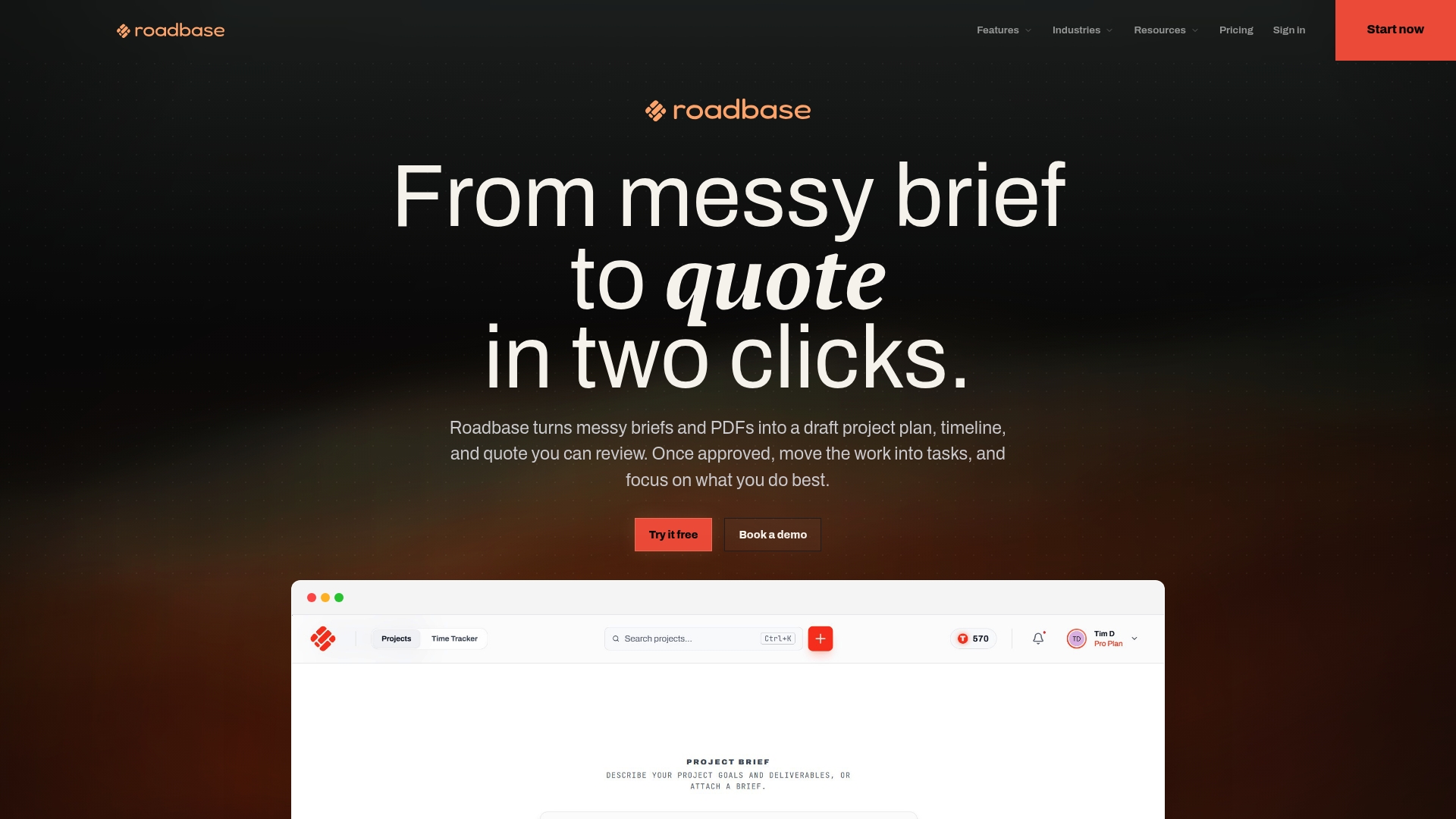
Once you have a real brief, you can paste the brief or attach a PDF. Roadbase builds an editable first draft of the work breakdown. Treat that as a draft to generate, review, and adjust, not as a finished or guaranteed-accurate scope.
Explicit constraints can be carried into the draft for review, but that depends on how the brief is worded. Price estimated hours by the roles doing the work, while remembering that Roadbase does not know your real costs unless you supply and maintain them.
You can review the labor, overhead, direct costs, contingency, and target margin behind the quote. Margin is a calculation, not margin protection or a profitability guarantee, and Roadbase is not accounting software. You can also compare tracked hours with the estimate while work is underway; that makes variance visible rather than preventing scope change or overruns.
When the plan and quote have been reviewed, Roadbase can export them as a proposal PDF. That PDF is not an e-signature workflow, contract, legal agreement, or automatic approval system.
For a broader look at pricing and quoting complex creative projects, keep the same standard: make the work, assumptions, and decisions visible before treating a quote as settled.
If you are a Roadbase for creative freelancers reader with a real brief or PDF, use Roadbase to create an editable draft, then review and adjust it before sharing a proposal.
FAQ
What is analogous estimating in simple terms?
It is a top-down method that starts with actual information from a sufficiently similar completed project and adjusts for meaningful differences in the new one. It is useful for a preliminary range, not a final fixed price. NASA PP&C Glossary and NASA Cost Estimating Handbook, Appendix C
When should I use analogous estimating instead of bottom-up estimating?
Use it when the brief has enough definition for a reasoned comparison but not enough task-level detail for a work breakdown. Move to bottom-up estimating when you need visibility into activities and responsibilities. NASA Cost Estimating Handbook, Appendix C and U.S. GAO Cost Estimating and Assessment Guide
What should I adjust when comparing a past creative project?
Review the factors that make the new brief meaningfully different: deliverables, stakeholders, revisions, deadlines, supplied inputs, specialist handoffs, and direct expenses. Record the rationale instead of applying assumed universal multipliers. NASA Cost Estimating Handbook, Appendix C
How should I present a preliminary range to a client?
Show the comparison basis, assumptions, exclusions, and next decision needed to refine the work. This makes the range easier to review; it is not a contract or a guarantee that the scope will not change. NASA Cost Estimating Handbook, Appendix C and U.S. GAO Cost Estimating and Assessment Guide
Can a tool replace my estimate review?
No. A tool can help create an editable draft and make estimate-versus-actual differences visible, but you still need to review the brief, comparison basis, constraints, costs, assumptions, and quote.
Sources
- S1: NASA PP&C Glossary
- S2: NASA Cost Estimating Handbook, Appendix C
- S3: U.S. GAO Cost Estimating and Assessment Guide
- S4: Project Management Institute, Leveraging the New Practice Standard for Project Estimating
Editor note
The sources support an estimation method and documentation discipline. They do not establish universal creative-work multipliers, guaranteed accuracy, or automatic software improvement. Review the comparison, assumptions, costs, and final quote before use.