

Margin vs. Markup for Project Quotes: Formulas and Examples
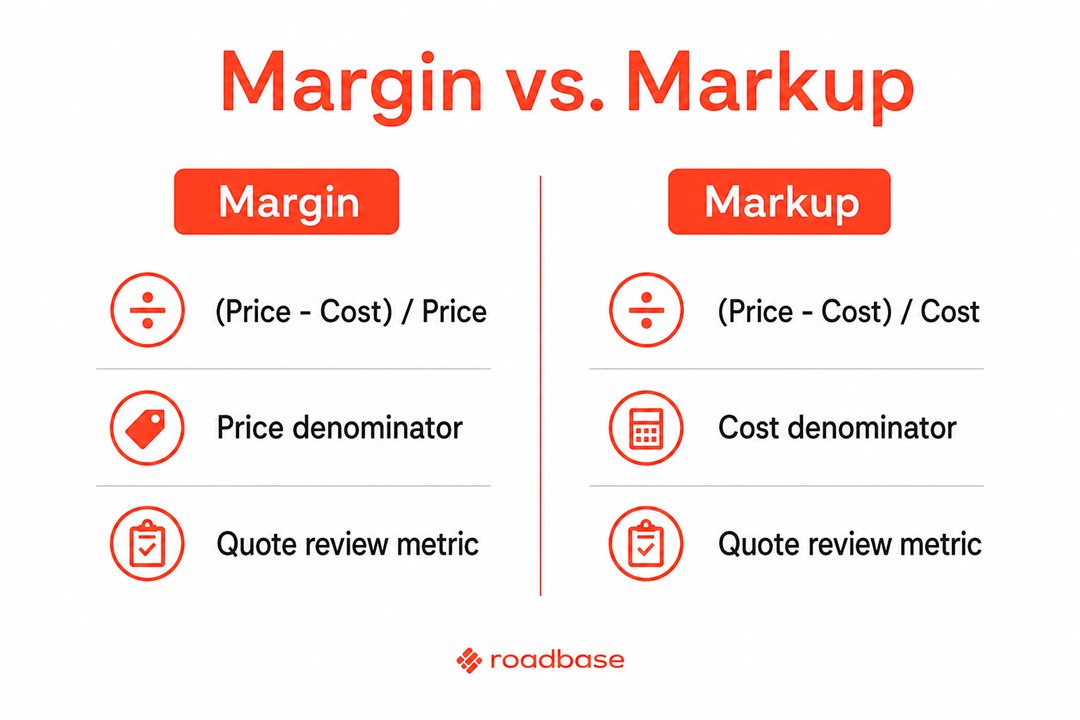
Margin and markup describe the same difference between a quote's price and its planned cost, but they use different denominators. That is why a 40% margin and a 40% markup do not produce the same quoted price.
In this article, cost means a reviewed planned delivery-cost model for one quote: priced labor, direct expenses, and consciously allocated overhead. The formulas help you check the math. They do not establish that your costs, scope assumptions, overhead allocation, or commercial judgment are complete.
Table of Contents
- How to calculate margin percentage
- How to calculate markup percentage
- When to use margin versus markup in business
- Practical examples and calculator usage for margin and markup
- Common misunderstandings and expert insights about margin and markup
- How Roadbase helps you apply margin and markup correctly
- Key Takeaways
- FAQ
How to calculate margin percentage
Margin uses price as its denominator:
margin = (price - cost) / price
Use decimal inputs in the equation, then convert the result to a percentage for display. If a project has a planned cost of $500 and a quoted price of $833.33, the difference is $333.33. Dividing that difference by $833.33 gives a 40% margin, subject to rounding.
The target-margin price formula is:
price = cost / (1 - margin)
For this formula, cost must be greater than zero and the target margin must be at least zero and less than one. A target margin of one would make the denominator zero, so it cannot produce a quote price. The denominator distinction and target-margin formula are explained by University of Maine Cooperative Extension and Mississippi State University Extension.

How to calculate markup percentage
Markup uses cost as its denominator:
markup = (price - cost) / cost
With the same $500 planned cost and $833.33 quoted price, the $333.33 difference divided by $500 is a 66.67% markup, subject to rounding. Because price is higher than cost when there is a positive difference, the markup percentage is higher than the corresponding margin percentage.
The conversion formula is:
markup = margin / (1 - margin)
For example, a 30% margin converts to a 42.86% markup. This conversion does not tell you which target to choose. It only lets a team use the same terminology when reviewing a quote.

When to use margin versus markup in business
For a project quote, the useful choice is about terminology. Start with markup when someone is expressing the difference from a reviewed planned cost. Start with margin when someone is expressing the same difference as a share of the quoted price. Before a quote is approved, confirm which percentage the team means and keep the chosen denominator visible.
This is not a recommendation about financial reporting, tax, accounting, investor materials, benchmarks, or business health. It is quote math: a way to avoid treating two different percentages as interchangeable.
Practical examples and calculator usage for margin and markup
Imagine a small mixed studio preparing a quote with a reviewed planned delivery cost of $500. That cost model includes priced labor, direct expenses, and consciously allocated overhead. It is a planning example, not a statement of actual profitability.
| Target | Calculation | Quoted price | Equivalent percentage |
|---|---|---|---|
| 40% margin | $500 / (1 - 0.40) | $833.33 | 66.67% markup |
| 40% markup | $500 x (1 + 0.40) | $700.00 | 28.57% margin |
The same 40% figure leads to different prices because the denominator changes. Another useful conversion check: a 100% markup equals a 50% margin.
To convert in the other direction, use:
margin = markup / (1 + markup)
Keep the units clear. Enter 40% as 0.40 in the formulas, then display the result as a percentage. A calculator or spreadsheet can perform the arithmetic, but it cannot confirm that the inputs or quote assumptions are complete.
Common misunderstandings and expert insights about margin and markup
The mistakes below are simple, but they can make a quote harder to review.
- Using the same percentage as if it means the same thing. A 40% margin is not a 40% markup. Write the metric beside the percentage and use the matching formula.
- Putting a percentage into a formula as a whole number. The formulas above use decimal inputs. Enter 40% as
0.40, then convert the result back to a percentage for display. - Treating a formula as a complete cost model. The calculation does not decide whether labor, direct expenses, allocated overhead, scope boundaries, or assumptions have been reviewed.
- Calling the result a guarantee. Margin and markup formulas describe the relationship between the price and the planned cost model in front of you. They do not protect margin or establish actual profitability.
How Roadbase helps you apply margin and markup correctly
Roadbase is a quote-first planning and pricing workspace for a real project brief. You can paste a project brief or attach a PDF, then Roadbase builds an editable first draft of the work breakdown, including phases, tasks or milestones, roles, estimated hours, timing, and brief estimate reasoning. AI output is a draft: review scope, assumptions, feasibility, and commercial judgment before relying on it.
You can price estimated hours by the roles doing the work, using internal costs and billable rates that you supply and maintain. Roadbase can show labor cost, role rates, overhead, direct costs, contingency, estimated cost, quoted price, and target margin behind a quote. It can also keep direct project expenses beside labor instead of hiding them inside hours. These are calculation and review inputs, not margin protection, a guarantee of profitability, or accounting software.
After review, you can export the plan and quote as a proposal PDF. It is not an e-signature workflow, contract, legal agreement, or automatic approval system.
If the brief is real but the work is still scattered across notes, Roadbase can turn it into a draft plan and quote for you to review.
Further reading
- Pricing and quoting complex creative projects: when spreadsheets stop working
- How to price a motion design project
- How to price a packaging design project
- Out-of-Scope Cost Calculator
Key Takeaways
| Point | What it means for a project quote |
|---|---|
| Different denominators | Margin divides the difference by price; markup divides it by cost. |
| Same number, different result | A 40% margin and a 40% markup produce different prices from the same planned cost. |
| Convert with decimals | Use markup = margin / (1 - margin) and margin = markup / (1 + markup). |
| Review the cost model | The formulas do not confirm that costs, expenses, overhead, scope, or assumptions are complete. |
| Keep the language clear | Name the metric beside the percentage before a quote is approved. |
FAQ
What is the difference between 30% margin and 30% markup?
A 30% margin expresses the difference as 30% of price. A 30% markup expresses the difference as 30% of cost. A 30% margin converts to a 42.86% markup, so they are not interchangeable.
Is 20% margin the same as 25% markup?
Yes, those are equivalent percentages expressed with different denominators. 20% / (1 - 20%) equals 25% markup, and 25% / (1 + 25%) equals 20% margin.
Is 50% margin the same as 100% markup?
Yes. A 100% markup means the price is twice the planned cost. The difference is then half of the price, which is a 50% margin.
Should I use markup or margin?
For a quote, use the term that matches the question being asked: markup when the difference is expressed from planned cost, and margin when it is expressed from quoted price. Confirm the denominator before the quote is approved. This article does not advise on accounting, reporting, tax, or business-health decisions.
Sources
- University of Maine Cooperative Extension: pricing guide
- Mississippi State University Extension: product pricing and break-even concept
- Investopedia: retained imported link
- Rippling: retained imported link
- Sage: retained imported link
- Shopify: retained imported link
Related guide: Cost-plus pricing for agencies.