

When Value-Based Pricing Fits a Creative Project Quote

Value-based pricing can be useful when a creative project is tied to a specific buyer outcome that both sides can discuss credibly. It is not a way to skip the work of defining the project, estimating delivery, or checking whether the client can actually make a decision on that basis.
At its simplest, value-based pricing starts with a buyer's perceived value, or willingness to pay. That is different from the price you quote and different again from the cost of doing the work. Harvard Business School's value-stick framework treats willingness to pay, price, cost, and willingness to sell as separate parts of a commercial decision. Harvard Business School Online
For a freelancer, studio, or agency, the practical question is not "Can I call this value based pricing?" It is: "Do we have enough shared evidence to discuss the outcome, while still making the delivery work and assumptions reviewable?"
Start with four separate things
Creative quotes get muddled when four related inputs are treated as interchangeable:
- Client value: what the buyer believes a particular outcome is worth in their situation.
- Quoted price: the amount you propose for the defined work.
- Delivery cost: the labor, direct expenses, and other costs you expect to carry.
- Estimated hours: the time you expect the roles on the project to need.
None of these automatically determines another. A buyer may care deeply about an outcome but have a limited budget. A project may have an attractive strategic case but still require more delivery effort than the proposed scope can support. And a well-estimated effort does not, on its own, tell you what the buyer is willing to pay.
This distinction is consistent with pricing guidance from OpenStax: buyer value, supply costs, competition, and financial effect are all inputs to a pricing decision, and perceived value can vary by buyer and context. OpenStax: Pricing and Its Role in the Marketing Mix
When value-based pricing is a credible fit
Value-based pricing is worth considering when the project has a specific outcome, the client can explain why it matters, and you can connect that conversation to a defined scope of work. It is a qualified decision, not a badge for higher prices.
Use this checklist before leading with a value-based conversation:
- The outcome is concrete. The client can describe the change they are trying to make, such as clarifying a brand system before a launch, preparing a packaging range for production, or giving an event team a consistent spatial concept. Keep the outcome specific enough to discuss, rather than treating "growth" or "better awareness" as settled facts.
- The buyer can discuss why it matters. Perceived value belongs to the buyer and their circumstances. Ask what decision, audience, timing, or operational need makes the work important now. Do not assume the value on their behalf. OpenStax: Pricing and Its Role in the Marketing Mix
- There is credible evidence, not just optimistic language. Evidence might be a confirmed launch date, an approved change in product range, a known production constraint, or direct input from the decision-maker. It does not need to become a revenue forecast. The point is to test whether the stated outcome is real enough to inform a commercial discussion.
- The delivery work is feasible and visible. The project still needs phases, deliverables, review points, roles, estimated hours, dependencies, and direct expenses. A value-led conversation does not make those inputs optional.
- The client can make the relevant decision. If the person receiving the quote cannot discuss the outcome, budget format, or approval route, pause before treating value as the primary pricing input.
Customer value, cost, target return, competition, and what the customer will pay are distinct pricing objectives, and more than one may apply at once. In practice, that means a value-led discussion can sit beside cost and scope review rather than replacing it. OpenStax: Establishing Pricing Policy
When it is not the right lead
Do not force a value-based price when the buyer outcome is undefined, cannot be discussed credibly, or rests on weak evidence. It may also be a poor fit when the scope is materially uncertain or when the buyer requires a rate-based format.
That does not make the project unquoteable. It means the next step is to clarify the work, separate unknowns from commitments, and agree on a pricing approach the buyer can actually review. A fixed project price or an hourly arrangement may be the clearer route in that moment; this is not a universal ranking of pricing models.
Turn the conversation into a reviewable quote
Once the buyer outcome is clear enough to discuss, bring the quote back to the work. A reliable estimate should document its purpose, scope, schedule, technical baseline, work breakdown, assumptions, data, method, results, and updates as actual costs become available. U.S. Government Accountability Office: Cost Estimating and Assessment Guide
For creative work, a reviewable quote should make the following easy to find:
- the outcome or decision the project is intended to support;
- the deliverables and phases required to do the work;
- responsibilities on both sides, including what the client supplies;
- assumptions and dependencies, such as copy readiness, approvals, specialist handoffs, or production inputs;
- exclusions and the process for discussing a change;
- estimated hours and roles, along with labor, overhead, direct costs, contingency, and the target margin behind the quote; and
- the next approval or clarification needed.
Explicit exclusions matter because they help set expectations and provide a reference point for a later change discussion. A scope statement normally identifies scope, major deliverables, and exclusions for that reason. Project Management Institute: PMBOK scope material
Documenting these elements does not prevent scope creep, protect margin, or settle a disagreement by itself. It gives both sides a clearer basis for reviewing what the quote covers and what needs a new decision. If work changes after approval, use an out-of-scope cost calculator as a starting point for the conversation rather than silently folding new work into the original scope.
A fictional mixed-studio example
Imagine a small studio asked to create a visual system and launch materials for an event series. The client says the work needs to help a new format feel consistent across venue signage, presentation materials, and partner communications. That is a meaningful outcome to discuss, but it is not a proven commercial result.
Before pricing, the studio asks who will approve the work, what materials already exist, how many locations are in scope, which suppliers are involved, and who is responsible for final production coordination. It then separates concept development, system design, adaptations, review rounds, and production support into a proposed work breakdown. The quote makes clear what the client will provide, where external expenses may arise, and which additions would require a further conversation.
The studio can now frame the price in the context of the client's stated need while still showing the delivery work. It has not claimed that the project will produce a particular business outcome, and it has not treated the stated outcome as a substitute for estimating the work.
Keep the quote useful after approval
The more clearly a quote names the work, the easier it is to carry the same structure into delivery. For example, a studio can use a practical brief-to-quote workflow to turn messy notes into defined phases, tasks, and assumptions before the proposal is reviewed.
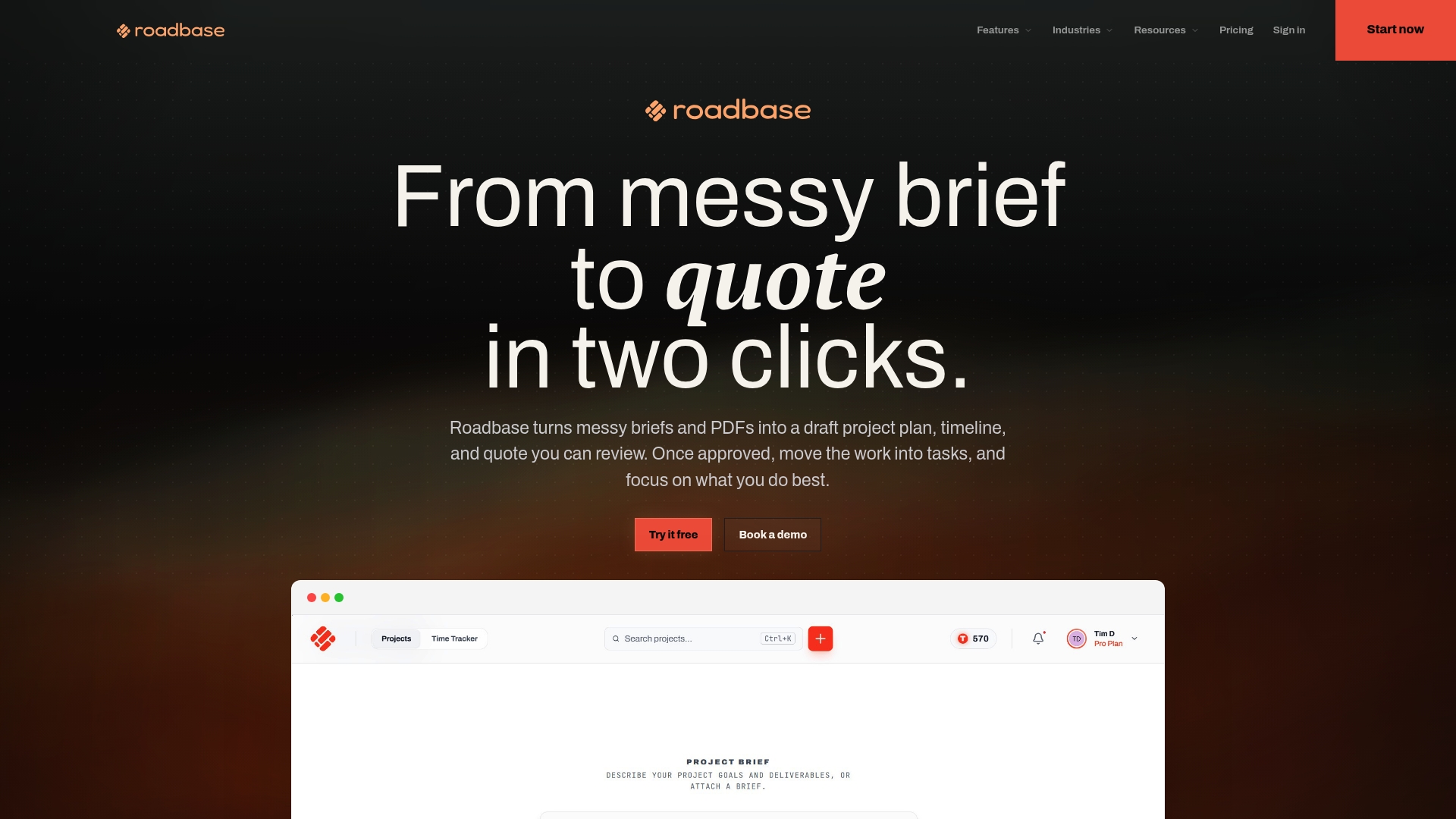
Roadbase can support that review process when you have a real brief, notes, or PDF. You can paste the brief or attach a PDF, and Roadbase builds an editable first draft of the work breakdown. Generate, review, and adjust it: the draft is not a finished scope or a guarantee of accuracy. Explicit constraints can be carried into the draft for review, but that depends on how clearly the brief states them.
Price estimated hours by the roles doing the work, using cost and rate information you supply and maintain. Roadbase can help you review labor, overhead, direct costs, contingency, and a target margin behind the quote, but those are calculations, not margin protection or a profit guarantee, and Roadbase is not accounting software. Export the reviewed plan and quote as a proposal PDF; it is not an e-signature workflow, contract, legal agreement, or automatic approval system.
After the work begins, you can compare tracked hours with the estimate while the project is underway. That makes variance visible; it does not prevent overruns or scope creep. For a freelancer-facing view of that workflow, see Roadbase for creative freelancers.
If the project is a brand identity engagement or motion assignment, these related guides can help you bring the discipline-specific variables into the review: pricing a brand identity project and pricing a motion design project.
If the brief is real but the work is still scattered across notes, Roadbase can turn it into a draft plan and quote for you to review.
FAQ
What is value-based pricing in simple terms?
It is an approach that starts with a buyer's perceived value, or willingness to pay, rather than treating delivery cost as the only pricing input. Price and cost remain separate components, so perceived value is not proof of what a buyer will pay. Harvard Business School Online
Does value-based pricing mean ignoring hours and costs?
No. Estimated hours and delivery costs remain essential review inputs. Value, cost, competition, target return, and buyer willingness to pay can all be relevant to a pricing decision. OpenStax: Establishing Pricing Policy
What should a creative project quote include?
Include the purpose, scope, schedule, work breakdown, assumptions, data or method used, results, and a way to update the estimate as the work develops. For creative projects, also make deliverables, exclusions, responsibilities, dependencies, direct expenses, and the next decision clear. U.S. Government Accountability Office: Cost Estimating and Assessment Guide Project Management Institute: PMBOK scope material
When should I avoid leading with value-based pricing?
Avoid leading with it when the buyer outcome is unclear, cannot be discussed credibly, lacks supporting evidence, the project scope is materially uncertain, or the buyer requires a rate-based format. Clarify the work and use a pricing approach the buyer can review.
How can Roadbase help with a value-based pricing conversation?
Roadbase can turn a brief or PDF into an editable draft work breakdown for review, let you price estimated hours by role, and keep the reviewed plan and quote together for proposal export. You remain responsible for reviewing and adjusting the scope, assumptions, feasibility, and commercial judgment; Roadbase does not choose the price for you or guarantee an outcome.
Further reading
Sources
Have a real creative brief to price?
Turn the brief into an editable project plan and quote, then review the work, assumptions, costs, and timing before you send it.