

Best Float Alternatives for Creative Teams in 2026

"Alternative" can be a misleading starting point. A creative team with defined work but uncertain availability has a different problem from a studio trying to turn an incoming brief into a reviewable plan and quote. Neither is the same as needing accounting, a CRM, or a contract-signature process.
Start by naming the missing job. Scope is the work required to deliver an agreed outcome, along with the boundaries and assumptions that shape it. Those details are worth making explicit before a team judges any tool.

Table of Contents
- Which workflow route fits your team's situation?
- A decision-criteria matrix
- How to choose the right alternative without assuming a migration path
- Key takeaways
- Why assumptions and review matter before any tool choice
- Where Roadbase fits in a quote-first workflow
- Sources and further reading
- FAQ
Which workflow route fits your team's situation?
1. Defined work, uncertain availability or allocation
Evaluate Float when the central question is who is available, what work they can take on, and how work sits across projects. Float's project-planning documentation describes project plans that connect phases, milestones, tasks, availability, skills, rates, workload, timelines, budgets, and resourcing, and it documents AI-assisted staffing. Its Help Center also documents project settings for estimates, budgets, expenses, team, phases, tasks, milestones, and scheduled and logged-time context.
That is a capacity-and-resourcing evaluation. Test it against a real period of overlapping work, rather than assuming it answers the commercial or approval process too.
2. An incoming brief needs a reviewable plan and quote
Evaluate Roadbase when the work starts with a real brief, notes, or PDF and the immediate need is a reviewable plan and quote. Paste the brief or attach a PDF. Roadbase builds an editable first draft of the work breakdown. It is a draft, not a finished or guaranteed-accurate scope, so review and adjust it before relying on it.
For quote review, price estimated hours by the roles doing the work. The studio supplies and maintains its real costs and rates. Review labor, overhead, direct costs, contingency, and target margin behind the quote; those calculations do not protect margin or guarantee profitability. Export the reviewed plan and quote as a proposal PDF. That PDF is not an e-signature, contract, legal agreement, or automatic approval system.
3. Accounting, invoicing, or CRM is the primary need
Choose a dedicated accounting/invoicing or CRM evaluation when reconciliation, invoices, bookkeeping, tax, payroll, sales-pipeline work, or client records are the job to solve. A quote-review workflow is not a substitute for those systems.
4. Contract or signature workflow is the primary need
Choose dedicated contract and e-signature tooling when the main requirement is a legally reviewed agreement, signature collection, or contract lifecycle. Treat that as its own evaluation, not as an extension of a planning or resourcing decision.
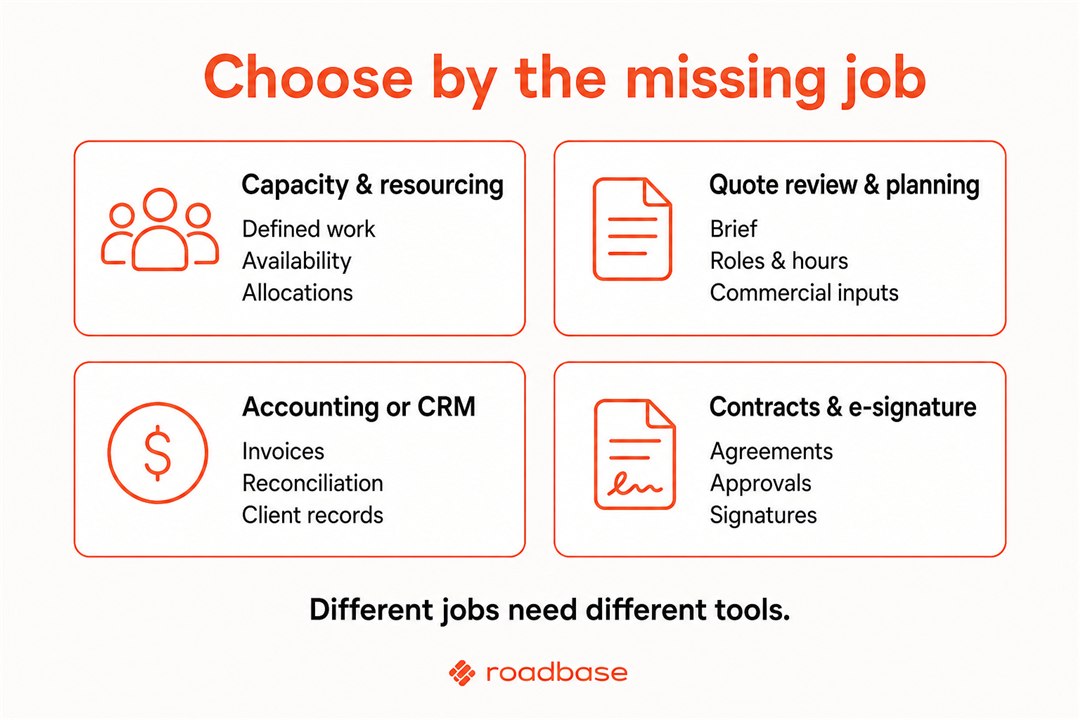
A decision-criteria matrix
This is a decision matrix, not a feature, price, or product-ranking comparison.
| If the missing job is... | Start with... | Essential test | No-fit signal |
|---|---|---|---|
| Capacity and resourcing | Current work, availability, allocations, and cross-project demand | Can the team inspect defined work against real availability and workload? | The first need is a reviewable quote from an incoming brief. |
| Quote review and project planning | A real brief, notes, or PDF | Can the team review the work breakdown, roles, estimated hours, assumptions, and commercial inputs before approving a quote? | The primary need is accounting, contracts, CRM, or enterprise capacity planning. |
| Accounting, invoicing, or CRM | Financial records, invoices, reconciliation needs, or customer records | Can the dedicated system support the required financial or relationship process? | A planning workspace is being asked to act as an accounting or CRM system. |
| Contract or e-signature workflow | The agreement, required approvals, and legal process | Can the dedicated process support the required signature and contract handling? | A proposal PDF is being treated as a legal agreement or signature workflow. |
How to choose the right alternative without assuming a migration path
Use one current project as the evaluation material. The point is to find the missing job, not to force unrelated work into one category.
- What is constrained right now? Is it availability across active projects, an unclear scope and quote, financial administration, relationship management, or a contract process?
- Which scope assumptions need to be visible? For a packaging project, that might include SKU variants, prepress support, proofing, and specialist cost inputs. Write the boundaries down before testing a workflow.
- Can the work breakdown be reviewed? A motion or video brief may need versions, review rounds, crew and post roles, and direct expenses. Check whether those details can be examined and adjusted instead of accepted as a finished answer.
- Is capacity the real question? If the work is already defined but allocations or availability are uncertain, use that as the capacity-and-resourcing test.
- Which commercial or approval system is actually required? Separate quote review from accounting, CRM, contracts, e-signatures, and enterprise capacity planning. They are different jobs with different evidence to examine.
Key takeaways
- Float can be evaluated in its documented project and resourcing context when availability, allocations, workload, and cross-project demand are the immediate concern.
- Roadbase fits when a real brief needs a reviewable plan and quote draft. The work breakdown and commercial inputs still need review and adjustment.
- A team that chiefly needs accounting, CRM, contracts/e-signatures, or enterprise resource planning should evaluate that dedicated need rather than force Roadbase into it.
Why assumptions and review matter before any tool choice
Tool choice cannot repair an unexamined brief. A packaging team may need the SKU count, dieline status, proofing route, specialist cost inputs, and review boundaries visible before it can judge the work. A motion team may need versions, review rounds, crew and post roles, and direct expenses set out before it can assess the same project responsibly.
Roadbase builds an editable first draft of the work breakdown. Explicit budget, deadline, review-round, and exclusion language can be carried into the draft for review, but that depends on the wording of the brief and does not mean every constraint is found or enforced. The team remains responsible for reviewing and adjusting the result.
Where Roadbase fits in a quote-first workflow
Roadbase is relevant when a studio needs to turn an incoming brief into a reviewable project plan and quote. Paste the brief or attach a PDF. Roadbase builds an editable first draft of the work breakdown, which the reader must review and adjust.
The commercial review can then price estimated hours by the roles doing the work. The studio supplies and maintains its real costs and rates. Review labor, overhead, direct costs, contingency, and target margin behind the quote. Those calculations do not protect margin or guarantee profitability, and Roadbase is not accounting software. Export the reviewed plan and quote as a proposal PDF; it is not a contract, e-signature workflow, legal agreement, or automatic approval system.
For creative freelancers with a real brief, notes, or PDF that needs reviewable project planning and quote preparation, Roadbase can turn it into a draft plan and quote for you to review. Software consultants can find related context in this industry page, but it does not change the need to review the plan and commercial assumptions.
Sources and further reading
Research sources used in this article
- Association for Project Management: What is scope management? - scope boundaries and documented assumptions.
- Float: Project Planning Software - Float's documented project-planning and resourcing context.
- Float Help Center: Projects - documented project settings and scheduled/logged-time context.
Roadbase resources for deeper reading
- How to estimate project hours before you send a quote - estimating hours before a quote.
- Pricing and quoting complex creative projects - commercial inputs and quoting.
- Checking a concrete scope-change cost - a concrete scope-change cost check, not evidence of ROI.
- Software integration project scope: how to estimate and quote - technical-project scope; this is not a claim about integration capability.
Related Roadbase reading
Imported further reading (not used as evidence for this comparison)
FAQ
How should a creative team choose among Float alternatives?
Start with the missing job. If defined work needs availability and allocation review, evaluate Float in its documented project and resourcing context. If an incoming brief needs a reviewable project plan and quote, evaluate that workflow. Treat accounting, CRM, contracts/e-signatures, and enterprise capacity planning as dedicated needs.
What should a team review in a Roadbase draft?
Roadbase builds an editable first draft of the work breakdown. Review and adjust the phases, tasks, roles, estimated hours, assumptions, feasibility, and commercial judgment before relying on it. Explicit constraints can be carried into the draft for review when the brief wording makes them explicit; that does not mean every constraint is found or enforced.
Can Roadbase handle accounting, CRM, or contracts?
No. Roadbase is not accounting, invoicing/reconciliation, a full CRM, e-signature tooling, or contract management. Use a dedicated evaluation when one of those systems is the main need.
What can Roadbase produce after the quote has been reviewed?
It can export the reviewed plan and quote as a proposal PDF. That output is not an e-signature workflow, contract, legal agreement, or automatic approval system.