

Parametric Estimating: How to Forecast Cost and Schedule
Parametric estimating uses cost estimating relationships, or CERs, built from historical data and statistical models to produce fast, repeatable forecasts of cost, duration, or effort. Instead of a single guess, a well-built model returns a probabilistic range: a point estimate plus a confidence band. The Project Management Institute treats it as a core estimating technique, and AACE International's RP 42R-08 recommends it specifically for systemic risk and contingency work. It fits best when you have a repeatable project type and clean historical records, whether that's construction square footage or, as we'll show later, hours on a creative brief inside Roadbase.
Key Takeaways
Parametric estimating turns historical CERs into fast, probabilistic cost and duration ranges, and it works best when paired with clean data, regular calibration, and expert review for outlier scope.
| Point | Details |
|---|---|
| Definition anchors CERs | Parametric estimating uses cost estimating relationships from historical data to forecast cost, duration, or effort. |
| One of five PMBOK methods | It sits alongside analogous, bottom-up, three-point, and expert judgment as a primary estimating technique. |
| RMSE sets contingency | Model error, measured through RMSE or MAE, converts directly into a defensible percentage-based buffer. |
| Validate before trusting | Holdout testing and documenting assumptions, as recommended by ICEAA guidance, help maintain model accuracy over time. |
| Roadbase automates the inputs | Roadbase starts the planning work: paste a brief or attach a PDF, then generate, review, and adjust a draft with phases, tasks, roles, and estimated hours. |
Table of Contents
- What Is Parametric Estimating and Where Does It Fit?
- How Does Parametric Estimating Actually Work?
- Parametric vs. Analogous vs. Bottom-Up: When to Use Each
- How Do You Build and Validate a Parametric Model?
- Two Worked Examples You Can Apply Today
- Where Parametric Estimating Breaks Down
- How Creative and Consulting Teams Apply the Same Logic
- A Practical Path to Adopting Parametric Models
- Turn Parametric Thinking Into Priced Proposals
- Sources
- FAQ
What Is Parametric Estimating and Where Does It Fit?
Project Management Body of Knowledge (PMBOK) guidance names parametric estimating as one of five primary techniques, alongside analogous, bottom-up, three-point, and expert judgment. Each solves a different problem: analogous borrows from a single similar past project, bottom-up sums granular task estimates, three-point blends optimistic, pessimistic, and most-likely scenarios. Parametric stands apart because it runs on statistics rather than analogy or aggregation.
The models themselves range from simple to genuinely complex.
- Simple CERs use one driver, such as cost per square foot or hours per feature point.
- Complex, multivariable models combine several parameters, like team size, complexity score, and revision count, using regression to weight each one.
- Data sources typically include historical project archives, published industry cost tables, and organizational databases built from past bids and actuals.
Software firms, engineering contractors, and increasingly creative agencies all draw from the same three source types, just with different variables plugged in.
How Does Parametric Estimating Actually Work?
Every parametric model starts with a cost estimating relationship, a formula linking a measurable input to an outcome. The basic form looks like this:
Outcome = constant + (coefficient × parameter 1) + (coefficient × parameter 2) + ...
For a construction estimate, that might be total cost = $50,000 + ($180 × square footage) + ($2,200 × number of stories). For a software integration project, it might be hours = 40 + (12 × number of API endpoints) + (6 × number of user roles). Building a usable CER involves three steps:
- Select parameters that actually drive the outcome. Square footage matters for a building; it's irrelevant for a marketing campaign, where audience size or asset count matters more.
- Normalize your inputs. Adjust historical costs for inflation, convert everything to consistent units, and account for learning curve effects if your team gets faster with repetition.
- Test the model's fit using RMSE (root mean square error) or MAE (mean absolute error) against your historical dataset.
These accuracy metrics aren't academic. AACE's guidance treats parametric outputs as inherently probabilistic, meaning the error term is not a flaw to hide but the basis for your risk-adjusted range.
Parametric vs. Analogous vs. Bottom-Up: When to Use Each
Every estimating technique trades speed against granularity, and knowing which trade you're making matters more than knowing the techniques exist.
- Parametric wins when you have a repeatable project family and at least a dozen or so clean historical data points; it's fast and consistent but only as good as that historical record.
- Analogous estimating works when you have just one or two comparable past projects and need a rough figure quickly, with far less data rigor. Roadbase's guide on analogous estimating for creative quotes walks through this for agencies without deep historical archives.
- Bottom-up estimating delivers the most granularity but takes the longest, since it sums individual task estimates.
- Three-point estimating suits high-uncertainty items where you want optimistic, pessimistic, and likely scenarios rather than a single formula.
Many mature teams run a hybrid: parametric for the bulk of the project, bottom-up for the two or three components carrying the most risk. PMI's guidance backs this approach, recommending parametric estimates for early-phase forecasts, then layering in more granular methods as scope definition improves.
How Do You Build and Validate a Parametric Model?
A parametric model is only as trustworthy as the data and testing behind it. Treat model-building as a discipline with defined steps, not a one-time spreadsheet exercise.
- Gather historical data. Aim for enough completed, comparable projects to support the number of parameters you're testing. Fewer than ten data points for a multivariable model usually produces unstable coefficients.
- Clean the dataset. Remove outliers caused by scope changes mid-project, flag any records with incomplete cost capture, and normalize units and currency.
- Fit the model. Run regression against your chosen parameters and inspect the resulting coefficients for logical sense. A negative coefficient on team size, for instance, usually signals a data problem, not a real relationship.
- Inspect residuals. Check whether errors cluster around certain project sizes or types. Uneven error spread (heteroskedasticity) often means you need a log transform or an added parameter.
- Compute RMSE and MAE to quantify overall fit, then translate that error into a contingency percentage.
- Validate on a holdout set. Reserve 20 to 30% of your historical projects, untouched during fitting, and test the model against them before trusting it on live work.
- Document assumptions and version the model. Record the inflation year, labor rates, and learning curve slope you used, per ICEAA's Parametric Estimating Handbook, so a future update doesn't quietly break comparisons to past estimates.
Pro Tip: Recalibrate at least once a year, or immediately after any major shift in labor rates or tooling. A model trained on 2023 rates will systematically underprice 2026 work.
Two Worked Examples You Can Apply Today
The cleanest way to understand a parametric formula is to run the numbers yourself. Here are two versions, from simplest to slightly more complex.
- Simple unit-cost CER. Say your historical data shows an average of $850 per website page produced, based on 40 past projects. A new site with 12 pages gets a point estimate of $10,200 (12 × $850). No adjustment yet for complexity or client revisions.
- Two-parameter CER. Now add a second driver. Suppose your regression on past projects yields: hours = 15 + (4.2 × number of pages) + (7.5 × number of revision rounds). A 12-page project with 3 planned revision rounds comes out to 15 + (4.2 × 12) + (7.5 × 3) = 15 + 50.4 + 22.5, or about 88 hours.
- Convert error to contingency. If your model's error metrics indicate uncertainty, apply a corresponding buffer percentage to produce a realistic estimate range rather than a false-precise single number. Statohub's breakdown of forecast accuracy metrics is worth a read if you want to understand when RMSE overstates or understates real-world error.
Tools like a software development cost calculator apply this same parameter-driven logic, just with pre-built coefficients instead of ones you derive yourself.
Where Parametric Estimating Breaks Down
Parametric methods earn their popularity through speed, repeatability, and an empirical foundation that opinion-based estimating can't match. But they carry real limitations you need to plan around.
- Historical bias is baked in. If your past projects ran inefficiently, the model will confidently predict more inefficiency.
- Unique project risks slip through. A model can't see a client's unusual approval process or a never-before-used technology stack.
- Small sample sizes produce unstable coefficients, especially once you add a third or fourth parameter.
- Outdated data quietly skews results if you haven't recalibrated for current labor rates or tooling.
- Scope creep invalidates the baseline the moment a project's actual work diverges from what the parameters described at kickoff.
The fix for most of these is the same: keep the dataset current, keep the sample size honest, and never treat a parametric output as gospel when a project genuinely doesn't resemble your history.
How Creative and Consulting Teams Apply the Same Logic
Roadbase helps creative and consulting teams turn a messy brief or notes document into a reviewable project plan. Paste the brief or attach a PDF, then generate an editable draft with phases, tasks, roles, estimated hours, timing, and estimate reasoning. Use that draft as the starting point for the team's scope and pricing review.

A Practical Path to Adopting Parametric Models
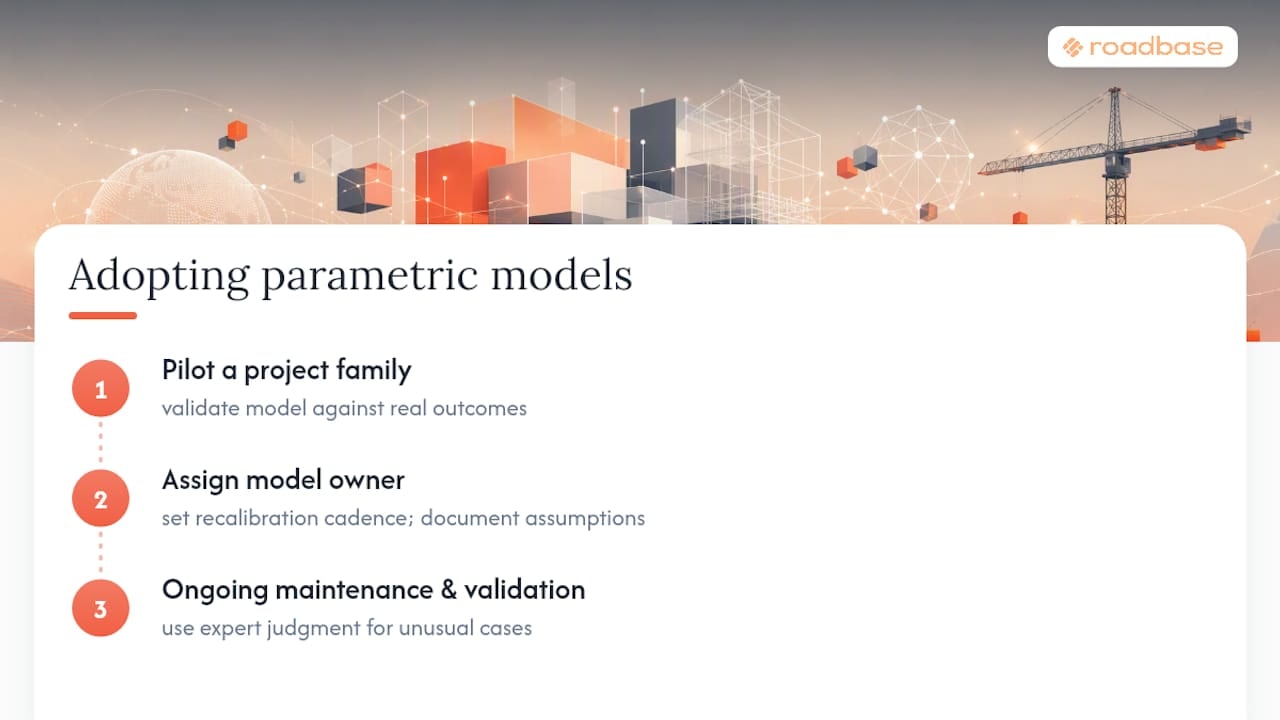
Start small: pilot a parametric model on one repeatable project family, whether that's website builds, integration work, or a recurring consulting engagement, and validate it against real outcomes before rolling it out further. Assign someone as the model owner, set a recalibration cadence, and document every assumption that feeds the formula. Parametric models earn trust through active maintenance, not a one-time build, and they still need expert judgment layered on top for anything genuinely unusual.
Turn Parametric Thinking Into Priced Proposals
Building your own CER from scratch takes real statistical work, cleaning historical data, running regressions, checking residuals. Roadbase gives creative freelancers, agencies, and small consulting teams a practical place to turn a brief into an editable work breakdown, then review the labor, overhead, direct costs, contingency, and target margin behind the quote. After the work is approved, tracked time can be compared with the estimate, and relevant estimate-versus-actual context by role can inform a later draft when enough correctly linked data exists.
A software consulting shop using Roadbase for consulting estimates can bring a client's scattered requirements document into a reviewable project plan and quote. Creative teams can follow the same draft, review, and adjust workflow through the freelancer-focused version. Start a free trial at Roadbase with a real brief, notes, or PDF, and turn it into an editable starting point for your next proposal.
Sources
For hands-on model-building detail, the ICEAA Parametric Estimating Handbook covers CER derivation and validation in depth. AACE's RP 42R-08 focuses on risk-based contingency, and PMI's estimating guidance frames when parametric fits alongside other techniques.
- AACE International RP 42R-08 (parametric estimating and risk analysis)
- ICEAA Parametric Estimating Handbook (4th ed.)
- PMI: Project estimating and accurate labor costs
FAQ
What Is the Difference Between Analogous and Parametric Estimating?
Analogous estimating scales a single past project's cost to a new one based on rough similarity, while parametric estimating uses a statistical formula (a CER) built from many historical projects to calculate the estimate.
What Are the Four Types of Estimating?
PMBOK actually names five primary techniques: analogous, parametric, bottom-up, three-point, and expert judgment, each suited to different levels of scope certainty and available data.
What Is the Formula for Parametric Estimating?
The general form is outcome equals a constant plus one or more coefficients multiplied by parameters, such as cost equals $50,000 plus $180 times square footage.
Can You Give an Example of Parametric Estimating?
A common example is calculating hours as 15 plus 4.2 times the number of pages plus 7.5 times the number of revision rounds. For a real brief, Roadbase can generate an editable first draft of phases, tasks, roles, and estimated hours for the team to review and adjust.
Does Parametric Estimating Give an Exact Number?
No. Because parametric models are probabilistic, the output is a point estimate paired with an error range, typically derived from the model's RMSE, rather than a single fixed figure.