

How to Write a Proposal Executive Summary for Creative Services
A proposal executive summary is the short, client-facing part of a proposal that helps explain the context, your proposed response, and the decision you want the client to make. For creative services, it works best when it reflects the proposal you have actually reviewed rather than adding polished claims that the scope, quote, or evidence cannot support. George Mason University Writing Center and San Jose State University Writing Center both describe summaries as concise, proposal-specific overviews of a problem and proposed response.
This guide is for creative-services proposals. It is not guidance for grant applications, public-sector procurement compliance, legal proposals, accounting, contract approval, or a quote sent without review. When a client or solicitation specifies a structure, page limit, pricing location, or evaluation rule, those instructions govern. Acquisition.gov
Table of contents
| Section | Go to |
|---|---|
| Writing order | Start with the reviewed proposal, not a blank page |
| Structure | A client-first executive-summary structure |
| Format and length | Format and length: follow the brief |
| Example | A creative-services example |
| Consistency check | Pre-send consistency check |
| Roadbase | Turn a reviewed plan into a proposal PDF with Roadbase |
| Questions | FAQ |
| Review table | Key takeaways |
What a proposal executive summary does
A useful executive summary gives a decision-maker a concise, self-contained view of the client's situation, the response proposed, and the next decision. It can help a reader orient to the proposal without replacing the detailed scope, assumptions, terms, or evidence elsewhere in the document. George Mason University Writing Center UMGC Effective Writing Center
A short client-context opening can be helpful. But the section should not turn into generic company background, a brochure, or a table of contents. Keep it centered on the client's proposal and the decision in front of them. San Jose State University Writing Center
Start with the reviewed proposal, not a blank page
A rough outline can be useful while the proposal is developing. It gives you somewhere to collect the client context, outcome, and intended response without pretending every detail has already been settled.
The client-facing version should be checked after the scope, assumptions, commercial terms, and supporting evidence have been reviewed. That does not mean every team must write the summary last; writing order can vary by team and by client instructions. It means the final language needs to match the proposal behind it. George Mason University Writing Center University of Chicago

The six inputs to gather first
Use these six inputs as an editorial checklist, not a universal formula. They give you a way to trace each summary statement back to the reviewed proposal. This checklist is a practical synthesis of common proposal guidance. George Mason University Writing Center San Jose State University Writing Center
| Input | What to gather |
|---|---|
| Client situation | The problem, context, or decision described in the brief. |
| Desired outcome | What the client wants to achieve, using their terms where useful. |
| Reviewed scope and boundaries | Deliverables, exclusions, assumptions, and dependencies already agreed in the proposal. |
| Proposed approach | The response you can describe without adding unapproved work. |
| Relevant, approved proof | Evidence or experience that is relevant and supported elsewhere in the proposal. |
| Requested next action | The decision, approval, or next step you are asking the client to take. |
If the scope is still unclear, work through the brief before trying to summarize it: How to turn a creative brief into a scope of work and quote - Roadbase Blog.
A client-first executive-summary structure
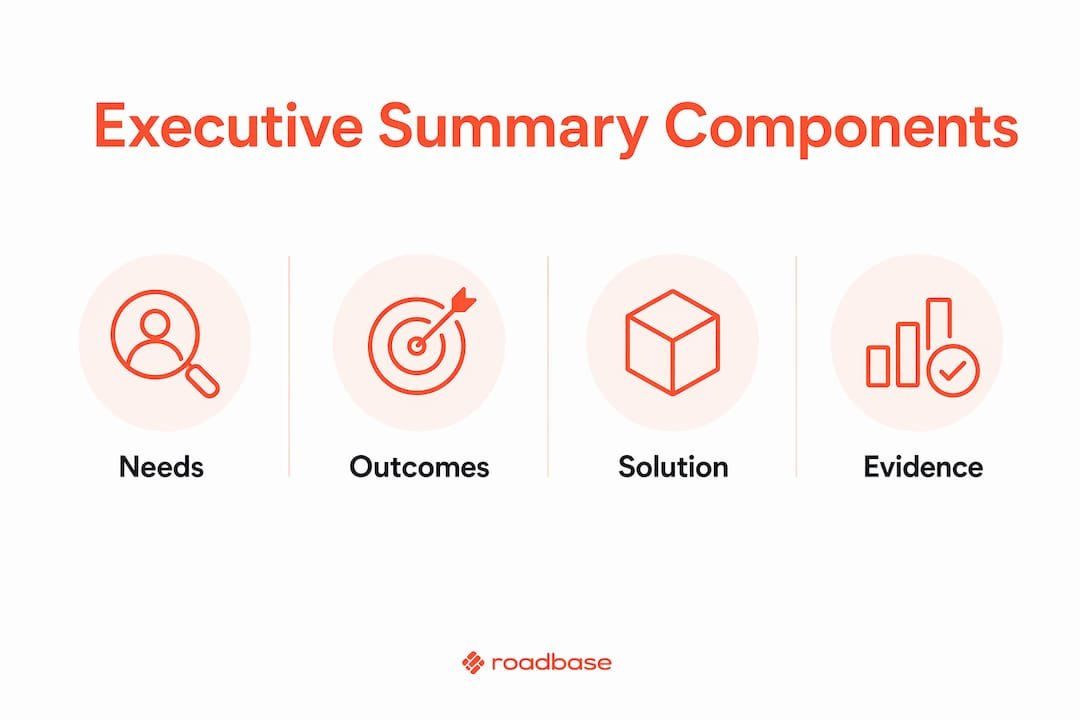
One practical flow is context, outcome, approach, relevant proof, and requested action. It is a usable editorial structure, not a mandatory sequence for every proposal. San Jose State University Writing Center
| Part | What it should do |
|---|---|
| Context or need | Name the proposal-specific situation the client is addressing. |
| Desired outcome | Describe the outcome the proposal is intended to help achieve. |
| Proposed approach | Summarize the reviewed response without adding deliverables. |
| Relevant proof | Include only approved detail that the proposal can substantiate. |
| Requested action | Make the next decision or action clear. |
Commercial or delivery terms belong here only when the client asks for them, when the solicitation requires them, or when they are needed to clarify the decision. Client instructions govern pricing placement. Acquisition.gov Relevant proof should be approved and supportable elsewhere in the proposal; do not invent a client name, project count, statistic, credential, sector, or outcome to make the summary sound stronger. George Mason University Writing Center
A creative-services example
The following is fictional and uses placeholders. Replace bracketed text only with material that has been reviewed and is supported in the proposal.
[Client Name] is preparing to [desired outcome] and needs a reviewed plan for [project context]. [Studio Name] proposes [high-level approach] covering [approved deliverables], subject to the assumptions and exclusions in the proposal. [Approved proof or relevant experience, if available] supports the approach. We invite [Client Name] to [requested decision or next action].
This example maps back to the checklist: the first sentence gives client situation and outcome; the second covers scope, approach, assumptions, and exclusions; the third reserves proof for approved evidence; and the last names the action. It does not claim a result, deadline, sector, client history, or project count.

Format and length: follow the brief
Let the client's stated instructions set the structure, page limits, evaluation requirements, and pricing placement. A public procurement rule illustrates the narrow principle: when a request specifies content and page limits, those requirements control the response. Acquisition.gov
There is no universal page count, percentage, paragraph length, or pricing policy for a creative-services executive summary. Use direct wording, useful headings where they help, and enough context for the reader to understand the proposal without copying the entire document. George Mason University Writing Center
The imported UMGC executive-summary page is retained for link fidelity and supports the idea that a summary may stand alone. It is not used here to set a fixed length. The imported Coursera reading is also retained for link fidelity only; it is not evidence for this article.
Pre-send consistency check
Before sending, compare the summary with the reviewed scope, exclusions, assumptions, deliverables, commercial terms, numbers, and supporting evidence. Remove anything the proposal cannot substantiate. This is an accuracy review, not a guarantee of approval, profitability, scope control, or project success. UMGC Effective Writing Center
| Check | Question |
|---|---|
| Claims | Can the proposal support every promise and statement? |
| Scope | Does the summary add deliverables, roles, or work that the scope does not include? |
| Numbers | Do dates, quantities, hours, and commercial terms match the reviewed proposal? |
| Assumptions | Are material assumptions, exclusions, and dependencies represented where they affect the decision? |
| Proof | Is every proof point relevant, approved, and supported elsewhere in the proposal? |
| Language | Does the wording describe this client's situation instead of relying on generic sales language? |
Turn a reviewed plan into a proposal PDF with Roadbase
If you have a real brief and want a structured starting point, roadbase.io can support the review process:
- Paste the brief or attach a PDF.
- Roadbase builds an editable first draft of the work breakdown. It is a draft, not a finished or guaranteed-accurate scope, so review and adjust it.
- Price estimated hours by the roles doing the work. Roadbase uses the costs and rates your studio supplies and maintains.
- Review the labor, overhead, direct costs, contingency, and target margin behind the quote. These calculations are not margin protection, a profitability guarantee, or accounting advice.
- Export the reviewed plan and quote as a proposal PDF. The PDF is not an e-signature workflow, contract, legal agreement, or automatic approval system.
FAQ
What is a proposal executive summary?
It is a concise, self-contained view of the client context, proposed response, and requested decision. It should reflect the detailed proposal rather than replace it. George Mason University Writing Center UMGC Effective Writing Center
Is an executive summary the same as a proposal introduction?
Not necessarily. A short client-context opening can help, but the summary should not become generic company background or a table of contents. San Jose State University Writing Center
When should I write an executive summary?
An early outline may help as the proposal develops. Check the client-facing version after the scope, assumptions, terms, and evidence are reviewed, while following any client instructions about format or order. George Mason University Writing Center University of Chicago
What should a creative-services executive summary include?
Use the client situation, desired outcome, reviewed scope and boundaries, approach, relevant proof, and requested next action as a practical review checklist. Adapt it if the brief requires another structure. San Jose State University Writing Center
How long should a proposal executive summary be?
Follow the client's instructions. There is no universal page or percentage rule; a stated page limit or required proposal structure takes priority. Acquisition.gov
Should an executive summary include price?
Follow the client's instructions about pricing placement. Include commercial terms when the request requires them or when they are needed to clarify the decision. Acquisition.gov
How do I make the summary match the scope of work and quote?
Compare each statement with the reviewed scope, exclusions, assumptions, deliverables, commercial terms, numbers, and supporting evidence, then remove what the proposal cannot substantiate. UMGC Effective Writing Center
What does a proposal executive summary template look like?
Use a practical flow of client context, desired outcome, proposed approach, relevant proof, and requested action. Treat it as an adaptable checklist rather than a fixed formula. San Jose State University Writing Center
Key takeaways
| Review point | What to check |
|---|---|
| Build from reviewed inputs | Use client situation, outcome, scope boundaries, approach, relevant proof, and next action. |
| Follow the brief | Let client instructions determine format, length, and pricing placement. |
| Use supportable detail | Remove claims, numbers, and promises the proposal cannot substantiate. |
| Check parity before sending | Compare the summary with scope, assumptions, terms, evidence, and the reviewed quote. |
| Review Roadbase output | Treat the work breakdown as an editable draft and review the plan and quote before PDF export. |
Recommended reading
These Roadbase links are navigation only, not evidence for the guidance above.
- From messy brief to clean quote: a practical workflow for freelancers and agencies - Roadbase Blog
- How to estimate project hours before you send a quote - Roadbase Blog
- Roadbase vs Dubsado: which is better for quoting and delivering creative projects? - Roadbase Blog
- software consulting work
Sources
Have a creative-services brief to turn into a proposal?
Build a reviewable first draft of the work, roles, hours, costs, assumptions, and quote before you write the executive summary.