

Work Breakdown Structure for Creative Projects: A Practical Guide Before You Quote
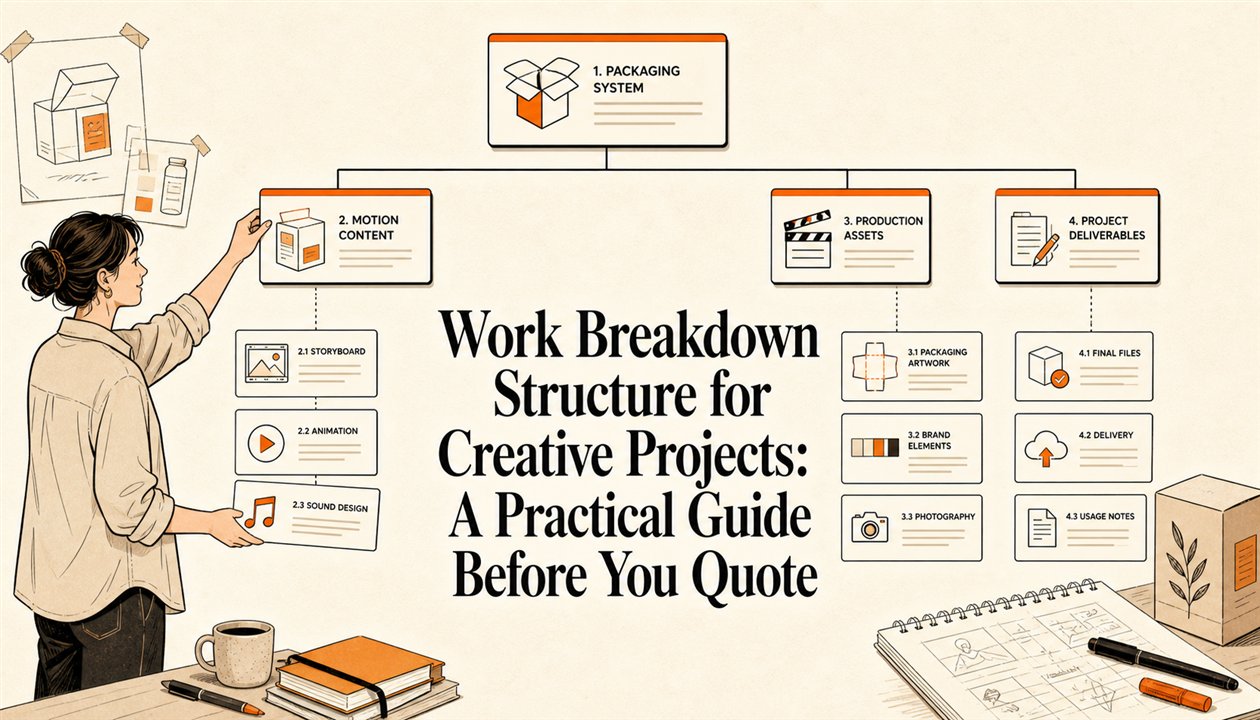
A creative brief can sound complete while leaving the expensive parts unstated. It may name a packaging launch, for example, but not say how many concept routes, SKU variants, review rounds, print-ready files, or vendor handoffs the work includes.
A work breakdown structure (WBS) gives that conversation a shape before you quote. NASA describes the underlying idea as a product-oriented hierarchy for organizing project scope and creating a common planning reference in its Work Breakdown Structure Handbook. For a freelancer, studio, or agency, it can be a simple, deliverable-led list rather than a large project-management exercise.
It will not prevent scope creep or make a price correct on its own. It gives you a clearer reference for asking what is included, what is assumed, and what needs a decision before the quote goes out.
Table of Contents
- What do the core WBS terms actually mean?
- Which type of WBS fits your project?
- Core design principles every WBS must follow
- How to build a WBS: step-by-step
- What goes in a WBS dictionary?
- What WBS formats and templates work best?
- How do you use the WBS for estimating, scheduling, and control?
- Common WBS mistakes that derail projects
- When should you move from templates to a dedicated tool?
- One-page WBS checklist and minimal template
- Key Takeaways
- The part of WBS practice most guides skip
- Roadbase turns your WBS into a priced proposal in one session
- Useful sources and templates
- FAQ
What do the core WBS terms actually mean?
The project root is the whole assignment. Under it sit the main deliverables, then smaller deliverables or work packages that make those outputs possible. The labels matter less than making the work understandable to the people reviewing the quote.
For a packaging project, the first level might be concept routes, SKU adaptation, production artwork, prepress support, and project reviews. A work package is simply a useful unit for discussion. It can hold the work that needs an estimate, an owner, a review point, or an assumption.
You do not need a prescribed number of levels. Stop when the item is clear enough to discuss the effort and conditions behind it. If a label still hides a meaningful choice, such as the number of variants or the supplied copy, split it into a more useful line.
Which type of WBS fits your project?
For creative work, a deliverable-led breakdown is usually the clearest place to start because it keeps the visible outputs in view. A phase-led list can help when the client has a fixed approval sequence, but it should still show what each phase is meant to produce.
There is no universal format. The useful test is whether a reviewer can point to a line and understand what is being made, what work it implies, and what has to be true for the estimate to hold.
As a secondary contrast, a motion project might be grouped by concept, final runtime, versioning or cutdowns, production, post-production, and review. That is an illustrative way to surface decisions, not a mandatory phase list or pricing benchmark.
Core design principles every WBS must follow
Keep the breakdown close to the actual brief. Use names that describe an output or a reviewable piece of work, and avoid hiding multiple decisions in one catch-all line.
For creative teams, three habits help:
- Start with the deliverables the client expects to receive.
- Add the production work required to make those deliverables real, such as variants, artwork preparation, or specialist support.
- Mark the decisions that change the estimate: supplied materials, number of routes, review rounds, approval dependencies, and vendor costs.
This is a working reference, not a legal scope document. A client agreement may need different language and a separate review.
How to build a WBS: step-by-step
- Read the brief, notes, and supplied files together. Mark stated outputs and questions that the material does not answer.
- List the main deliverables before listing production tasks. For packaging, that could mean concept routes, SKU variants, production artwork, prepress support, and reviews.
- Add the work and dependencies that sit behind each deliverable. A variant may depend on approved copy, a supplied dieline, or a vendor specification.
- Write down what is included and what is still assumed. Use plain language that a client and your collaborators can check.
- Review the draft with the people who can answer the open questions. Update the breakdown before treating it as an estimate input.
If you need the broader move from a messy brief to a clean quote, read From Messy Brief to Clean Quote. This article stays focused on the breakdown itself.
What goes in a WBS dictionary?
A lightweight WBS dictionary is the notes beside the structure. The U.S. Government Accountability Office's Cost Estimating and Assessment Guide supports the practical principle of making the work, assumptions, and estimate conditions explicit enough to assess the estimate. For a creative project, keep the record usable rather than turning it into a federal-program procedure.
For each work package, record:
| Field | What to capture |
|---|---|
| Work package | A short name for the deliverable or production item |
| Included work | The specific work covered by the line |
| Exclusions | Work that is not included in the current discussion |
| Responsible role | The role expected to do or coordinate the work |
| Review point | The feedback or approval moment that affects the next step |
| Assumption | A condition assumed true, such as approved copy or supplied assets |
| Estimate condition | The version count, vendor input, timing, or other condition that changes the estimate |
The purpose is not to declare that every unknown is resolved. It is to make the unknowns visible before they silently become part of the work.
What WBS formats and templates work best?
Use the format your team can review without translation. A short indented outline works well for a working session. A table can pair each work package with its assumptions and review point. A diagram can help a client see how the deliverables relate.
The format does not make the estimate reliable by itself. Choose the one that makes missing decisions easiest to notice and revise.
How do you use the WBS for estimating, scheduling, and control?
Use the breakdown to prepare a better estimate conversation, not to force a false precision. Review each line for the work included, the conditions it depends on, and any specialist or vendor expense that needs separate treatment.
In the packaging example, a quote conversation may need to cover the number of concept routes, the SKU count, the amount of copy supplied, review rounds, production-artwork requirements, prepress support, and external costs. The list does not set a price. It makes the inputs to your commercial judgment easier to review.
A WBS describes scope and work. Sequence and timing belong in a schedule or network view, as PMI explains in its WBS overview. A date change may need a quote review, but a timeline alone does not prove that an estimate or price is right.
For integration-specific scope examples, see Software Integration Project Scope and Estimate. It is a separate article because integration work has its own technical conditions.
Common WBS mistakes that derail projects
- Treating a broad label such as "design" as if it answered what is being delivered.
- Listing outputs without the production work, review points, assumptions, or dependencies that make them possible.
- Using a template as a substitute for a conversation about variants, supplied materials, approvals, or vendor work.
- Treating the breakdown as proof that no new work will be requested. It is a reference for recognizing and discussing requests, not a scope-creep guarantee.
- Turning the breakdown into an accounting ledger or a replacement for a contract, schedule, or legal review.
When should you move from templates to a dedicated tool?
A note, outline, or spreadsheet can be enough when the breakdown is easy to review and revise. A dedicated tool can help when the brief is scattered across notes or a PDF and the team needs a reviewable draft plan and quote to discuss.
Start with the immediate job. If you need a client signature, bookkeeping, a sales pipeline, enterprise capacity planning, or a client portal, a WBS tool is not the whole answer.
One-page WBS checklist and minimal template
Use this checklist before you prepare a quote:
- Name the deliverables the client expects.
- Add production work that the deliverables require.
- Note variants, supplied materials, specialist costs, and vendor dependencies.
- Record included work, exclusions, responsible role, review point, assumption, and estimate condition for each meaningful line.
- Review open questions with the client or collaborators before relying on the breakdown for a quote.
Minimal packaging outline:
Packaging launch
  Concept routes
  SKU variants
  Production artwork
  Prepress support
  Review rounds
  Specialist or vendor expense
Key Takeaways
- A WBS is a deliverable-led planning reference for organizing scope.
- For creative work, it is most useful when it exposes the choices behind the deliverables before a quote is prepared.
- The dictionary beside the breakdown should make included work, exclusions, review points, assumptions, and estimate conditions easy to inspect.
- It does not guarantee an estimate, prevent scope creep, or replace a contract or schedule.
The part of WBS practice most guides skip
The useful work is often in the questions beside the tree. A client may approve a packaging direction while the number of variants, copy readiness, prepress requirements, and vendor dependency remain undecided. Those are not administrative details. They are estimate inputs.
A reviewable breakdown makes those questions visible without pretending to settle them. That is enough to improve the next conversation before you commit a quote.
Roadbase turns your WBS into a priced proposal in one session
If the brief is real but the work is still scattered across notes, Roadbase can turn it into a draft plan and quote for you to review. Start with a client brief or PDF. Roadbase can turn that material into an editable draft project plan and quote, and you can review the draft plan and timeline before sending the quote.
The draft needs review and adjustment for scope, assumptions, feasibility, and commercial judgment. It is not an automatic final WBS, and a timeline or changed dates do not prove the estimate or price is right. For a real brief, notes, or PDF, you can open Roadbase.
Useful sources and templates
The following links are provided for further reading. They are not evidence for the substantive claims above unless stated in the article.
- PMI Work Breakdown Structure Practice Standard
- Work Breakdown Structure (WBS) - Basic Principles | PMI
- Work Breakdown Structures | Microsoft Docs
- Work Breakdown Structure Overview | Coursera
- Wikipedia's WBS overview
- From Messy Brief to Clean Quote
- Software Integration Project Scope and Estimate
- Roadbase
More references
These additional references offer more background on WBS practice, related Roadbase workflows, and adjacent project-planning tools. They are further reading, not added support for the claims above.
- PMI Work Breakdown Structure Practice Standard
- PMI WBS principles
- PMI WBS overview
- Microsoft WBS guidance
- Microsoft WBS implementation notes
- Microsoft WBS product guidance
- Coursera WBS overview
- Wikipedia WBS overview
- Roadbase
- Roadbase home
- From Messy Brief to Clean Quote
- Software Integration Project Scope and Estimate
- Roadbase vs ClickUp: quoting-first vs work management
- Software consultants
FAQ
What is a work breakdown structure?
It is a product-oriented hierarchy that organizes project scope into deliverables and smaller work packages. For a creative team, it can be a compact reference for reviewing what must be made and what conditions affect the quote.
How detailed should a creative WBS be?
Make it detailed enough for the decision in front of you. If a line still hides a meaningful choice about variants, review rounds, supplied materials, or vendor work, split it. Do not use fixed depth or hour rules as a substitute for judgment.
Does a WBS prevent scope creep?
No. It can give the team a reference when new work is requested, but it does not prevent requests, create a contract, or settle a commercial decision.
Is a WBS the same as a schedule?
No. A WBS organizes the work and scope. A schedule shows sequence and timing. They can inform one another, but they answer different questions.
Can Roadbase help with a WBS?
Roadbase can start with a client brief or PDF and turn that material into an editable draft project plan and quote. Review and adjust the draft for scope, assumptions, feasibility, and commercial judgment before sending the quote; it is not an automatic final WBS.
Recommended
- From Messy Brief to Clean Quote
- Software Integration Project Scope and Estimate
- Roadbase
- Roadbase vs ClickUp: quoting-first vs work management
- Software consultants
Jump back to a section
- What do the core WBS terms actually mean?
- Which type of WBS fits your project?
- Core design principles every WBS must follow
- How to build a WBS: step-by-step
- What goes in a WBS dictionary?
- What WBS formats and templates work best?
- How do you use the WBS for estimating, scheduling, and control?
- Common WBS mistakes that derail projects
- When should you move from templates to a dedicated tool?
- One-page WBS checklist and minimal template
- Key Takeaways
- The part of WBS practice most guides skip
- Roadbase turns your WBS into a priced proposal in one session
- Useful sources and templates
- FAQ