

Client Profitability for Creative Freelancers: A Project Review

Client profitability can be a useful prompt to look back at one completed or active creative project. The useful question is not which client to keep or drop. It is whether the reviewed quote, the delivery-cost assumptions behind it, and the hours recorded against the work still tell the same story.
This is a project review, not a set of accounts. It cannot establish complete costs, actual profitability, or the right commercial decision for a client relationship. It can make one assumption visible enough to test in the next estimate.
Table of Contents
- What a first project review needs
- How to build a simple project review
- Six useful review inputs
- When a high-touch project needs a closer allocation
- Use the next estimate, not a verdict on the client
- A reviewed workflow from brief to tracked hours
- What to record after the review
- Key takeaways
- Why reputation is not a cost model
- Roadbase puts the project data together
- Useful sources and further reading
- FAQ
What a first project review needs
Start with the quote you reviewed before the work began. Pull the labor assumptions by role, direct expenses, and the overhead approach you chose at the time. Then put those assumptions beside the hours actually recorded against the project or its tasks.
That comparison will be incomplete if the brief, cost inputs, or time records are incomplete. It is still worth doing because it gives you a concrete place to investigate rather than a vague sense that the project took more effort than expected. If the original request was scattered, the messy-brief-to-clean-quote workflow is useful background for seeing how assumptions become reviewable before a quote is sent.
Pricing guidance from the University of Maine Cooperative Extension supports separating costs and pricing decisions. In this article, that separation matters: the review arithmetic is a planning aid, not a financial statement.
How to build a simple project review
Use a short record with the same categories you used when you reviewed the quote. Cost information only becomes useful when its classification and purpose are clear, as OpenStax's introduction to cost behavior explains. A creative project does not need one universal cost formula; it needs a model you can explain and revisit.
Here is a fictional packaging project example. The reviewed quote is $8,400. The team had planned labor of $3,000, direct production expenses of $900, and an overhead allocation of $500. The reviewed model therefore showed a $4,000 difference between the quote and those planned delivery inputs.
If the tracked work later indicates $3,600 in reviewed labor rather than $3,000, the revised model shows $3,400 using the same direct-expense and overhead assumptions. That does not prove the project was or was not profitable. It tells the studio which assumption deserves a closer look: perhaps the role mix, feedback path, production coordination, or time estimate.

Keep the record labelled as an illustration. The right allocation choices depend on how the studio uses the information and what it can support with its own records.
Six useful review inputs
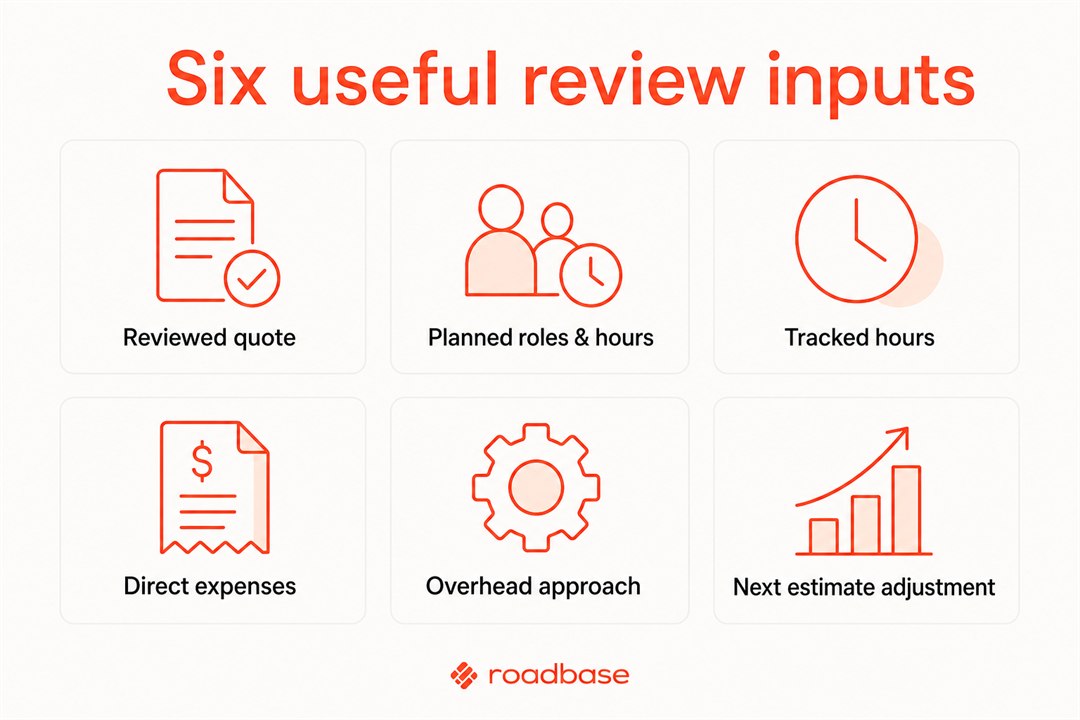
There is no universal KPI set that every creative firm must use. For one project review, these six inputs are usually enough to make the conversation specific:
- Reviewed quote. Keep the price that was actually reviewed, rather than replacing it with a later guess.
- Planned roles and hours. Note which roles were expected to do the work and the hours assigned to each.
- Tracked hours by project or task. Compare the recorded work with the estimate, including the points where actual hours changed the picture.
- Direct expenses. Keep production, specialist, or other direct costs visible instead of hiding them in a general total.
- Overhead approach. Record the allocation method used for the review and treat it as a conscious choice, not an objective fact.
- The assumption to revisit. Write down the one assumption that the next estimate should handle differently.
If added work was outside the agreed delivery inputs, document it separately before deciding how it should affect a later quote. The out-of-scope cost calculator is relevant when the question is the visible cost of that extra work, rather than a general verdict on the client.
When a high-touch project needs a closer allocation
Some projects involve unusual levels of client calls, review rounds, or production coordination. In that situation, a limited activity-based check can be more useful than applying the same broad overhead treatment without question. Activity-based costing allocates overhead through activities and cost drivers, as OpenStax's activity-based costing chapter describes.
For a motion-production project, you might separately note extra coordination around version approvals or handoff. That is a focused review of a specific activity, not a recommendation to install an agency-wide accounting system or a claim that one allocation is always more accurate.
Use the next estimate, not a verdict on the client
The most practical output of this review is a documented adjustment for similar future work. If a packaging project used more senior review time than planned, record that condition. If a production expense was left out of the quote model, make it visible next time. If a requested deliverable was unclear, revise the brief and the review point before the next quote is agreed.
Do not use one review to decide that a client is unprofitable, to set a rate change, or to recommend ending a relationship. Those judgments need information this article does not try to provide. The project record is simply evidence for a more deliberate next estimate.
A reviewed workflow from brief to tracked hours
Roadbase can help keep the planning inputs and later time comparison close together. You can paste a brief or attach a PDF, then use Roadbase to build an editable first draft of the work breakdown. Review and adjust the scope, assumptions, feasibility, and commercial judgment before treating that draft as a project plan.
Price estimated hours by the roles doing the work, using internal costs and billable rates that you supply and maintain. Before a quote is agreed, review labor, role rates, overhead, direct costs, contingency, estimated cost, quoted price, and target margin behind it. Those calculations do not protect margin or guarantee profitability; Roadbase is not accounting software.
Once work begins, track time against the project or task and compare tracked hours with the estimate while the work is underway. That makes a difference visible. It does not prevent an overrun or scope creep, and it does not make the commercial decision for you.
What to record after the review
You do not need a broad profitability dashboard to use this method. Keep a small project-review note with the reviewed quote, the cost-model assumptions, the relevant tracked-hour difference, and the next-estimate adjustment. The useful cadence is the point at which the project has enough recorded work to make a comparison meaningful, not a prescribed weekly or monthly ritual.
When the question is how price and planned cost use different denominators, read Margin vs. Markup before changing the arithmetic. Keep that separate from the project review itself.
Key takeaways
- Treat client profitability as a narrow project-review prompt, not a substitute for accounting or a verdict on a client relationship.
- Compare a reviewed quote and delivery-cost model with tracked hours, then identify one assumption worth revisiting.
- Keep labor, direct expenses, and overhead choices explicit. A simple allocation can be useful without being universal or complete.
- Use the record to improve the next estimate deliberately; it does not predict profitability or accuracy.
Why reputation is not a cost model
A well-known client, an enjoyable project, or a difficult project does not by itself explain delivery cost. The evidence in this review comes from the work that was planned, the inputs that were reviewed, and the hours that were recorded. Keep reputation and client sentiment separate from the project data so the next estimate responds to a visible assumption instead of a story about the account.
Roadbase puts the project data together
If you have a real brief, notes, or PDF and need a reviewable project plan and quote, Roadbase is a quote-first planning, pricing, and tracked-time workspace. Start with a draft, review it, adjust the inputs, and compare tracked hours with the estimate as work progresses. Open Roadbase when that is the job in front of you.
Useful sources and further reading
Reviewed sources
- University of Maine Cooperative Extension: Basic Pricing Strategies
- OpenStax: Identify and Apply Basic Cost Behavior Patterns
- OpenStax: Calculate Activity-Based Product Costs
Further Roadbase reading
- Roadbase for creative freelancers
- How to price a motion design project
- When value-based pricing fits a creative project quote
- Margin vs. Markup
- Out-of-scope cost calculator
- From a messy brief to a clean quote workflow
Retained imported links
The following imported links are preserved for URL fidelity only. They are not factual authority for this article.
- Imported external link: Tyson Kaye work page
- Imported external link: Intuit client-profitability page
FAQ
What is client profitability in this article?
Here, it is a prompt to review one creative project's quote, delivery-cost assumptions, and tracked hours. It is not a complete accounting or financial-reporting result.
What should I compare first?
Start with the reviewed quote, planned roles and hours, direct expenses, your stated overhead approach, and tracked hours against the project or task. Then identify one assumption that deserves attention in the next estimate.
Does a tracked-hours difference prove a project was unprofitable?
No. It makes a difference visible, but it cannot establish complete costs, profitability, or the right commercial decision without broader, reviewed information.
Should every studio use activity-based costing?
No. A limited activity-based check can help examine an unusually high-touch project, such as one with extra review or production coordination. It is not a universal requirement or a claim of automatic accuracy.
How can Roadbase help with the review?
Roadbase can create an editable draft from a brief or PDF, support reviewed quote inputs, track time against projects or tasks, and show actual versus estimated hours. You still need to review and adjust the scope, costs, assumptions, feasibility, and commercial judgment.