

Contingency Percentage: How to Pick a Defensible Reserve
A contingency percentage is a reserve for risks you can name before a shoot, not a number to borrow from another production. A locked schedule can still be exposed to weather cover, a talent change, a location constraint, an extra versioning round, or a delivery problem. The useful question is what those risks could cost in this particular plan.
Use the percentage as a summary of the risk work, not as a substitute for it:
- Treatment and pre-production: assumptions are still moving, so list the open creative, schedule, crew, location, and supplier questions before choosing a reserve.
- Locked schedule, crew, and vendor commitments: revisit the reserve when rates, availability, permits, travel, insurance, or turnaround expectations become concrete.
- Production and post: draw only against documented risks inside the approved scope; a client-approved scope change needs its own budget and approval.
Pro Tip: A fixed-price production with unresolved talent, weather, or location assumptions deserves a closer risk review than one with those items already confirmed. The percentage follows that review; it is not a universal media benchmark.
Key Takeaways
Contingency percentage should reflect identifiable production uncertainty and be documented well enough for the producer and client to understand what it covers.
| Point | Details |
|---|---|
| Start with production risks | List the assumptions that could change the cost of treatment, crew, locations, production, post, or delivery. |
| Keep purpose and approval clear | Separate a production contingency from client-approved scope changes and schedule buffer. |
| Use EMV when risks are specific | Build a reserve from probability and cost impact when the risks can be described and costed. |
| Revisit at real production gates | Update the rationale as commitments lock, then during production, post/versioning, and delivery. |
| Track five decision fields | Record purpose, approval, committed amount, spent amount, and balance. |
Where To Go Deeper on Contingency Governance
- PMI's guidance on IT service proposals is useful background on expressing uncertainty in a proposal, but it is not a media-production percentage benchmark.
- Engineers Australia's contingency guideline is useful method reading for confidence and probabilistic estimates, not a percentage table for a shoot.
If the production brief is real but the schedule, crew assumptions, and cost notes are scattered, Roadbase can turn the brief or PDF into an editable first draft of the plan and quote. Review the roles, hours, direct costs, contingency, and target margin, then export the reviewed proposal as a PDF. Teams working on creative and technical projects can start with the working assumptions in one reviewable place.
Table of Contents
- What Is Contingency Percentage and Why Projects Need One
- How To Calculate Contingency: Percentage Methods vs. Probabilistic Models
- Contingency Percentage Ranges by Phase and Project Type
- What Actually Drives Your Contingency Number
- How To Govern and Track Contingency Once a Project Starts
- Two Worked Examples: Media Production and Technical Delivery Contingency
- Contingency vs. Allowance vs. Management Reserve
- Setting Your Contingency Percentage Step by Step
- Tracking Contingency Spend Without Losing Control
- Sources
- FAQ
What Is Contingency Percentage and Why Projects Need One
Contingency is a planned amount, expressed as a dollar figure or percentage of cost, for identifiable uncertainty inside the approved production scope. It is not a slush fund, a client-change budget, or a substitute for a schedule buffer. It is the cost response to assumptions that are reasonable today but may prove wrong.
For a media production, the ownership question is usually simpler than an owner-versus-contractor model. Name the budget line production contingency, define the risks it can cover, and identify who can approve a draw. Keep a separate line for client-approved scope changes, such as a new deliverable, additional shoot day, or extra versioning requested after approval. Keep schedule buffer visible as time, even when a delay could later have a cost effect.
That separation makes a closeout conversation less argumentative. A producer can show which amount was reserved for a weather cover plan or a crew-availability risk, which amount was approved for a new client request, and what remains.
How To Calculate Contingency: Percentage Methods vs. Probabilistic Models
Two methods can be useful, depending on how much the team knows.
A percentage method applies a selected percentage to the working cost base. It is a practical way to summarize a short, documented risk review when the production resembles work the team has delivered before. The percentage is a conclusion, not proof by itself.
A probabilistic method starts with a risk register. Expected Monetary Value (EMV) multiplies each named risk's probability by its cost impact, then adds those values into a reserve. Range estimating can add a confidence view when the team has credible cost-variance data. The terms P50 and P90 describe different confidence points in a distribution; DNV's explanation of P10, P50, and P90 is useful general background. Engineers Australia's contingency guidelines offer another general example of confidence-level thinking, not a media-production percentage recommendation.
| Method | Best for | Data required |
|---|---|---|
| Percentage with written rationale | Familiar production patterns and early proposals | Assumptions, comparable work, and named risks |
| Expected Monetary Value | Productions with identifiable, costable risks | Risk register with probability and cost impact |
| Range estimating (P50/P90) | Larger or unusual work with credible variance data | Cost distribution modelling and relevant history |
- A percentage is quick to communicate, but it should still point back to the risks that drove it.
- EMV is auditable because each amount traces to a named risk.
- Range estimating needs stronger data than many short productions have; do not invent confidence levels when the data is absent.
Contingency Percentage Ranges by Phase and Project Type
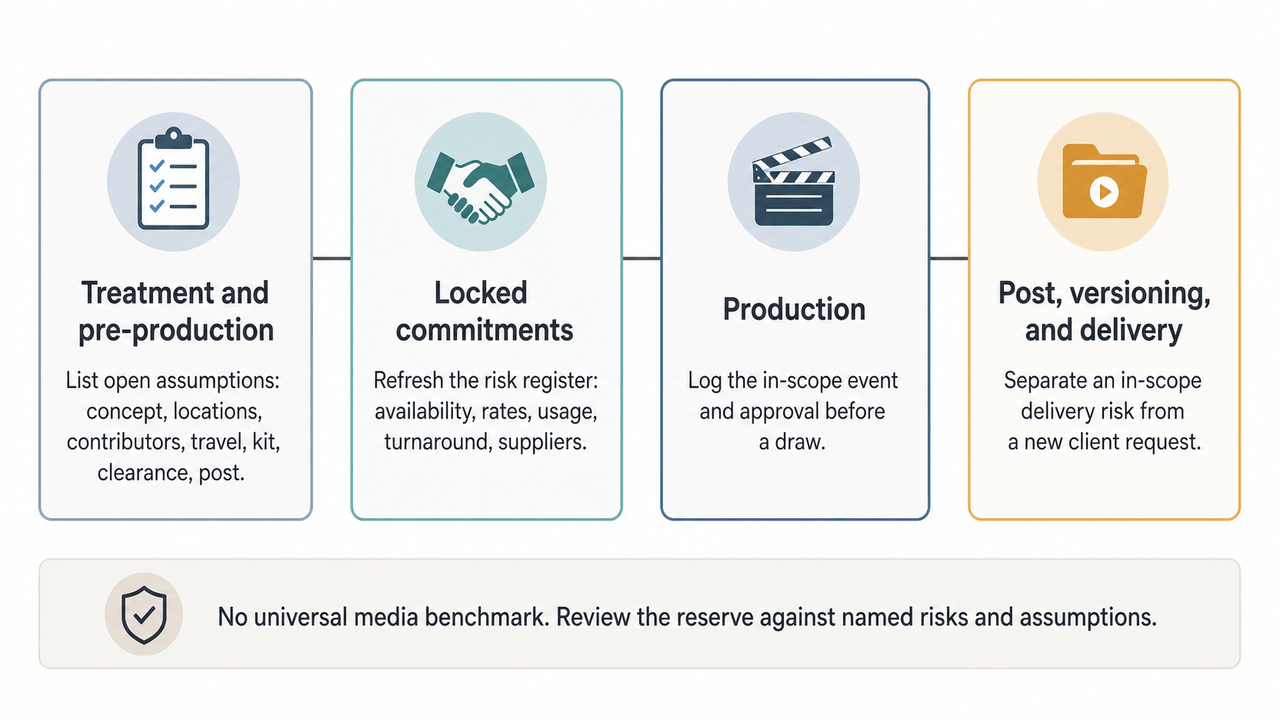
There is no universal media-production range to copy. What should change over a production is the uncertainty behind the reserve.
By production stage:
- Treatment and pre-production: separate confirmed requirements from assumptions about concept, locations, contributors, travel, kit, clearance, and post.
- Locked schedule, crew, and vendor commitments: update the risk register when availability, rates, usage, turnaround, and supplier commitments are known.
- Production: log actual events against the agreed purpose before committing the contingency.
- Post, versioning, and delivery: distinguish an in-scope technical or delivery risk from a client request for new versions, formats, or deliverables.
Screen Australia's documentary information for applicants requires a 10% contingency in that specific funding context. It does not establish 10% as the right percentage for every campaign film, social cutdown, animation, or event capture project. A team should document its own risk assumptions and revisit them when the plan matures.
What Actually Drives Your Contingency Number
Projects with the same headline budget can need different reserves because their uncertainty is different. Review these factors before choosing a percentage:
- Brief and treatment maturity: an unapproved treatment or an unclear deliverable list leaves more open than a signed-off production brief.
- Scope clarity: unclear review rounds, versions, rights, or deliverables can turn into cost quickly.
- Client and approval process: a fixed price may need a clearer reserve rationale when client feedback or approvals are still uncertain.
- Crew and contributor availability: a key-person change, overtime requirement, or replacement booking can alter both schedule and cost.
- Location, travel, and weather exposure: these are specific risks only when the plan actually depends on them.
- Vendor and technical dependencies: rental availability, specialist suppliers, data handling, render time, or delivery specifications can create late cost pressure.
- Schedule compression: less time for approvals, pickups, or post can increase the cost of a disruption.
- Team experience: relevant completed work can make an assumption more credible; it does not make uncertainty disappear.
Pro Tip: Write the three risks that would hurt the budget most, then decide whether the reserve can explain them. If it cannot, revise the scope, schedule, or risk treatment before sending the proposal.
How To Govern and Track Contingency Once a Project Starts
Contingency needs a purpose and an approval path before it needs a spreadsheet. Agree which person can approve a draw and what evidence they need: a production report, vendor quote, revised schedule, or written decision. Use the reserve for an identified production risk within scope, not to absorb a new client request without discussion.

Revisit the reserve at practical gates: after treatment and pre-production planning, after crew and vendor commitments lock, during production when an event occurs, and before post/versioning and delivery. The goal is not to release a preset share on a calendar. It is to keep the reserve aligned with the risks that remain.
For each draw, record:
- purpose and the named risk or event;
- approval and the decision-maker;
- amount committed;
- amount spent; and
- remaining balance.
Clear reporting helps the producer and client see whether the plan is absorbing ordinary uncertainty or drifting into a scope conversation. Screen Australia's recoupment versus profit guidance is not a production-contingency rule, but it is a useful reminder to keep categories and financial reporting clear.
Two Worked Examples: Media Production and Technical Delivery Contingency
Hypothetical campaign-film production example. This is an illustration, not a benchmark. A short campaign film has a working base cost of $80,000. The producer identifies four risks:
| Risk | Probability | Cost impact | EMV |
|---|---|---|---|
| Weather cover requires a location change | 20% | $8,000 | $1,600 |
| Lead talent becomes unavailable | 10% | $12,000 | $1,200 |
| Extra edit and versioning work is needed within the approved deliverables | 25% | $6,000 | $1,500 |
| Delivery issue requires a specialist fix | 15% | $4,000 | $600 |
The illustrative EMV total is $4,900. The team can decide whether that sum is adequate for the named risks, then document the chosen reserve and its limits. It should not add a generic floor because the risks above are hypothetical and the production facts will differ.
Range-estimating companion example. A larger post-heavy production may have relevant completed-project variance data for render time, versioning, and delivery work. The team can use that data to discuss a P50 or P90 cost view, but it should label the confidence level, data source, and assumptions. PMI's guidance on proposing service projects can be read for general proposal method; it is not evidence for a media-production percentage. Teams that are estimating adjacent technical delivery work can use software integration projects as a separate Roadbase reading path, not as a media benchmark.
Contingency vs. Allowance vs. Management Reserve
These labels answer different questions. A contingency covers identifiable uncertainty inside a defined production scope. An allowance is a placeholder for work that is expected but not sufficiently specified, such as an unconfirmed location fee or a music licence selection. A management reserve sits above the working production budget for uncertainty that the production team cannot assign to a known risk.
| Line item | Covers | Typically approved by |
|---|---|---|
| Production contingency | Identified uncertainty within approved scope | Named production approver |
| Allowance | Expected work with an unresolved detail | Producer with client input as needed |
| Management reserve | Unassigned uncertainty outside the working risk register | Executive sponsor or client, if one exists |
A client-approved scope-change budget is separate again. It covers new work that was not in the approved scope; it should not silently consume contingency.
Setting Your Contingency Percentage Step by Step
- Review production maturity. Mark what is confirmed and what is still assumed in the brief, treatment, schedule, crew plan, vendor plan, and deliverables.
- Identify risks. Build a short risk register covering the cost threats that are specific to this production.
- Check the current production stage. Review what has changed between treatment/pre-production, locked commitments, production, post/versioning, and delivery.
- Choose a sizing method. Use a percentage only when its written rationale is clear; use EMV when risks can be quantified; use range estimating only with relevant data.
- Select the percentage and document the rationale. Record why the reserve fits the risk assumptions, not only the number.
- Get approval and file it. Confirm who can draw the reserve and how a client-approved scope change is handled before the proposal is issued.
At each step, capture the top risks and the assumptions behind them. Teams that estimate project hours before they send a quote have a clearer starting point for this conversation. The reserve still needs review when the production plan changes.
Tracking Contingency Spend Without Losing Control
A usable tracker records purpose, approval, committed amount, spent amount, and balance. Add the production-risk reference beside each line. This makes it easy to distinguish a committed backup location from an invoice that has actually been paid.
Watch for these red flags:
- contingency is being committed before the underlying risk or decision is documented;
- a new client deliverable is being coded as a production contingency draw;
- several vague entries hide different crew, location, post, or delivery issues; or
- most of the reserve is committed while major assumptions are still unresolved.
Review the tracker at the production gates that matter to the plan, and after any event that changes the risk picture. A quick, specific record is more useful than a monthly ritual that arrives after the decision.
A Practitioner's Note on Pragmatic Contingency Use
A reserve can make a proposal look less competitive if it is unexplained. Hiding it makes the later conversation worse. The workable middle is a clear scope, a short risk register, and a reserve that the producer can explain without pretending it is a universal rule.
Sources
- Screen Australia's documentary information for applicants
- Screen Australia's recoupment versus profit guidance
- Contingency guideline (third edition) - Engineers Australia
- Contingency when proposing IT service projects - PMI
FAQ
What Is a 5% Contingency?
Five percent is a percentage, not a universal media-production benchmark. It may be a documented result of a particular production's assumptions and risks, but it should not be copied without that rationale.
What Is a Good Contingency Percentage?
There is no single correct media-production percentage. A defensible figure follows the documented production risks, the maturity of the brief and commitments, and the sizing method the team can explain.
What Does a 10% Contingency Mean?
It means 10% of the selected cost base is held as a reserve. Screen Australia's 10% documentary-budget requirement applies to its specific program context; it is not a universal rule for media productions.
How Do You Calculate Contingency Percentage?
For a percentage method, multiply the selected percentage by the cost base: Contingency = percentage x base cost. For an EMV method, add the probability x impact amount for each identified risk, then review whether the resulting reserve matches the documented assumptions.
Is Contingency the Same as Management Reserve?
No. Contingency covers identifiable uncertainty inside the approved production scope. Management reserve sits above the working budget for uncertainty that has not been assigned to a known risk. A client-approved scope change should be tracked separately from both.