

Risk-Based Pricing for Creative Project Quotes

For a creative team, risk-based pricing is a way to look at uncertainty before it gets buried inside a quote. The useful question is not "What percentage should we add?" It is "What is still unclear, who owns it, and how should the quote reflect that?" Scope, client inputs, approvals, dependencies, timing, and deliverable definition can all change the work behind a number. The 2026 multimedia production risk synthesis is retained here as original related reading, not as a formula for creative quotes.
Key Takeaways
Risk-based pricing for creative projects starts with a documented review of uncertainty. Clarify what can be clarified, consider a separate phase when the work needs more definition, revise the scope or timing where necessary, and use a contingency only when the team can explain its purpose in the quote.
| Point | Details |
|---|---|
| Make uncertainty visible | Record the assumptions, inputs, approvals, dependencies, and deliverables that still need review. |
| Choose a response | Clarify the brief, phase the work, revise scope or timing, or include a contingency the team can explain. |
| Keep the quote reviewable | State the commercial assumptions and the discussion process for changes in plain language. |
| Compare the work with the estimate | Tracked hours can make estimate variance visible for later review. |
| Use Roadbase as a review workspace | Roadbase can hold an editable work breakdown, quote inputs, a proposal PDF, and tracked-versus-estimated hours. |
Table of Contents
- How does risk-based pricing work in a creative quote?
- What risks actually inflate creative project costs?
- How do you calculate a risk-adjusted fee?
- How do you write risk adjustments into proposals and contracts?
- What practices actually reduce the risk premium you need to charge?
- How do you track outcomes and sharpen future estimates?
- When should you not use a risk premium?
- An editorial perspective on pricing for risk
- Roadbase fits directly into this workflow
- Sources
- FAQ
How does risk-based pricing work in a creative quote?
Start by making the uncertain parts of the brief easy to see. A written scope, named approval route, client-supplied assets, technical dependencies, timing assumptions, and deliverable formats give a quote something concrete to stand on. PMI's Developing a complete project scope statement describes assumptions as decisions outside a team's full control; when one fails, it can affect dependent work.
Then decide what belongs in the current quote. Sometimes the right move is to clarify the brief. Sometimes the unknown is substantial enough to separate early work into a discovery or planning phase. Sometimes the scope or timetable needs to change. A contingency can also be a reasonable commercial choice when the team understands what it covers and can explain it. None of those options is automatic or universally required.
Finally, record the choice in the proposal. U.S. GAO's Cost Estimating and Assessment Guide treats documented scope, assumptions, risks, updates, and actual costs as parts of a disciplined estimate. It is a government-estimating guide, not a creative-contract formula, but its documentation discipline is useful here. The scored brief decision matrix remains as original related reading rather than a rule for accepting, declining, or pricing work.
What risks actually inflate creative project costs?
The risk is usually not a mysterious category. It is an unresolved part of the work that may require time, a different sequence, or a changed plan.
Ambiguous scope appears when the brief names an outcome but not the deliverables, formats, responsibilities, or review boundaries. The Scope creep drives average cost overruns of roughly 27% link is retained as original related reading; this article does not rely on its numerical claim. What matters for a quote is whether the team can describe what it is making and what is outside the current work.
Technical dependencies matter when a project relies on a platform, integration, supplier, or source material that has not been confirmed. A packaging studio might need final dielines; a motion team might need usable footage; a web consultant might need access to an existing system. Each is an assumption worth recording.
Approvals and timing can change the delivery path when many people contribute feedback or no response window is clear. Approver count and brief clarity multiply realistic calendar time is retained as original related reading, not as proof of a timing rule. Identify who needs to respond, what they are approving, and what happens when required inputs arrive late.

Commercial and legal boundaries deserve the same clarity. Ownership, usage, payment, cancellation, and contract wording may affect the project, but a pricing article cannot supply legal terms. Flag the open issue, state the commercial assumption plainly, and obtain qualified advice for the contract language.
Stakeholder and external changes can also affect a quote. A missing decision-maker, a late client decision, a supplier problem, a platform change, or a client-side budget change may call for a conversation about scope, timing, or the next phase. The purpose of the review is to surface that possibility before the team treats it as invisible work.
How do you calculate a risk-adjusted fee?
There is no universal calculation that turns uncertainty into the right fee. A useful review is qualitative: list the uncertainty, describe its practical effect, identify what would resolve it, and decide whether the present quote should clarify, phase, revise, or include a contingency the team can explain.
Keep the underlying estimate visible. Price estimated hours by the roles doing the work, then review labor, overhead, direct costs, contingency, and target margin behind the quote. Those inputs need the team's own judgment and maintenance; a calculation does not protect a margin or guarantee a profitable result.
For a particular scope change, the Out-of-Scope Cost Calculator is related reading. It should not be used to turn this article's uncertainty review into a fixed formula.
How do you write risk adjustments into proposals and contracts?
Write the commercial assumptions in a way a client can discuss. A proposal can identify the current deliverables, client responsibilities, approval route, dependencies, timing assumptions, and how the team will discuss work that changes those conditions. If the quote includes a contingency, explain what it is intended to cover without presenting it as a universal rule or a legal remedy.
Do not borrow contract clauses from a general article and assume they fit the work. The contract workflow management link remains as neutral original related reading, not legal authority. Contract language, payment arrangements, cancellation, ownership, IP, and formal change procedures require qualified legal advice. For a practical project discussion of boundary-setting, see preventing scope creep.
What practices actually reduce the risk premium you need to charge?
The aim is not to force every quote into a contingency. It is to reduce avoidable uncertainty before the team commits to work it cannot yet describe.
- Clarify the deliverables. Name the formats, versions, handover items, and exclusions that matter to the client and the team.
- Name the inputs and dependencies. Record what the client, a supplier, or another system must provide, and when it is needed.
- Set an approval route. Identify the decision-maker, the feedback process, and the points where the work needs a decision to continue.
- Use phases when they match the unknown. An earlier discovery, definition, or planning phase can be a better fit than pretending later work is fully known.
- Revisit the estimate when the facts change. A changed scope, missing input, or new dependency should lead to a conversation before the team silently absorbs new work.
PMI's Developing a complete project scope statement is useful support for reviewing assumptions and their dependencies. It does not prescribe a creative-project reserve, a fixed review process, or a contractual outcome.
How do you track outcomes and sharpen future estimates?
After a project, compare the estimate with what the work actually required. Look at the original assumptions, where time was recorded, what changed, and which unknowns mattered. The point is to understand the estimate in context, not to invent a universal percentage for the next quote.
Tracked hours can make variance visible while work is underway. They do not prevent overruns or scope creep, and they do not establish a contingency by themselves. A client profitability review can be useful related reading when the team wants to review the commercial side of completed work.
U.S. GAO's Cost Estimating and Assessment Guide also emphasizes updating estimates with actual costs. Applied carefully, that is a documentation habit: compare a real project with its real assumptions before deciding what, if anything, should change in a later quote.
When should you not use a risk premium?
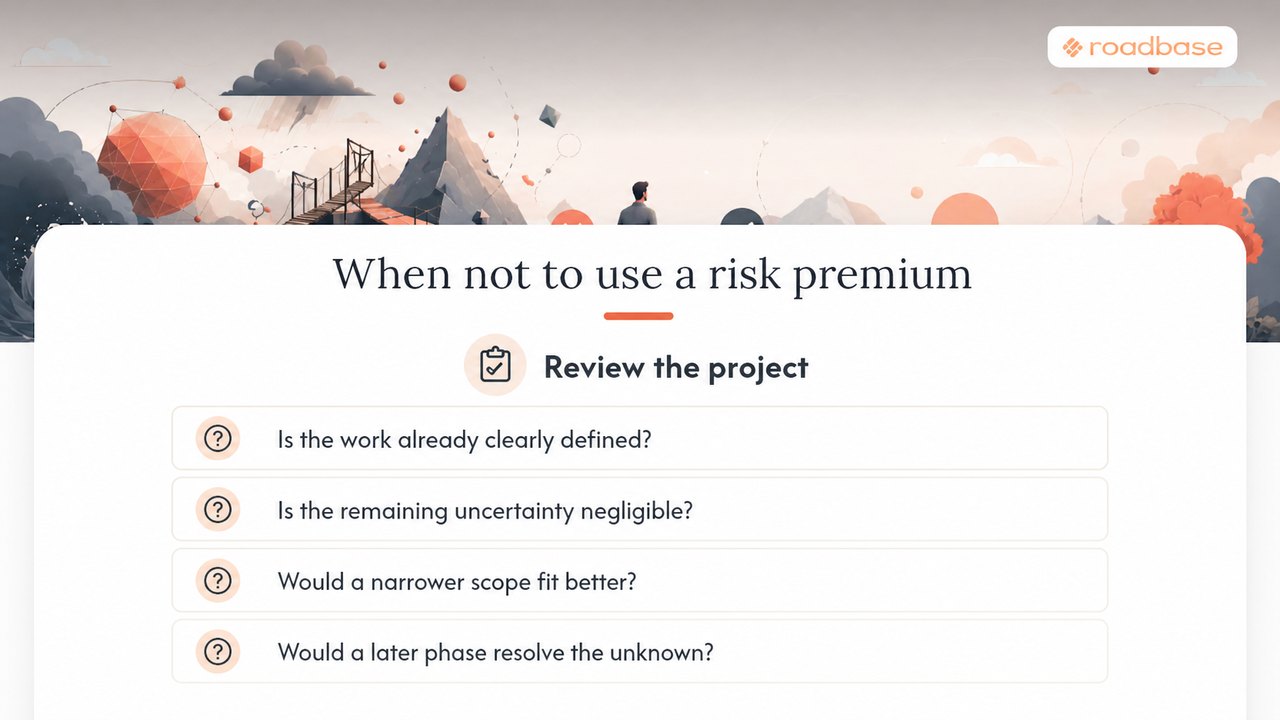
Do not manufacture a contingency when the work is fully defined and the remaining uncertainty is negligible. A clear, small fixed-scope task may need a straightforward quote instead. A quote with a tight client budget may call for a narrower scope, a changed sequence, or a later phase rather than an unexplained amount.
If the choice is really about the commercial model, when value-based pricing fits is related reading. That is a separate decision from claiming that uncertainty can be resolved by a standard premium.
An editorial perspective on pricing for risk
The weakest quote is often the one that hides its assumptions. A team may avoid an uncomfortable conversation about missing inputs, approvals, or timing, then discover that the work has changed after the price feels fixed.
The more useful habit is simple: keep the uncertainty attached to the decision it affects. If an assumption changes, revisit the scope, schedule, or quote with the client. If the project remains uncertain, choose a response the team can explain. That is clearer than treating a contingency as a negotiating tactic or a substitute for definition.
Roadbase fits directly into this workflow
Roadbase is a quote-first planning and pricing workspace for a real brief. You can paste the brief or attach a PDF, then use Roadbase to build an editable first draft of the work breakdown. Review and adjust the phases, tasks, roles, estimated hours, and assumptions before relying on the draft as the basis for a quote.
Price estimated hours by the roles doing the work, using costs and billable rates that the team supplies and maintains. Review labor, overhead, direct costs, contingency, and target margin behind the quote, then export the reviewed plan and quote as a proposal PDF. The PDF is an output, not a contract, legal agreement, e-signature workflow, or automatic approval system.
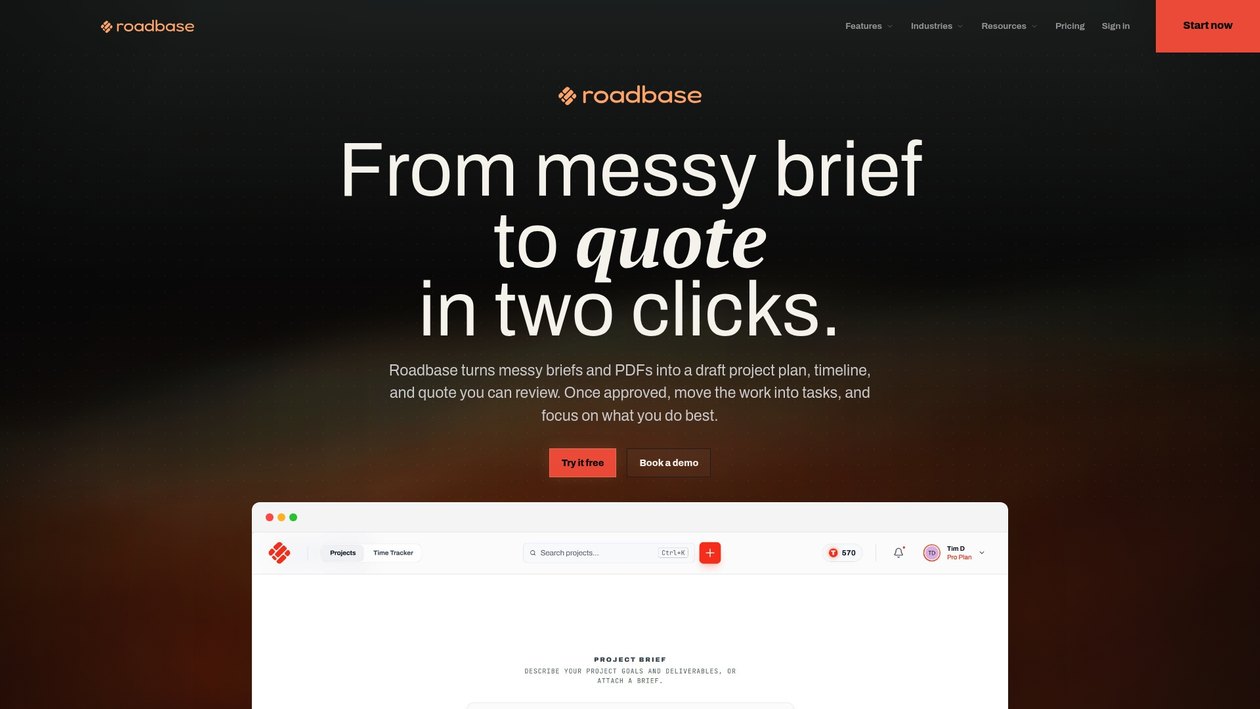
Once work is underway, Roadbase can compare tracked hours with the estimate. That makes variance visible for review; it does not prevent overruns or scope creep. For creative freelancers and small studios with a real brief in hand, Roadbase can keep the reviewed plan and quote connected to the work that follows.
Sources
- U.S. Government Accountability Office, Cost Estimating and Assessment Guide.
- Project Management Institute, Developing a complete project scope statement.
- Multimedia production risk synthesis (2026) (original related reading; not used here for numerical rules or outcomes).
- The Hidden Cost of Scope Creep: How Freelancers Lose $5,000+ Per Year | Sengi (original related reading; not used here for its numerical claim).
- How to Estimate Creative Project Timelines (Honestly) (original related reading; not used here as a timing rule).
- Evaluate Creative Roadmaps: Freelance Decision Matrix (original related reading; not used here as a scoring rule).
FAQ
What is risk-based pricing for creative projects?
For creative projects, it is a review of quote uncertainty: scope, inputs, approvals, dependencies, timing, and deliverable definition. The team can clarify the brief, phase the work, revise scope or timing, or use a contingency it can explain. There is no universal score or percentage that makes that choice for every project.
What contingency percentage should I add to a creative proposal?
This article does not recommend one. A contingency is a reviewed commercial choice, not a universal band or formula. Start with the actual uncertainty in the brief and decide whether clarification, a phase, a revised scope, timing change, or an explainable contingency fits the work.
How do I explain a contingency line to a skeptical client?
Explain the current assumptions, what remains uncertain, and how the team will discuss changes if the facts move. Do not promise that an unused amount will be credited, transferred, or handled in a particular way unless the reviewed agreement says so and qualified advice supports the language.
When should I use a discovery phase instead of a contingency?
Use an earlier discovery, definition, or planning phase when it would help resolve a material unknown before later work is quoted. It is one possible response, not a mandatory trigger. If the issue is legal wording, payment, ownership, IP, cancellation, or a contract clause, get qualified legal advice.
How does Roadbase support risk-based pricing?
Roadbase can turn a pasted brief or attached PDF into an editable draft work breakdown for review. Teams can adjust roles and estimated hours, review labor, overhead, direct costs, contingency, and target margin, export a reviewed proposal PDF, and compare tracked hours with the estimate. The draft needs review and adjustment, and the comparison makes variance visible rather than preventing overruns or scope creep.
Recommended
- When Value-Based Pricing Fits a Creative Project Quote
- Pricing and quoting complex creative projects: when spreadsheets stop working - Roadbase Blog
- Freelancer Project Estimates & Quotes | Roadbase
- From messy brief to clean quote: a practical workflow for freelancers and agencies - Roadbase Blog
Editor note: This article provides an editorial framework for reviewing creative-project uncertainty. Contract wording, payment terms, cancellation, ownership, IP, and legal rights require qualified legal advice.