

TeamGantt Alternatives: Start With the Job Your Agency Needs Done
Searching for a TeamGantt alternative can hide the real decision. A creative agency may be looking for a better delivery schedule. Or it may be trying to turn an unstructured client brief into a plan and quote that the team can review before delivery begins. Those are related jobs, but they are not the same job.
That distinction matters because a workable project plan starts with defined scope, a work breakdown, resources, milestones, and a schedule. The schedule comes after the work has been described well enough to plan.
TeamGantt's Gantt view is built around project timelines, including scheduling, dependencies, milestones, and other views. If your agency already has a solid task list and needs to manage delivery dependencies, evaluate a scheduling tool on that need. This article should not steer you toward Roadbase as a replacement for critical-path scheduling, advanced dependencies, workload management, or a broader operations platform.
If the brief itself is the bottleneck, start somewhere else: make the work visible before trying to optimize its dates.
Table of Contents
- Start by naming the problem
- Separate planning from scheduling
- Start with the job the workflow must support
- Why agencies pick the wrong tool first
- Where Roadbase fits
- How to test an alternative safely
- The practical recommendation
- Key takeaways
- FAQ
- Sources and further reading
Start by naming the problem
Use a delivery-scheduling evaluation when the project is already defined. You know the tasks, owners, milestones, and dependencies; the question is how to sequence and monitor them.
Use a quote-first planning evaluation when the project begins as a client brief, a set of notes, or a PDF. The unanswered questions are about phases, tasks, roles, estimated hours, assumptions, costs, and what will appear in the proposal.
Many agencies need both kinds of work. The mistake is assuming that a Gantt replacement will also resolve uncertainty in the estimate, or that a quote-first workspace will substitute for dependency planning. It is better to make the tradeoff explicit before starting trials.
Start with the planning job and the scheduling job
Do not begin with a feature matrix or a pricing table that has already gone stale. Begin with the job that has to survive the workflow.
For a defined project, test whether the scheduling tool can represent the milestones and dependencies your team relies on. For an early-stage brief, test whether the planning workflow leaves you with a reviewable work breakdown and quote rather than an attractive but unexamined draft.
This is deliberately not a ranked list. A tool can be appropriate for a dependency-heavy delivery plan and still be the wrong place to start a new piece of client work. The reverse is true as well.
Why agencies pick the wrong tool first

The first visible problem is often the timeline: dates moved, a review round appeared, or the client asked for a faster launch. But a timeline cannot answer what has not yet been decided about the work. If the team has not agreed on the tasks, the roles, the hours, the assumptions, and the milestones, changing the schedule may only make the uncertainty look more organized.
For example, a packaging studio might receive a brief that says it needs a new range ready for a retailer meeting. Before anyone can plan delivery dates, the studio needs a reviewable breakdown of strategy, concept routes, artwork, production checks, and client review. The schedule belongs beside that breakdown, not in place of it.
The same is true for a motion team with a short client brief. The team may need to decide the rounds of review, the roles involved, the estimated hours, and the direct costs before it can judge whether the requested date is realistic. This is a planning exercise, not a promise that software will settle the judgment for them.
What Roadbase is for in this decision
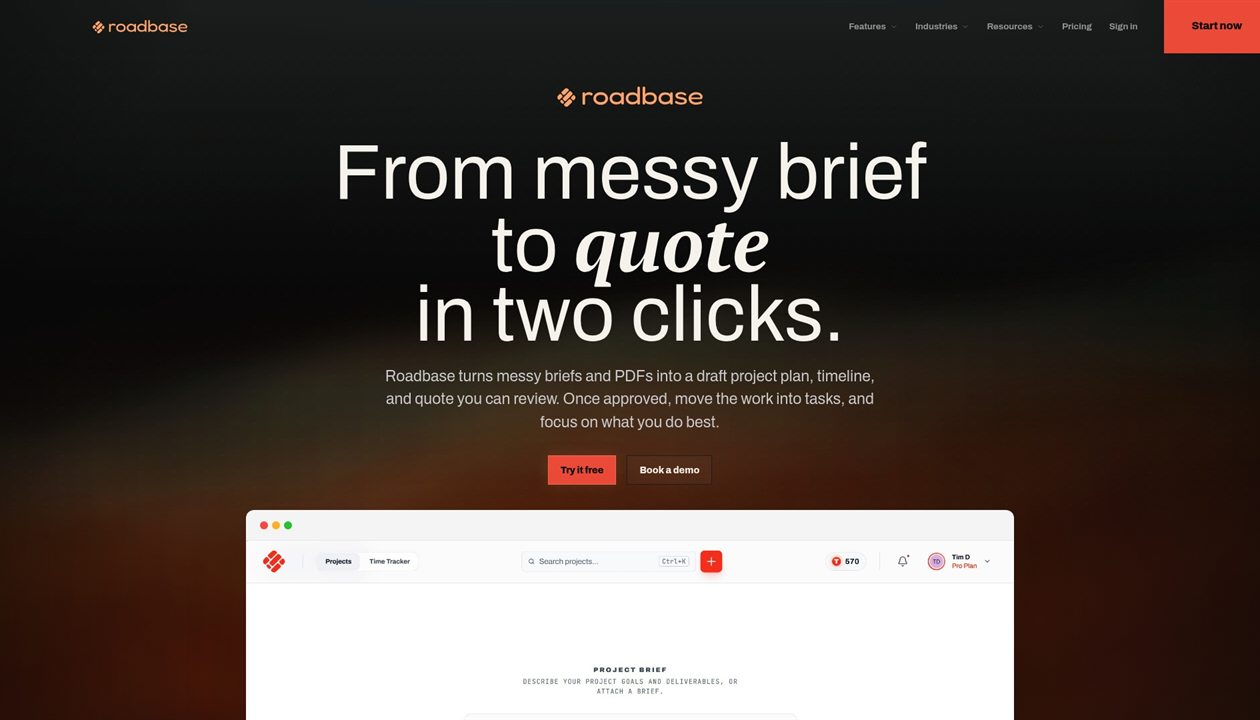
Roadbase is relevant when the agency has a real brief and needs to turn it into an editable planning and pricing draft. You can paste the brief or attach a PDF, then use Roadbase to build an editable first draft of the work breakdown. The output needs to be generated, reviewed, and adjusted; it is not a finished scope.
That draft can keep estimated hours beside the roles doing the work. It can also bring labor, overhead, direct costs, contingency, and target margin into the quote review, so expenses do not have to disappear inside a generic hours figure. Users still supply and maintain their own costs and rates, and any expense suggestion needs review.
Once the plan and quote have been reviewed, Roadbase can export them as a proposal PDF. That output is not a contract, an e-signature process, or an automatic approval step.
After approval, the same work can continue in a focused project and task board. Task-linked time entries can show actual hours against estimated hours while work is underway. That makes variance visible; it does not prevent an overrun, resolve scope creep, or make Roadbase a full portfolio, resource-planning, or dependency-management system.
How to test a TeamGantt alternative safely
Run one representative project through the part of the workflow you are actually replacing. Do not use a demo template alone.
For a scheduling evaluation, use a project that already has a real work breakdown. Check whether the milestones and delivery dependencies that matter to your team remain understandable.
For a quote-first planning evaluation, use an actual brief, notes, or PDF. Ask these questions during the trial:
- Can the team review the generated work breakdown against the real brief, including its assumptions and exclusions?
- Are the roles and estimated hours visible enough to challenge before the quote goes out?
- Can the team review labor, overhead, direct costs, contingency, and target margin rather than treating a total as self-explanatory?
- After approval, can the project carry the reviewed work into task status updates and tracked time without pretending it replaces dependency planning?
This is a trial method, not a migration guarantee. The point is to see whether the work breakdown, assumptions, estimates, approvals, and delivery dependencies survive the workflow your agency actually uses.
The practical recommendation
Do not choose a TeamGantt alternative by asking which product is best in the abstract. Choose it by locating the gap.
If tasks are defined and dependency-focused delivery scheduling is the gap, assess a scheduling tool on that requirement. If the work begins as a messy client brief and the gap is creating a reviewable plan and quote, assess a quote-first planning workflow. Roadbase fits the second job: it can turn a pasted brief or attached PDF into an editable draft for review, adjustment, pricing, and proposal export.
If you are already comparing specific products, these retained internal reads may be useful: Roadbase vs. ClickUp, Roadbase vs. monday.com, and Roadbase vs. Ganttify. They are next steps for those specific comparisons, not evidence for a ranking in this article.
If the brief is real but the work is still scattered across notes, Roadbase can turn it into a draft plan and quote for your team to review.
Key Takeaways
- A schedule is downstream of defined scope, a work breakdown, resources, milestones, and a plan.
- TeamGantt's Gantt view is relevant when the work is already defined and the main need is timeline, scheduling, milestones, or dependencies.
- Roadbase is relevant when an agency needs to generate, review, and adjust an editable work breakdown and quote from a brief or PDF.
- Use one representative project to test the workflow you need. Do not turn a successful trial of one job into a claim that it covers every other job.
FAQ
Can Roadbase replace a dependency-focused Gantt scheduling tool?
No. This article does not present Roadbase as a replacement for critical-path scheduling, advanced dependencies, workload management, or a broader operations platform. It is for the earlier work of building and reviewing the plan and quote when the brief is still messy.
What can Roadbase do with a client brief?
You can paste the brief or attach a PDF, then generate an editable first draft of the work breakdown. Review and adjust the draft before relying on it. Roadbase can keep roles, estimated hours, costs, and quote inputs beside the plan, then export the reviewed result as a proposal PDF.
How should a creative agency run a trial?
Use one representative project. Check whether its real work breakdown, assumptions, estimates, approvals, and delivery dependencies survive the workflow. That is a way to assess fit, not a promise that a tool will migrate data correctly or solve every delivery problem.
Sources and further reading
Project-planning context:
- Project Management Institute, Project Plan Assembly: Elements and Summary.
- Project Management Institute, Scope Management.
- TeamGantt Support, Gantt View.
- TeamGantt Support, Dependencies.
Additional retained internal reading from the imported draft: