

Best Proposal Software for Agencies and Freelancers
There is no universal best proposal tool. A freelancer with a repeatable offer, a studio pricing an unclear creative brief, and a sales team managing signatures are not starting with the same problem.
Start with one current or representative brief. If the work still needs to be broken down and quoted, evaluate a workflow that makes that draft reviewable. If the work is already defined and the bottleneck is a signature, contract, CRM process, billing, RFP response, or broader operations, evaluate that specialist workflow directly.
Do not let a generic template decide how your work should be scoped. Use the brief you actually expect to price, then inspect every assumption before relying on the output.
Table of Contents
- How proposal workflows compare at a glance
- Which workflow fits your situation?
- Concise review: what your proposal workflow needs to do
- How to test the workflow with your brief
- How to choose the right proposal software
- Final recommendation and next steps
- Key takeaways
- Why the question is harder than it looks
- Roadbase and the brief-to-proposal gap
- Sources and further reading
- FAQ
How proposal workflows compare at a glance
| If the unresolved job is... | Evaluate a workflow that helps you... | Keep the boundary clear |
|---|---|---|
| Turn a loose creative brief into a reviewed work breakdown and quote | Start from brief text or a PDF, make assumptions visible, and revise the draft before pricing it. Roadbase is relevant only to this quote-first job. | A reviewed quote is not a contract, signature process, CRM, accounting system, or PSA. |
| Present work that is already defined | Assemble and share the proposal in the format your client needs. | Presentation does not resolve missing scope or pricing assumptions. |
| Collect a signature or manage a legal agreement | Evaluate a contract or signature workflow directly. | Do not assume a proposal PDF is a signed agreement. |
| Run leads, accounts, or sales follow-up | Evaluate a CRM-led sales process directly. | A quote-first workflow does not replace CRM work. |
| Invoice, collect payments, or keep books | Evaluate billing or accounting tools directly. | Pricing a quote is separate from accounting. |
| Coordinate broad delivery, staffing, or agency operations | Evaluate an operations or PSA system directly. | Do not stretch a proposal tool into a full operating system. |
| Reuse approved RFP answers at volume | Evaluate a content-reuse or RFP workflow directly. | RFP response is a different starting point from a creative brief. |
Which workflow fits your situation?
Solo freelancer with repeatable work: Start by checking whether your offer is genuinely repeatable. A simple presentation workflow may be enough when the scope is already clear. If it is not clear, test the proposal process with the actual brief instead of forcing it into a stock template.
Creative freelancer or small agency with an unclear brief: Look for a way to turn the input into an editable work breakdown and quote. Check the draft against the real work: phases, tasks or milestones, roles, estimated hours, timing, direct expenses, and assumptions. For a fuller discussion of that work before the comparison stage, see the messy brief-to-clean quote workflow.
Team that has the scope but needs approval or signature: Evaluate a specialist agreement workflow directly. Do not treat an exported proposal as a substitute for a legal agreement or approval process.
Team whose deal work lives in a CRM: Evaluate the CRM-led workflow directly, including how it handles the data and approvals your team actually uses. A quote-first tool is not a claim to CRM coverage.
RFP-heavy team: Evaluate a content-reuse workflow directly. Its job begins with approved answers and response management, not with estimating a creative brief.
Larger agency with broad operational needs: Evaluate a PSA or operations system as its own category. That is relevant context, not a claim that proposal software covers that job.
Concise review: what your proposal workflow needs to do
This article does not review or rank named vendors. Current features, plans, integrations, security terms, and implementation requirements need direct verification with any provider you are considering. The useful review is whether one current brief can be turned into a document your team can inspect before it is sent.
Roadbase
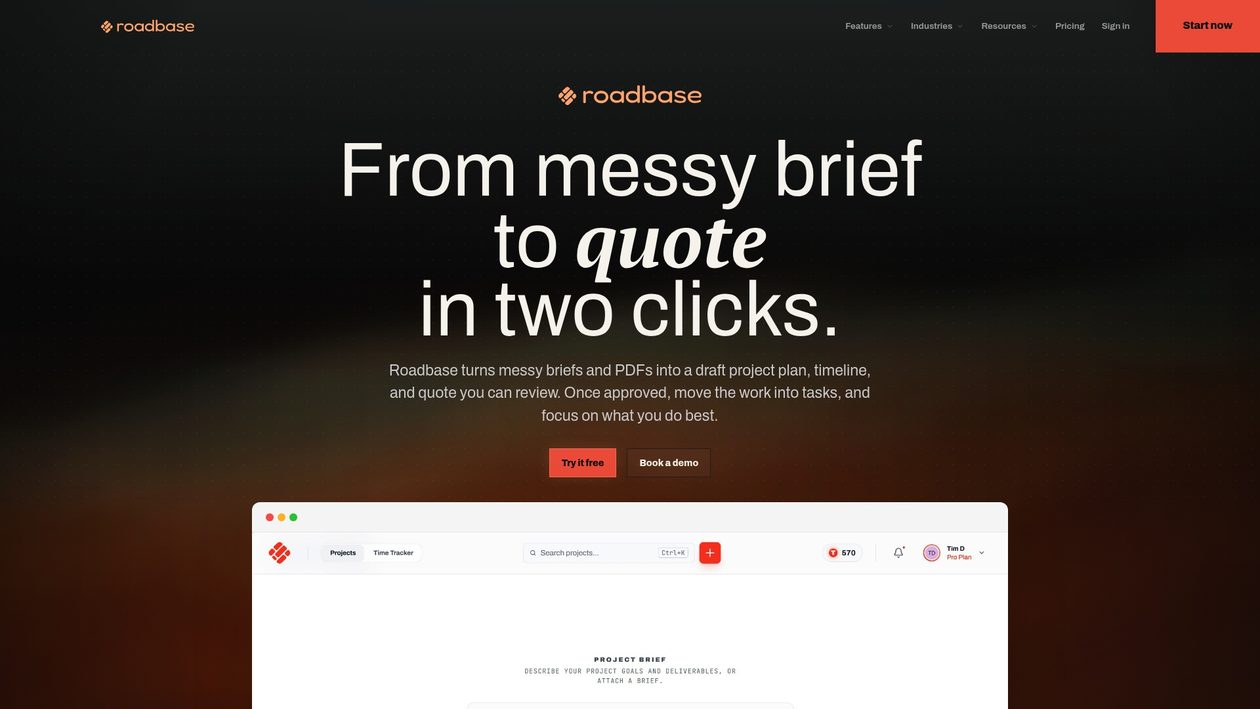
Roadbase is relevant when the unresolved work is the gap between a rough creative brief and a reviewable plan and quote. A user can paste brief text or attach a PDF to start. Roadbase creates an editable first draft of a work breakdown with phases, tasks or milestones, roles, estimated hours, timing, and estimate reasoning. It is a draft to review and adjust, not a finished or guaranteed-accurate scope.
Users can price estimated hours by the roles doing the work with supplied internal cost and billable-rate information. The quote model can show labor cost, role rates, overhead, contingency, direct expenses, estimated cost, quoted price, and margin calculations. The studio must supply and maintain its real costs and rates, and calculations require review. This is not accounting, margin protection, or a profitability guarantee.
After review, the plan and quote can be exported as a proposal PDF. That is not an e-signature, contract, legal-agreement, or automatic-approval workflow. If your current decision is instead about a broader all-in-one system, the Roadbase versus Dubsado article is related reading rather than a substitute for checking your own workflow.
How to test the workflow with your brief
This article did not test or rank vendors. A better way to evaluate the category is to run one representative brief through the workflow you are considering.
Use a brief with enough real uncertainty to expose the job: a packaging project with SKU count, dieline status, copy readiness, variants, printer coordination, proofing, and specialist expenses; a motion project with runtime, versions, shoot requirements, footage, animation complexity, review rounds, and cutdowns; or an event project with venue status, physical outputs, suppliers, install or show-day responsibilities, and approvals.
Inspect the result with the people who will own the work. Ask what was assumed, what is missing, what needs review, and what other system would still be needed after the quote is ready. Verify a provider's current terms and requirements directly where they matter to your decision.
How to choose the right proposal software
The trial checklist
- Start with one current or representative brief, not a generic sample.
- Identify whether the work needs a reviewed breakdown and quote, a presentation, a signature, CRM handling, billing, RFP response, or operations support.
- Inspect the draft and every assumption with the people responsible for delivery and pricing.
- Ask the provider to demonstrate the part of your actual workflow that remains unresolved.
- Verify current terms, requirements, and limitations directly before you make a purchase decision.
Questions to ask vendors
- Can you show this workflow using our representative brief or equivalent material?
- Which assumptions remain for our team to review and adjust?
- What is included in the current plan or agreement we are considering?
- Which separate workflow would we still need for signatures, legal agreements, CRM work, billing, RFP response, or broad operations?
- What current requirements should we verify before adopting the product?
Red flags to watch for
- A polished template hides work that has not been discussed or priced.
- A generated draft is treated as final without a human review.
- A proposal PDF is mistaken for a signature, contract, or legal-agreement workflow.
- A product is asked to solve an adjacent job it does not claim to handle.
- The team cannot explain its real costs, rates, direct expenses, or assumptions before it sends a quote.
Final recommendation and next steps
The useful answer is not a universal winner. It is the workflow that matches the work still unresolved in front of you.
Three steps to run a useful evaluation
- Name the unfinished job. If the brief still needs a reviewed work breakdown and quote, keep the evaluation quote-first. If it needs a signature, contract, CRM process, billing, RFP response, or operations system, evaluate that category directly.
- Test one representative brief and review the output with the people who own the work, price, and client commitment. The brief-to-quote workflow is useful context for this step.
- Compare the reviewed output with the decision your team still needs to make. If you are really choosing broad agency operations software, use the PSA context instead of treating this as an equivalent comparison.
Key takeaways
| Takeaway | What it means in practice |
|---|---|
| Use case comes before feature count. | First identify the unresolved job, then evaluate that workflow. |
| A real brief is a better test than a generic template. | The missing assumptions in real work show you what needs review. |
| Generated output is a draft. | Inspect and adjust it before relying on the plan or quote. |
| Current vendor terms need direct verification. | Do not rely on a roundup for mutable plans, requirements, or claims. |
| Roadbase has a narrow fit. | Roadbase fits the quote-first boundary: an editable plan and quote from a brief, reviewed by the studio. |
Why the question is harder than it looks
Feature lists hide the point at which work begins. A freelancer with a clear, repeatable service may mainly need a way to present it. A studio pricing a packaging, motion, or event project may still be working through the details that make a quote defensible. A sales team may already have the scope and instead need a signature or CRM process. Those are different decisions even when each person searches for proposal software.
For a creative-services team, the hard part is often deciding what the project includes before deciding how the document should look. Keep the field examples as questions, not a universal template: which variants are in the packaging work; what footage and cutdowns are required in the motion work; what physical outputs, suppliers, and show-day responsibilities belong in the event work? The answers need review before they become a quote.
That boundary also prevents category drift. A proposal workflow can help prepare a reviewed quote, but it does not automatically become a CRM, accounting package, contract system, RFP platform, or full agency-operations product.
Roadbase and the brief-to-proposal gap
Roadbase is for the quote-first boundary. Start by pasting brief text or attaching a PDF. Roadbase creates an editable first draft of a work breakdown with phases, tasks or milestones, roles, estimated hours, timing, and estimate reasoning. The studio reviews and adjusts that draft; it is not a finished or guaranteed-accurate scope.
The studio can price estimated hours by role with its supplied internal cost and billable-rate information. The quote model can show labor cost, role rates, overhead, contingency, direct expenses, estimated cost, quoted price, and margin calculations. Those calculations need review, and the studio must maintain its real costs and rates.
After review, Roadbase can export the plan and quote as a proposal PDF. It is not an e-signature, contract, legal-agreement, or automatic-approval workflow. If the brief-to-quote gap is your current problem, use one real brief to see whether the editable draft and reviewed quote suit your process.
Sources and further reading
The four external links below are preserved imported reading links only. They do not support claims in this article, and they are not a vendor shortlist or comparative evidence. Verify any current product terms with the provider directly.
- BeeSign imported reading link: first preserved occurrence and second preserved occurrence.
- Oneflow imported reading link: first preserved occurrence and second preserved occurrence.
- GetAccept imported reading link: first preserved occurrence and second preserved occurrence.
- Zapier imported reading link: first preserved occurrence and second preserved occurrence.
- Roadbase overview: product context for the narrow quote-first boundary.
- From messy brief to clean quote: related workflow reading, not proof of unverified product claims.
FAQ
What is the best proposal software for freelancers?
There is no universal answer. Start with the job still unfinished. A freelancer with a clear offer may need a presentation workflow; a freelancer pricing an unclear creative brief may need an editable draft plan and quote to review; a freelancer handling signatures, contracts, billing, or CRM work should evaluate those specialist workflows directly.
What should I prioritize when choosing proposal software?
Prioritize the fit between the workflow and your actual brief. Check whether the tool helps with the unresolved job, what your team must review, and which adjacent systems you would still need. Verify current terms and requirements directly with the provider.
How should I test proposal software?
Use one representative brief. Inspect the work breakdown, assumptions, pricing inputs, and output with the people who will price and deliver the work. Treat generated material as a draft to review and adjust.
Does an exported proposal PDF handle signatures or contracts?
Not by itself. A proposal PDF is separate from an e-signature, contract, legal-agreement, or automatic-approval workflow. Evaluate that adjacent job directly if it is part of your decision.
Is Roadbase suitable for sales teams outside creative services?
Roadbase is relevant to creative freelancers and agencies that need to turn a brief into an editable work breakdown and quote to review. Teams with CRM-led sales, signature, contract, billing, RFP, or broad operations needs should evaluate those workflows directly.
Recommended
- Roadbase
- Roadbase vs Dubsado: quoting and delivering creative projects
- Best PSA Software for Creative Agencies
- From messy brief to clean quote: a practical workflow for freelancers and agencies
- Creative agency software comparison
- Roadbase vs Bonsai for 3D visualization studios
Quick navigation
- How proposal workflows compare at a glance
- Which workflow fits your situation?
- Concise review: what your proposal workflow needs to do
- How to test the workflow with your brief
- How to choose the right proposal software
- Final recommendation and next steps
- Key takeaways
- Why the question is harder than it looks
- Roadbase and the brief-to-proposal gap
- Sources and further reading
- FAQ