

Billable vs Nonbillable Hours: Find Leakage in 30 Days

The useful question isn't simply how much client time your team logged. It's how that time relates to the agreement, the estimate, and, for hourly work, what actually reached an invoice. A 30-day review can show where those numbers diverge and give you a clearer basis for the next quoting or billing decision.
TL;DR:
- Classify client work against the agreement and your studio's time-coding policy; internal work is usually tracked separately.
- For hourly work, compare logged client hours with invoiced hours using the same available-hours denominator. An invoice is not a payment receipt.
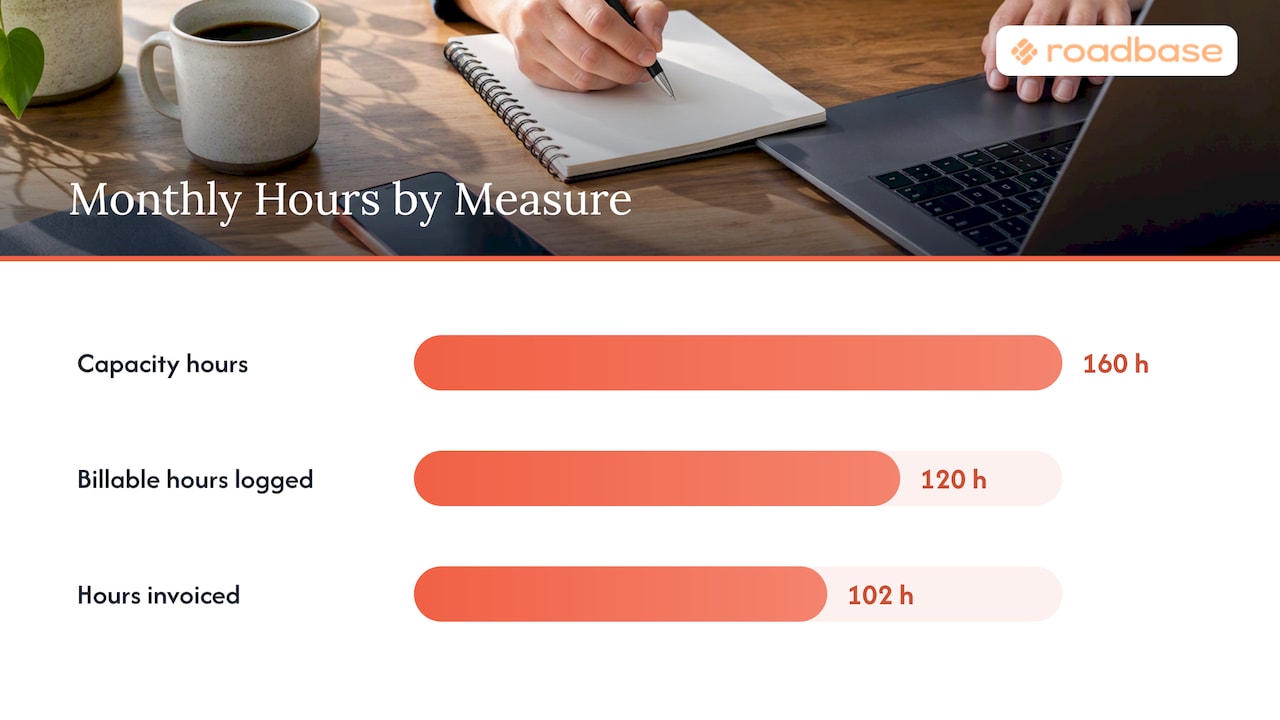
- At 160 available hours, 120 logged billable hours is 75% and 102 invoiced hours is 63.75%: a difference of 11.25 percentage points, or 18 hours to investigate.
- On fixed-fee work, compare actual hours with the estimate and review the fee and scope; an "invoiced hours" ratio may not fit.
- Use the next 30 days to review entries, agreements, and invoice decisions. The review can reveal causes; it cannot promise recovered revenue.
Table of Contents
- Defining billable hours and non-billable hours
- Why the billable and non-billable split drives profitability
- What counts as billable vs non-billable in practice
- How to track billable hours and measure utilization accurately
- Reducing leakage without burning out your team
- How structured scoping tools keep hours and invoices aligned
- A 30-day plan to start closing the leakage gap
- Roadbase: try a workflow that keeps estimates and delivery hours aligned
- FAQ
- Sources
Defining billable hours and non-billable hours
Billable time is client work you can charge for under the engagement's terms. On an hourly project, that might include production, agreed meetings, research, and revisions. On a fixed-fee project, the team still needs to record the hours it spends, but the client may receive one fee rather than an invoice listing those hours. A task's connection to a deliverable alone doesn't decide how it should be billed.
Non-billable time often covers work the studio needs to operate but doesn't charge to a particular engagement:
- Internal meetings, team standups, and planning sessions
- New business development, pitching, and proposal writing
- Training, skill development, and onboarding new staff
- General administration, invoicing, and internal reporting
- Recruiting and performance reviews
Some categories depend on the agreement. A client workshop may be covered by the fee; an internal planning meeting may also be part of an agreed project phase. Write down how those cases are coded so the team doesn't have to reconstruct the decision months later. The discussion of AI-assisted billing in legal work illustrates why time spent using and reviewing a tool deserves a clear policy, but a lawyer's billing rules don't automatically set a creative studio's terms. For an hourly creative engagement, record the work actually done and check the agreement before deciding what to charge. Treat training time according to that same documented policy.
Why the billable and non-billable split drives profitability
One utilization figure can hide two different questions: how much available time went to client work, and how much of that time was included on an invoice. Both are useful if you name the denominator and keep the underlying records. A difference between them is a prompt to review entries, not proof that the studio lost profit or that a client owes for every hour.
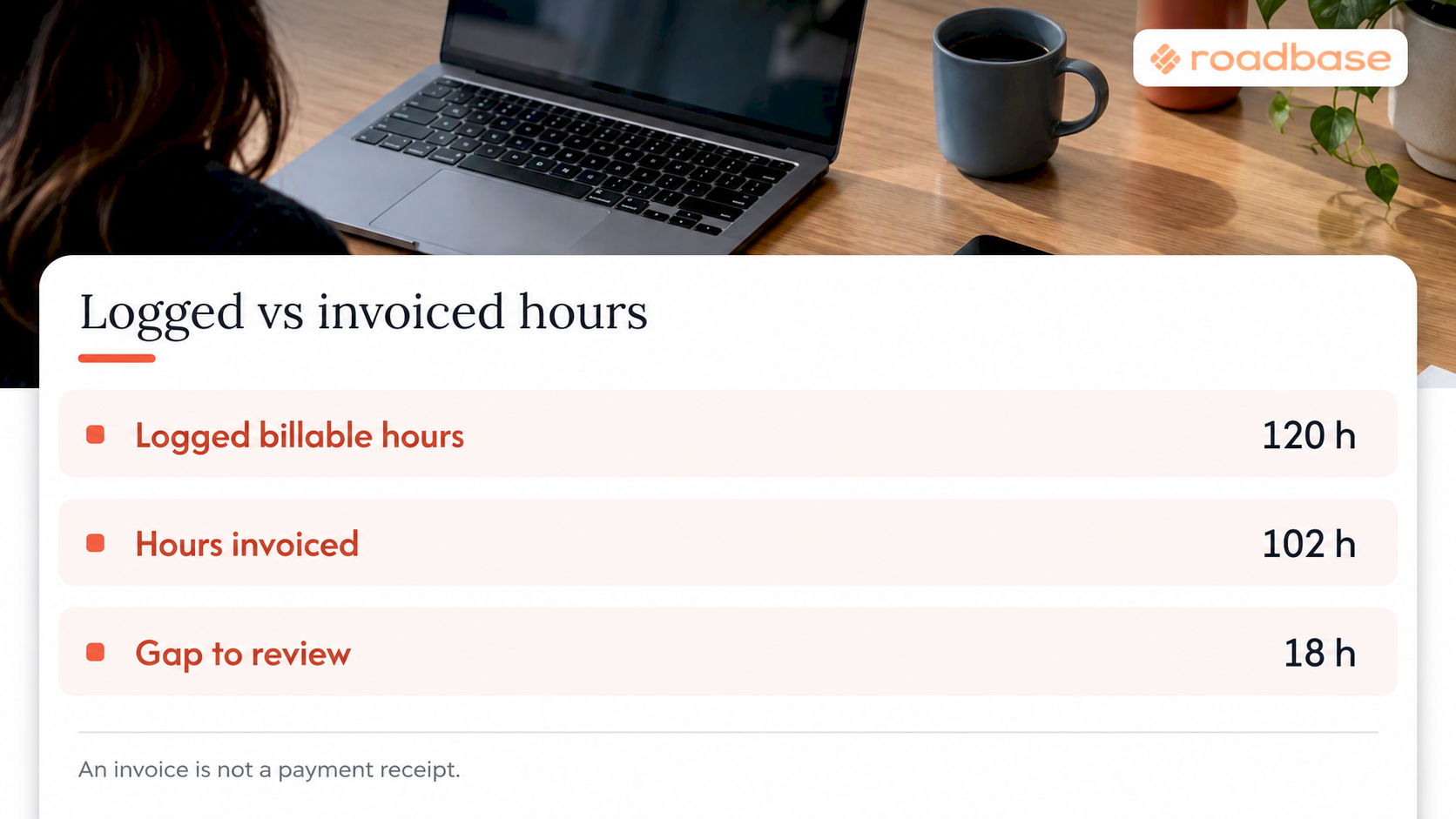
The cause might be a deliberate write-off, an agreed fixed fee, a billing cutoff, an entry coded to the wrong project, or work outside the agreed scope. Invoice status also differs from payment status: invoiced work has been charged; collected revenue has actually been paid. Keeping those stages separate makes the review useful.
Role averages can obscure the work behind them. A designer producing client deliverables and a studio principal developing new business may have very different mixes of client and internal time. Compare each role's numbers with its actual responsibilities and the engagement model. For additional reading on utilization terms, see Rocketlane's overview; its suggested targets are not a benchmark for every creative team.
What counts as billable vs non-billable in practice
Begin with the contract or statement of work, then apply a consistent coding policy. Work that may be chargeable under an hourly agreement includes:
- Client deliverable work such as identity design, production artwork, code, or written content
- Client meetings and workshops included in the engagement
- Revisions within the agreed number of rounds, and additional work after approval of its terms
- Client-authorized travel or research when the agreement allows it
Work usually coded as internal includes:
- Studio operations, internal planning, and general team meetings
- Proposal writing, pitching, and new business development
- Training and onboarding
- General administration and internal reporting
- Extra revisions the studio chooses to absorb rather than charge
A packaging team, for example, might log a third round of SKU adaptations after the agreed two rounds. That entry should be visible even if the manager decides not to bill it. Record the reason and discuss any new scope with the client before assuming it can be charged. The same habit helps on fixed-fee work: actual hours still show whether the next estimate needs adjusting.
How to track billable hours and measure utilization accurately
Capture time close to when the work happens, with a project, task, and short description. Then have someone review ambiguous entries before the invoice is prepared. A timer can help, and a manual entry can work too; the important test is whether the record is complete enough to explain later.
Choose billing increments and rounding from the engagement terms and any rules that apply to your work. The one-tenth-hour example in attorney billing explains a legal-practice convention; it is not a universal six-minute rule for studios. Whatever increment you use, make it explicit and apply it consistently.
For an hourly project, keep three calculations distinct:
- Available hours: the person's working hours in the period after planned time off, using one clearly stated denominator.
- Logged billable share: logged client hours marked billable divided by available hours.
- Invoiced-hours share: hours included on invoices divided by those same available hours. This is a local comparison measure, not a universal definition of realized utilization.
Suppose a designer has 160 available hours in a month, logs 120 as billable, and 102 of those hours appear on invoices. The arithmetic shows a difference. It does not tell you why the 18 hours were left off or whether they can now be charged.
| Metric | Formula | Example value |
|---|---|---|
| Available hours | Working hours in the period | 160 hours |
| Logged billable share | 120 / 160 | 75% |
| Invoiced-hours share | 102 / 160 | 63.75% |
| Difference | 120 - 102; 75% - 63.75% | 18 hours; 11.25 percentage points |
Keep the denominator and labels beside the dashboard. The companion article on a clear utilization rate formula explains why a ratio changes when the available-hours base changes. On fixed-fee projects, skip the invoiced-hours share if invoices don't itemize time. Compare actual hours with the estimate, then examine the fee and scope separately.
Reducing leakage without burning out your team
The aim is a clearer account of where work went, so decisions can be made before the next quote or billing cycle.
- Review time by role and project rather than assigning one utilization target to everyone.
- Give common work types clear codes, including client revisions, internal review, and proposal work.
- Sample a few entries against project notes and the agreement to find coding mistakes or unclear terms.
- Plan internal time for training and business development instead of treating it as an unexplained shortfall.
- Ask a manager to review the agreement and entries before invoicing or discussing additional charges.
Pro Tip: Review the same four fields each month: available hours, logged client hours, invoiced hours where relevant, and the reason for any difference. The explanation matters more than the size of the gap alone.
Fixed-fee and hybrid work change the question. The client may pay for a deliverable or phase, while the studio records time internally to learn whether its estimate was realistic. A longer-than-expected project doesn't automatically create extra billable hours. It may call for a better estimate next time, or an agreed scope change during this project.
How structured scoping tools keep hours and invoices aligned
A useful review starts before delivery. Put the work in a plan with phases, tasks, roles, estimated hours, and assumptions. Price that plan against the studio's own rates and costs, then review it with the client before work starts. When actual hours accumulate against the tasks, the team can compare them with the estimate and decide what needs attention.
Roadbase supports that planning sequence: paste a brief or attach a PDF, review and adjust the editable draft work breakdown, examine role-based labor and other quote inputs, and export the reviewed plan and quote as a proposal PDF. After approval, project and task statuses and correctly linked time entries let the team compare actual task hours with the estimate. The manager still checks the agreement and invoice records to explain any gap between logged and invoiced hours. The proposal PDF records the reviewed quote; it isn't an invoice or an agreement by itself.
A 30-day plan to start closing the leakage gap
In week one, choose a recent completed billing period and agree on the available-hours denominator. Pull the project time entries, the applicable agreements, and the invoices. Keep fixed-fee work in its own group so its hours aren't forced into an hourly invoice ratio.
In week two, compare logged client hours with invoiced hours for hourly engagements. Investigate each difference: invoice timing, an agreed write-off, a coding error, a revision outside scope, or another documented reason. Record the reason rather than guessing from the totals.
In week three, review the recurring categories with the people doing the work. Clarify which meetings, revisions, training, and specialist handoffs belong in the project log, and which need a client conversation before any charge changes.
In week four, update the time-coding guide, the next estimate, or the way approval decisions are recorded. Put another review on the calendar. Thirty days is enough to run this first pass; whether it changes future billing depends on what the records and agreements actually show.
Roadbase: try a workflow that keeps estimates and delivery hours aligned
Have a real brief or PDF in front of you? Open Roadbase and turn it into a draft plan and quote. Review the phases, roles, hours, assumptions, and price before you send the proposal. After approval, track time against the project tasks and compare actual hours with the estimate. That gives your next review a concrete starting point.
If you work with freelancers or outside specialists, clarify who records which hours and where the handoff sits in the quote. The Freelance PM Club and Brainiac Media are examples of outside perspectives on freelance management and outsourcing, respectively; use the same agreement and time-review discipline for any collaborator.
Explore current Roadbase pricing when you're ready to choose a plan. The software consultant quoting page and freelancer estimate page show where a structured quote fits those workflows. You can also explore Roadbase before opening a project.
FAQ
What does "billable" mean?
Billable time is work that can be charged under the client's agreement. A project entry should identify the work and engagement, but its presence in a time log doesn't by itself make the time invoiceable. Internal operations are usually tracked as non-billable time.
What is billable time in law?
For a lawyer charging by time, billable time concerns work actually performed on a client's matter under the fee arrangement. ABA Formal Opinion 93-379 addresses lawyers' billing for time and charges. Its professional-duty analysis is specific to legal practice; a creative studio should use its own engagement terms and applicable rules.
How many hours a week is 3,000 billable hours?
Three thousand hours over 52 weeks is about 57.7 billable hours every week, before vacation, holidays, administration, or business development. Treat that as arithmetic, not a healthy target. Any workload plan also needs to account for the non-billable work the role carries.
What is billable and non-billable in a corporate services context?
Billable work is client work chargeable under the engagement; non-billable work is tracked time that isn't charged to that client. Internal meetings, training, and proposals are often non-billable, while agreed client workshops can be billable. Check the contract and the organization's coding policy for borderline tasks.
How do I calculate billable utilization and leakage?
Choose an available-hours denominator. Divide logged billable hours by it, then divide invoiced hours by the same number for hourly work. In the 160-hour example, 120 logged hours gives 75% and 102 invoiced hours gives 63.75%. The difference is 18 hours, or 11.25 percentage points. Review the entries and invoices to learn why; invoiced hours don't show whether payment was collected. For fixed-fee work, compare actual hours with the estimate instead.
Sources
- Understanding attorney billing increments for a more efficient practice - CosmoLex (legal-practice context)
- ABA Formal Opinion 93-379 - NV Bar (lawyer-specific billing opinion)
- Billing ethics of AI-assisted legal work - Modern Law Office (legal-practice commentary)