

Turn Briefs Into Priced Proposals: Copywriting Rates for Freelancers
Most persuasive copy should be priced by the project, not the hour or the word. Per-word rates average around $0.70 for professional freelancers, while sales pages run $5,000 to $25,000 and VSLs $7,500 to $50,000 at the experienced end. Specialization and proven results can push writers above typical market anchors, which is why value-based pricing is often preferred for conversion-focused work.
TL;DR:
- Specialization in high-demand niches like financial, health, or SaaS copywriting can command premiums of 20% to 40% over generalist rates, based on documented results.
- Project fees are generally more aligned with the value of conversion-focused work than hourly or per-word rates, especially for sales pages and VSLs that require strategic thinking.
- Accurate scope definition through detailed briefs and task breakdowns reduces disputes and helps justify rate premiums, with clear policies on revisions, ownership, and deadlines.
- Retainers suit ongoing, predictable projects with volume, while performance deals tie compensation directly to revenue generated by the copy, requiring robust tracking infrastructure.
- Using a structured, itemized proposal based on comprehensive briefing and risk buffers leads to more defensible, efficient quoting in competitive markets.
Table of Contents
- What Do Copywriting Rates Look Like Right Now?
- Which Pricing Model Fits Your Project?
- How Much Does Specialization Actually Add to Your Rate?
- How Do You Set a Rate and Build a Defensible Quote?
- What Should Clients Look for in a Copywriting Quote?
- When Do Retainers and Royalty Deals Make Sense?
- How Do You Turn a Messy Brief Into a Confident Quote?
- A Pragmatic Path for Pricing Copy in 2026
- A Faster Way to Turn Your Rates Into Real Proposals
- Where These Rate Figures Come From
- Sources
- FAQ
What Do Copywriting Rates Look Like Right Now?
The numbers below are anchors, not quotes. Think of them as the range you'd expect to see on a rate card before anyone has looked at your brief, your goals, or what a winning piece of copy is actually worth to your business.
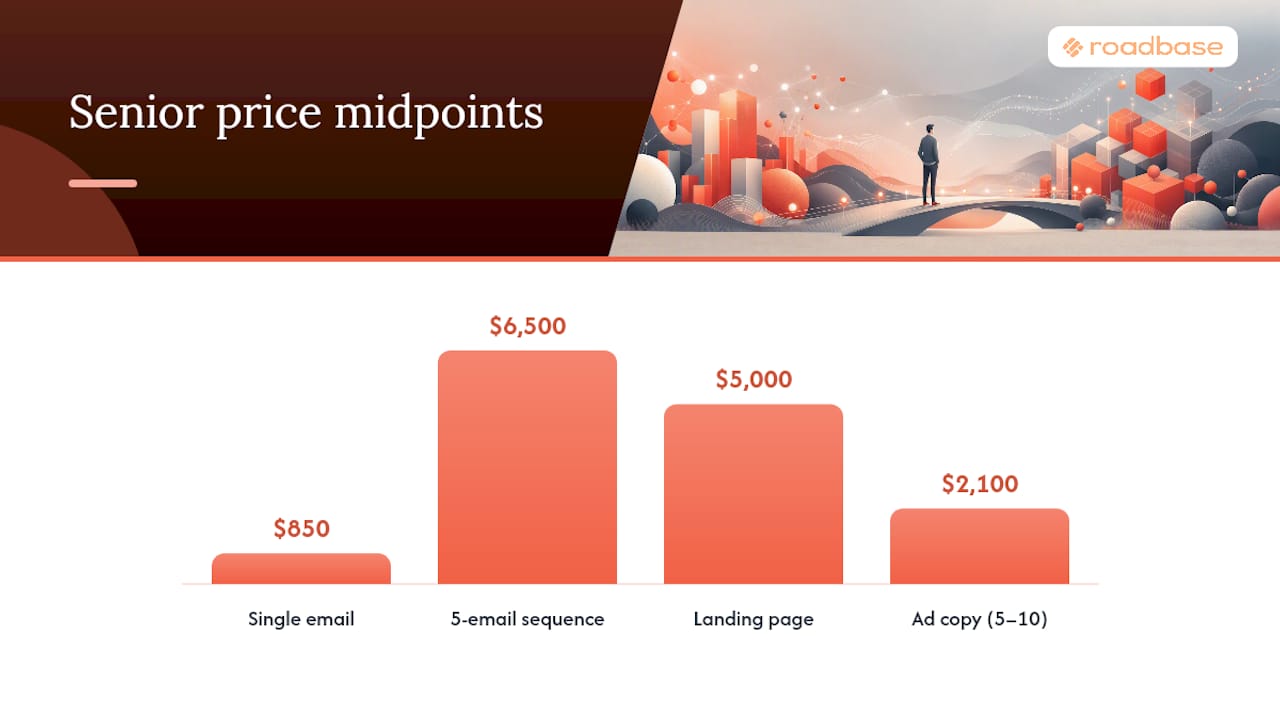
A blog post from a junior writer might run $50 to $150. The same post from a specialist with a documented content history can land at $300 to $600, especially if it requires original research or interviews. Email copy scales fast too: a single promotional email might cost $150 from a generalist and $750 from a direct-response specialist who can point to past open and click performance.
Here's how the common deliverables break down across experience tiers:
| Deliverable | Junior | Mid-level | Senior/specialist |
|---|---|---|---|
| Blog post (1,000 words) | $50-$150 | $150-$400 | $400+ |
| Single email | $75-$200 | $200-$500 | $500-$1,200 |
| 5-email sequence | $500-$1,200 | $1,200-$3,000 | $3,000-$10,000 |
| Landing page | $300-$800 | $800-$2,500 | $2,500-$7,500 |
| Sales page | $1,000-$3,000 | $3,000-$8,000 | $5,000-$25,000+ |
| VSL script | $1,500-$4,000 | $4,000-$10,000 | $7,500-$50,000+ |
| Website package (5-7 pages) | $1,500-$3,500 | $3,500-$8,000 | $8,000-$20,000+ |
| Ad copy (set of 5-10 variations) | $200-$500 | $500-$1,200 | $1,200-$3,000 |
| Monthly retainer | $1,500-$3,000 | $3,000-$7,500 | $7,500-$15,000+ |
These deliverable ranges track closely with the industry figures compiled by Rob Palmer's 2026 pricing breakdown, and the email sequence and retainer bands align with the long-form fee ranges AWAI publishes for professional engagements.
Turnaround time matters just as much as scope. A single email typically ships in 2 to 4 business days. A full sales page or VSL script usually needs 1 to 3 weeks once research and drafts are accounted for. If a client needs something inside 24 to 48 hours, a rush fee of roughly 25% on top of the base rate is standard practice across the industry, and it should be stated in the quote before work starts, not added as a surprise on the invoice.
A few things to keep in mind before you lean on any of these numbers:
- These ranges assume a competent generalist to mid-tier specialist. Niche expertise moves the ceiling up, sometimes dramatically.
- The bands reflect deliverable price, not hourly equivalent. A senior copywriter's $15,000 sales page might take 20 hours or 60, depending on research depth.
- Revision rounds, strategy calls, and testing recommendations are often bundled into the project fee at the higher tiers. At the junior tier, they're frequently billed separately.
- Retainer pricing depends heavily on deliverable volume per month, which the table above assumes is moderate (4 to 8 pieces).
None of these figures replace a real scope conversation. They're a starting point for negotiation, not a ceiling or a floor.
Which Pricing Model Fits Your Project?
Copywriters and clients generally choose among five pricing structures, and the right one depends on how predictable the scope is and how directly the copy drives revenue.
- Per-word pricing. You charge a flat rate per word, typically $0.10 to $1.00+ depending on experience. This works for high-volume content like blog posts, product descriptions, or SEO articles where output is standardized and research time is minimal.
- Hourly pricing. You bill for time spent, usually $50 to $150+ per hour depending on specialization. Hourly makes sense for editing, consulting, or projects where scope keeps shifting and neither side wants to renegotiate constantly.
- Per-project pricing. You quote a flat fee for the whole deliverable regardless of hours worked. This is the standard for experienced direct-response writers because it ties the fee to outcome rather than time spent, rewarding efficiency instead of penalizing it.
- Retainers. A client pays a fixed monthly amount for an agreed volume of work, often a mix of emails, ad copy, and landing pages. Retainers suit ongoing relationships with predictable, repeatable deliverables.
- Royalty or performance deals. You take a percentage of revenue the copy generates, sometimes layered on top of a reduced upfront fee. This aligns incentives tightly but requires real tracking infrastructure on both sides.
Per-word and hourly models increasingly mismatch high-value persuasive work because they don't account for the strategic thinking behind a converting sales page. A junior writer and a seasoned direct-response copywriter might spend the same 15 hours on a landing page, but the output isn't remotely comparable in revenue impact. Charging by the hour caps the specialist's income at exactly the level of the junior writer's time.
That said, per-word and hourly pricing aren't obsolete. They're the right call when:
- The client needs volume content (blog posts, product descriptions) where quality variance is low.
- The engagement is editing or polishing existing copy rather than writing from scratch.
- Scope is genuinely unclear at the outset and neither party wants to lock in a number prematurely.
Pro Tip: If a client insists on hourly billing for a sales page or VSL, propose a hybrid: a capped hourly rate with a project ceiling. It protects you from scope creep without forcing the client into an unfamiliar pricing model on day one.
For anything designed to convert, value-based pricing usually produces a fairer number for both sides. It asks what the copy is worth to the business, not how long it took to write.
How Much Does Specialization Actually Add to Your Rate?
Niche expertise is the single fastest way to move out of generalist pricing. Copywriters in financial services, health and supplements, or SaaS routinely charge premiums of 20% to 40% over generalist rates, and the gap is wide enough that it changes which band you're competing in entirely.
The premium breaks down by niche:
- Financial services: 30% to 40% above generalist rates, reflecting compliance knowledge and the regulatory review most financial copy requires.
- Health and supplements: 25% to 35% above generalist rates, tied to FTC-adjacent claim substantiation and familiarity with what a legal team will actually approve.
- SaaS: 20% to 30% above generalist rates, driven by the technical fluency needed to write credibly about integrations, onboarding flows, and product positioning.
Specialization in financial, health, or SaaS copywriting adds a documented 20% to 40% premium over generalist rates, making niche depth one of the highest-leverage moves a copywriter can make in a single year.
Picture the same landing page brief going to two writers. A generalist quotes $1,200 based on standard rates for a mid-tier landing page. A SaaS specialist with three published case studies showing trial-to-paid conversion lifts quotes $2,800 for the same page, and wins the project anyway, because the client isn't buying words. They're buying confidence that the page will convert.
That confidence has to be packaged, not just claimed. Writers command premium rates when they can show, not tell: a one-page case study with before-and-after conversion numbers, a testimonial referencing a specific metric, or a portfolio organized by industry rather than by format. Documented results like conversion lifts and revenue increases are the strongest single lever for justifying a rate above the anchor bands, stronger even than years of experience alone.
If you're building toward a specialist rate, pick one niche and collect metrics from every project, even small ones. A 12% lift on a $2,000 project is still worth citing when you're pitching a $10,000 one.
How Do You Set a Rate and Build a Defensible Quote?
A rate only holds up if the scope behind it is airtight. Most disputes over price come from vague scope, not unreasonable numbers, so the fastest way to protect your rate is to nail down the brief before you name a figure.
Before quoting anything, request answers to these:
- What's the specific business goal? (More leads, higher conversion rate, more email replies?)
- Who's the audience, and is there existing research or personas available?
- What's the success metric, and how will it be measured after launch?
- What assets already exist? (Brand guidelines, past copy, competitor examples, product data.)
- What's the hard deadline, and is there flexibility on it?
- How many revision rounds are included, and who signs off on final approval?
Once you have those answers, estimate time in three buckets: research (reading existing materials, competitor analysis, customer interviews if any), production (drafting), and revision (built-in rounds plus buffer for scope surprises). A sales page might break down as 4 hours research, 8 hours drafting, 4 hours revision, for 16 hours total. If your target hourly value is $150, that's a $2,400 baseline, which you then adjust upward for niche premium, urgency, or the size of the audience the page will reach.
Convert that number into a flat project fee before you send the quote. Clients respond better to a single number tied to a deliverable than to a rate times an hour estimate, because a flat fee reads as confidence rather than a guess.
Your contract should nail down:
- Deposit: 30% to 50% upfront is standard, due before research or drafting starts.
- Revision scope: name the number of rounds included (2 is common) and define what counts as a revision versus a new project.
- Ownership: specify when copyright transfers, typically on final payment, not on delivery of drafts.
- Cancellation terms: what happens to the deposit if the client cancels mid-project.
- Rush fees: the same 25% premium mentioned earlier for compressed timelines, written into the contract, not negotiated after the fact.
Pro Tip: Send the brief checklist as a short form before the discovery call, not during it. Clients who fill it out seriously tend to be the ones who respect scope later. Clients who skip half the questions are often the ones who'll ask for "just one more revision" six times.
What Should Clients Look for in a Copywriting Quote?
A low number on a quote is rarely the bargain it looks like. The real cost of hiring the wrong copywriter shows up later, in missed deadlines, endless revision requests, or copy that reads fine but doesn't move a single metric.
Before you request quotes, your brief should already include:
- The specific goal (sign-ups, sales, downloads) and how you'll measure it after launch.
- Any existing brand voice guidelines, past-performing copy, or customer research.
- A realistic deadline, with an honest note if there's flexibility.
- Whether A/B testing is planned, and who owns the testing process.
When quotes come back, compare them on more than the number at the bottom. Ask each writer directly what's included: how many revision rounds, whether strategy or research time is baked in, and what happens if the first draft misses the mark. A quote that's silent on revisions is a quote that will cost more once you're three rounds deep and being billed hourly for the overage.
Watch for these red flags:
- Vague deliverables. "Sales page copy" without a defined word count, section structure, or number of variants tested.
- No stated revision policy. If it's not in writing, assume it's unlimited in the client's mind and capped at one in the writer's.
- Rates far below the market anchors for the deliverable type, without a clear reason (a new writer building a portfolio is a reasonable exception; a senior-sounding pitch at junior pricing is not).
- No questions asked during the proposal stage. A writer who quotes a sales page without asking about your audience or offer hasn't scoped the actual problem.
- Portfolio samples that don't match your industry or format. Blog samples don't tell you anything about someone's sales page instincts.
Tie the price to expected return before you sign. If a $6,000 sales page is going to sit in front of $500,000 in annual ad spend, the fee is a rounding error against the traffic it's meant to convert. If it's going on a page that gets 200 visits a month, that same fee needs a different conversation entirely.
When Do Retainers and Royalty Deals Make Sense?
Retainers and royalty structures shift risk and reward differently than a flat project fee, and each fits a specific kind of relationship.
Retainers work best when deliverables are repeatable and volume is predictable month to month, a point the AWAI State of the Industry makes clearly: retainers designed around unclear or shifting scope tend to create friction fast. Define the deliverable list up front (say, 8 emails and 2 landing pages per month) and specify what happens to unused capacity, whether it rolls over, expires, or gets credited.
Royalty deals work differently: instead of, or in addition to, a flat fee, the writer takes a percentage of revenue the copy generates directly. These typically run 3% to 10% of net sales, and they only work when both sides can actually track attribution cleanly, usually through dedicated tracking links, unique promo codes, or a shared analytics dashboard.
Before proposing either structure:
- Confirm what tracking infrastructure already exists (analytics, CRM tagging, unique landing page URLs).
- Agree on reporting frequency (monthly is standard) and who pulls the numbers.
- Build in a review clause after 60 to 90 days to renegotiate if volume or results shift materially.
A simple ROI framework makes the case for either structure better than any rate card. If a $15,000 sales page lifts conversion rate on $200,000 worth of monthly traffic by even a few percentage points, the math often returns multiples of the fee within the first month or two, which is the argument that gets a hesitant client to a signature faster than any per-word comparison ever will.
How Do You Turn a Messy Brief Into a Confident Quote?
Most quoting delays don't come from indecision about price. They come from a brief that's missing half the information needed to price anything with confidence, forcing writers to guess at scope and clients to wonder why the number came back higher than expected.
A structured brief-to-quote process fixes this at the source. It follows the same shape whether you're doing it manually or with a scoping tool:
- Capture every asset first. Pull in the client's notes, brand guidelines, and any existing copy before estimating a single hour.
- Map the brief into discrete tasks. Break "write a sales page" into research, outline, first draft, revision rounds, and final polish, each as its own line item.
- Allocate roles and hours per task. Even solo freelancers benefit from thinking in roles, since research time and writing time draw on different skills and should be priced accordingly.
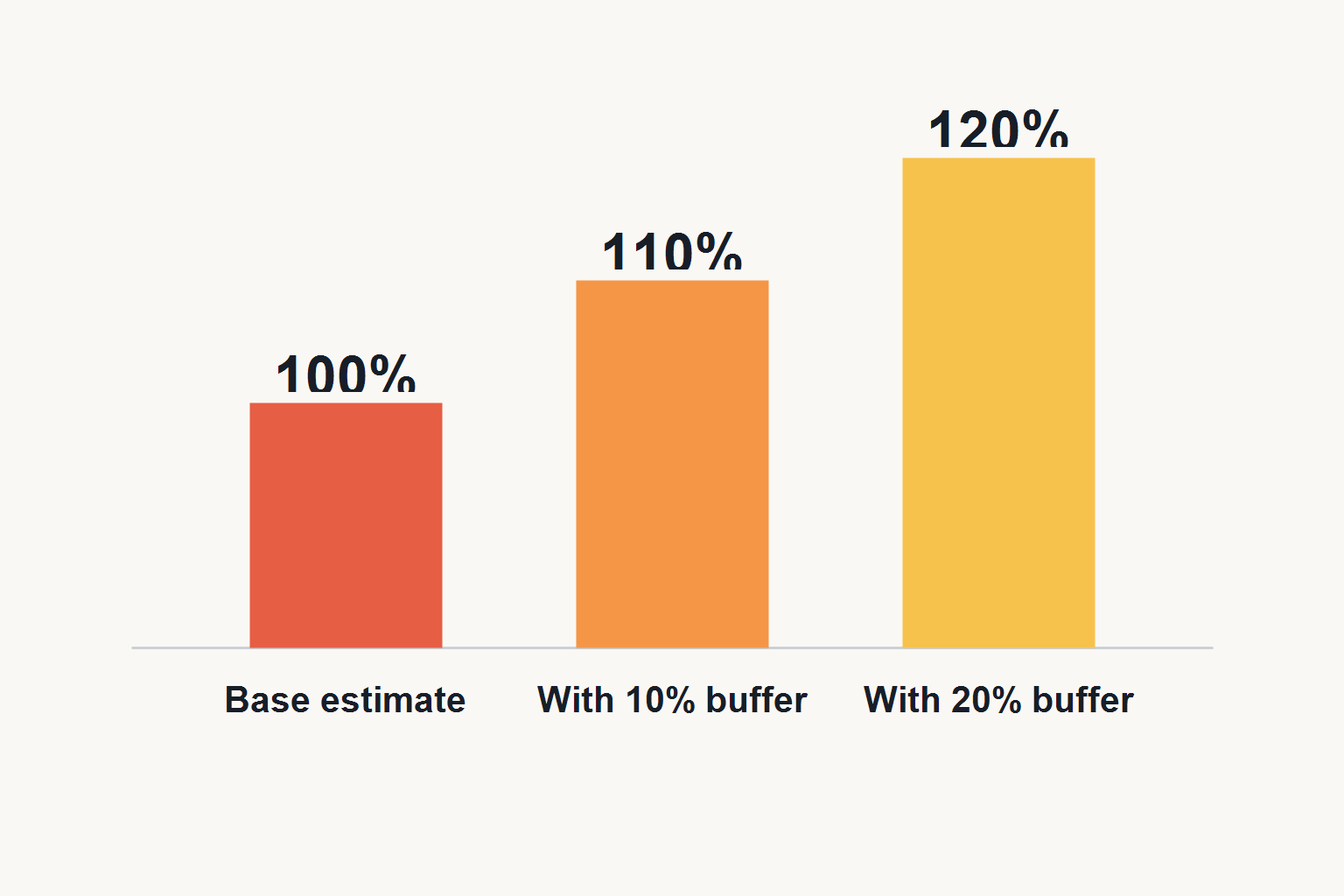
- Add a margin and risk buffer. Unclear scope, tight timelines, or a first-time client all justify a buffer of 10% to 20% on top of the base estimate.
Structuring a quote this way does two things at once. It makes the number defensible when a client asks "why does this cost this much," because you can point to specific tasks rather than a single lump figure. And it sharply reduces revision disputes later, because the scope was itemized before anyone signed, not negotiated loosely after the fact.
The Roadbase brief-to-quote workflow can be a practical starting point: Roadbase turns creative briefs into scoped projects, estimates, and trackable delivery plans. The same logic applies to pricing that accounts for genuine project risk, which matters most on unfamiliar client relationships or first-time deliverable types where your usual estimate might not hold.
Pro Tip: Build a task template once for each deliverable type you quote often (sales page, email sequence, landing page) and reuse it every time. You'll quote faster, and clients will notice the consistency between your proposals.
If you present pricing in tables rather than a single number, structure matters. Well-built proposal pricing tables break scope into visible line items, which tends to reduce the "can you just lower it a bit" negotiation reflex, since the client can see exactly what would need to come off the table to change the price.
A Pragmatic Path for Pricing Copy in 2026
The rate anchors in this guide are a starting point, not a script. The writers who move up a band fastest are the ones who treat pricing as something to test, not something to memorize. Quote a new client 15% above your usual rate, document what happens to the close rate, and adjust from there. That's a faster path to real market data than any rate survey.
Specialization compounds this. Every project in your chosen niche, even a modest one, is a data point you can use in the next pitch. Build the habit of asking for a result, a number, anything measurable, before the engagement ends. That single habit, repeated across a dozen projects, does more for your rate than any negotiation script.
Use the brief checklist earlier in this guide on your next quote, even if the client hasn't asked for that level of structure. Clients who see a itemized, well-reasoned proposal tend to push back on price less, not more, because the number finally looks earned rather than pulled from a rate card.
-- Nicolas Robertson
A Faster Way to Turn Your Rates Into Real Proposals
Roadbase turns creative briefs into scoped projects, estimates, and trackable delivery plans. If you have a brief to price, start a Roadbase proposal and give yourself a clear basis for the next client conversation.
Where These Rate Figures Come From
The pricing anchors throughout this guide draw on four industry sources, each covering a different angle of the market. Mediabistro's employer-facing pricing survey supplies the per-word averages and niche premium percentages, since it's built from what companies actually report paying. Rob Palmer's 2026 rate breakdown provides the deliverable-specific project ranges for sales pages, VSLs, and email sequences, along with the ROI framing used to justify higher fees. AWAI's State of the Industry report backs the long-form fee ranges and the case for retainer and project-based pricing over hourly billing. Upwork's hiring data rounds it out with marketplace hourly medians, useful for clients budgeting against a broader hiring pool rather than specialist direct-response rates.
Sources
- Freelance Copywriter Rates: What Employers Actually Pay in 2026
- Copywriting Rates 2026: What Every Project Type Costs | Rob Palmer
- State of the Industry 2026: Copywriter Rates, Marketing Stats
FAQ
Is Copywriting Still Worth It in 2026?
Yes. Persuasive, conversion-focused copy still commands project fees in the thousands, and specialists in niches like SaaS or financial services see premiums of 20% to 40% over generalist rates, a gap that's grown rather than shrunk as buyers get pickier about who they hire.
How Much Should I Charge for 1,000 Words?
For standard content writing, professional per-word averages sit around $0.70 per word, and blog-style content from a generalist often runs lower, $50 to $150 per post for junior writers and $150 to $400 for a mid-level specialist.
Is AI Going to Replace Copywriters?
AI tools speed up drafting and research, but the strategic thinking behind high-converting sales pages and VSLs, the part clients actually pay premium rates for, still depends on a copywriter's judgment about audience and offer. Roadbase turns creative briefs into scoped projects, estimates, and trackable delivery plans; the persuasive work still depends on the copywriter's judgment about audience and offer.
Should I Ever Use Hourly Billing for Copywriting?
Hourly billing still makes sense for editing, consulting, or projects with genuinely unclear scope, but it tends to underpay experienced writers on persuasive work since per-project pricing rewards efficiency instead of penalizing it.