

12 Creative Brief Questions Every Marketer Needs
A creative brief can be shaped around different processes. These twelve questions provide a practical checklist before kickoff:
- Objective: What problem does this project solve, and what does winning look like?
- Audience: Who exactly are we talking to?
- Key message: What's the one thing they should walk away thinking?
- Tone: How should this feel, in three words or fewer?
- Deliverables/specs: What formats, sizes, and file types are required?
- Timeline: When does this launch, and what are the hard milestones?
- Budget: What's the range, and is it fixed or flexible?
- Success metrics: How will we know this worked?
- Stakeholders/approvers: Who signs off, and who just weighs in?
- Distribution: Where will this actually run?
- Constraints: What's off limits, legally or creatively?
- Assets on hand: What existing materials do we need to reference or reuse?
Table of Contents
- What a Creative Brief Actually Does
- Breaking Down Every Creative Brief Question
- A Fillable Creative Brief Template You Can Use Today
- Best Practices That Separate Strong Briefs From Weak Ones
- Running a Brief Workshop That Gets Real Answers
- Turning Brief Answers Into a Scoped Project
- The One-Page Brief QA Checklist
- A Pattern to Watch For
- Turn Answered Briefs Into Priced Proposals Faster
- Templates and Checklists Worth Bookmarking
- Sources
- FAQ
What a Creative Brief Actually Does
A creative brief is a short document that records a project's mission, goals, challenges, audience, messaging, and distribution plan. It can give the client, creative lead, and account manager a shared starting point before design begins. HubSpot's creative-brief guidance provides one example of that structure.
When the objective and decision-makers are recorded before work starts, the team has a clearer basis for reviewing later choices.
Breaking Down Every Creative Brief Question
Group related questions for contextual discussion.
Project foundations
- What's the objective? State a primary objective and priority.
- What problem are we solving? Ask what changes if work does not ship.
- What's the background? Prior campaigns, past attempts, internal politics worth knowing before you pitch a direction.
Audience and insight
- Who exactly are we reaching? Name a specific audience/situation.
- What do they currently believe? Record misconceptions.
- What's the insight that makes this land? A tension, frustration, or desire your creative can lean into.
Message and tone
- What's the single key message? Write the key message in one sentence.
- What tone fits? Use three positive/three avoided tone adjectives.
- What's the call to action? Name the intended action.
Execution and deliverables
- What exactly are we producing? List formats, dimensions, page counts, video length, file types.
- Where does this run? A billboard headline and an Instagram caption are not the same writing problem.
- What assets exist already? Logos, brand guidelines, past creative, product photography.
Constraints and success
- What's the budget? Record a budget range if final budget is unset.
- What's the deadline, and is it real? Record which of timeline/quality is fixed.
- How will we measure success? Ask for one primary KPI.
- Who approves this? Name the person, not the department.
Example short answers, for calibration:
Objective: "Drive 200 qualified demo requests from mid-market operations managers in Q2."
Tone: "Confident and plainspoken. Not corporate, not cute."
Pro Tip: Ask for one primary KPI.
Pro Tip: Record which of timeline/quality is fixed.
Canva's brief guidance is one example of framing that decision.
A Fillable Creative Brief Template You Can Use Today
Copy the questions above into a document or intake form, with space for an answer below each one. That gives the team a simple fillable brief to review together.
Best Practices That Separate Strong Briefs From Weak Ones
Good briefs share habits. Weak ones share excuses.
- State one objective, never a list of goals competing for priority.
- Make success measurable: a number, not a feeling.
- Name the approver, not "marketing" or "the client."
- Include what's explicitly excluded, not just what's included.
- Attach existing assets instead of describing them from memory.
- Keep the document as short as practical while retaining the decisions the team needs.
- Specify format and file specs, not just "make some social posts."
- Separate a hard deadline from a preferred one.
Vague: "Target young professionals." Specific: "Renters aged 25 to 34 in their first apartment search, price sensitive, comparison shopping."
Vague: "Improve brand awareness."
Review the brief for completeness and feasibility before work starts. CheckFlow's checklist is one possible starting point for that review.
Running a Brief Workshop That Gets Real Answers
A short workshop can give the requester, approver, and creative lead time to resolve unclear answers together.
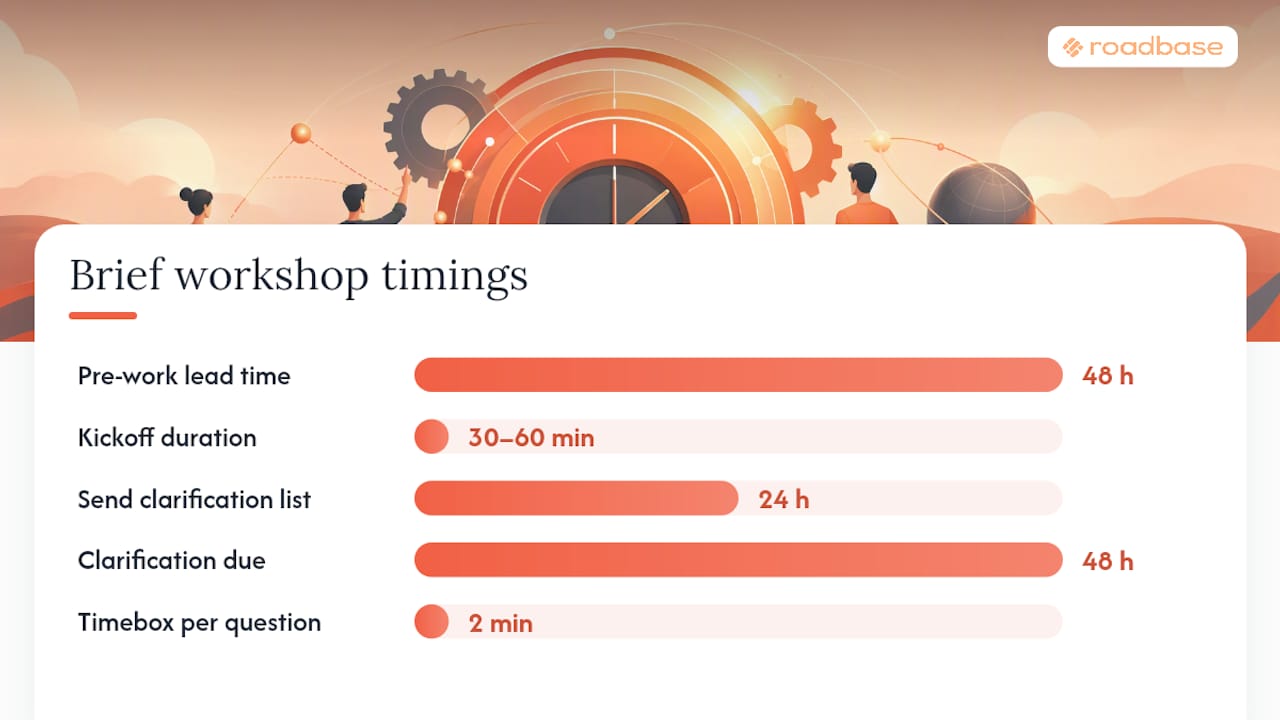
- Pre-work: Send the template 48 hours ahead. Ask the requester to fill what they can before the room fills up.
- Kickoff (30 to 60 minutes): Walk the template field by field. Don't move past a vague answer, push for specificity in the room.
- Follow-up: Compile every unanswered or fuzzy item into one clarification list, sent within 24 hours, due back within 48.
Invite the requester (owns the objective and budget), the approver (confirms sign-off authority), and the creative lead (flags feasibility issues early). Skip anyone who can't answer a direct question about scope.
Pro Tip: Timebox each question to two minutes. If nobody can answer in that window, it's a clarification item, not a stalled meeting.
Keep one running clarification list so the team can see what still needs an answer. HubSpot's brief guidance includes a related example.
Turning Brief Answers Into a Scoped Project
A finished brief gives a scope of work a starting point, but it does not replace a scope. Confirm deliverables, revision boundaries, dependencies, assumptions, and approval ownership before estimating. For the separate detailed workflow, see how to turn a creative brief into a scope of work and quote.
Pro Tip: If the requester can't answer budget, timeline reasoning, or who signs off, that's a risk finding, not a missing checkbox. Recommend a undefined before quoting, rather than guessing.

The One-Page Brief QA Checklist
Before accepting a brief into production, confirm:
- [ ] Objective stated as one goal, not a list
- [ ] Audience specific enough to write for
- [ ] Key message fits in one sentence
- [ ] Deliverables include formats and specs
- [ ] Budget stated, even as a range
- [ ] Approver named by person, not department
Red flags that should stop work: no budget listed, no named approver, conflicting deadlines from different stakeholders, or a success metric nobody can measure.
A Pattern to Watch For
A brief is easier to review when it identifies an approver and a concrete success measure. Those details give the team a clear decision path before production begins.
Turn Answered Briefs Into Priced Proposals Faster
Roadbase helps turn a real brief, notes, or PDF into a reviewable project plan and quote. Paste the brief or attach a PDF to generate an editable first draft of phases, tasks or milestones, roles, estimated hours, timing, and estimate reasoning. Shape the plan around your rates, costs, overhead, direct expenses, contingency, and target margin, then export the reviewed plan and quote as a proposal PDF.
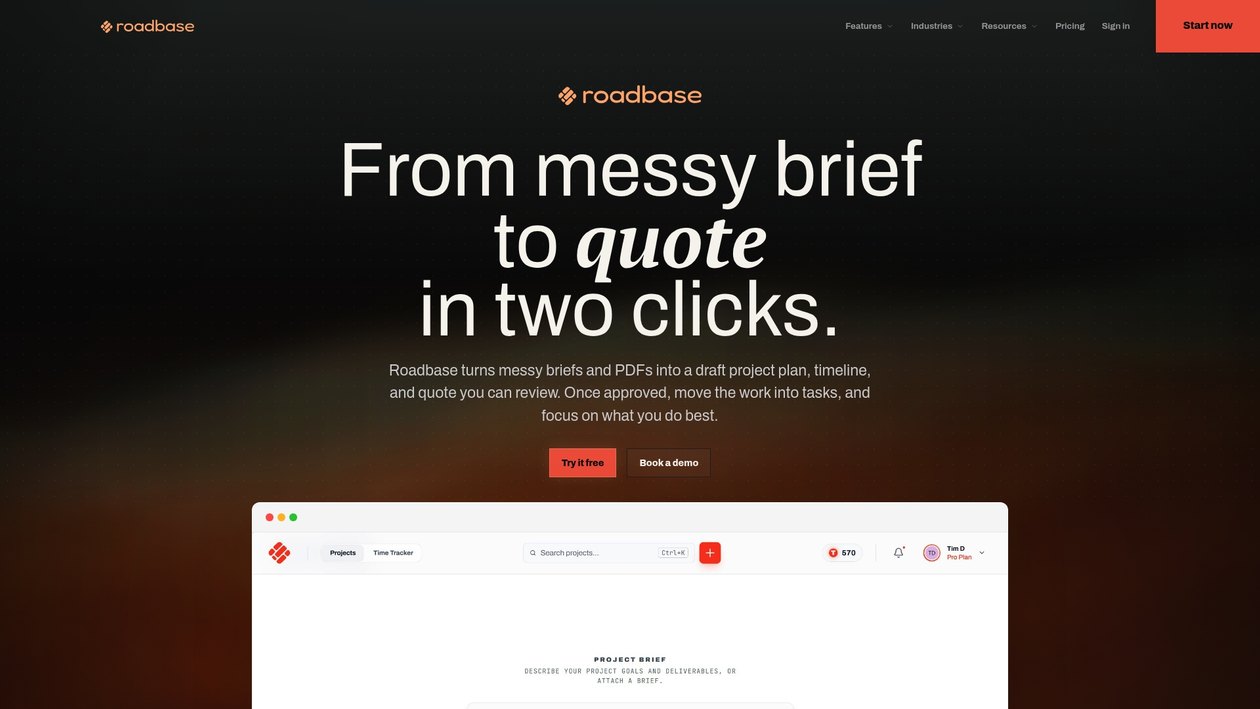
If you're a freelancer or small creative team with a filled brief, Roadbase's freelancer tools give you a practical place to turn it into a draft plan and quote for review before you send it.
Templates and Checklists Worth Bookmarking
- Creative brief intake checklist, for gating incomplete briefs
- HubSpot's brief templates and examples, for step-by-step brief writing
- Client approval workflow tools, for managing sign-off after the brief stage
Sources
- How to Write a Creative Brief in 11 Simple Steps Examples + Templates
- Creative Brief Intake Checklist Template | CheckFlow
- How to Write a Creative Brief (Example and Templates) - Canva
FAQ
What Is an Example of a Creative Brief?
A filled example includes a stated objective ("drive 200 demo requests"), a specific audience, a one-sentence key message, listed deliverables with specs, a budget range, and a named approver, all fitting on one or two pages.
What Are the Main Specifications a Design Brief Should Include?
A design brief typically covers objective, audience, key message, tone, deliverables and file specs, timeline, budget, and the approver, with distribution and success metrics rounding out a complete version.
What Makes a Strong Creative Brief?
A strong brief states one measurable objective, describes a specific audience instead of a demographic label, and names an approver by person, all in a document short enough to actually get read.
What Are Some Good Client Discovery Questions to Ask Before Quoting?
Ask what success looks like and what happens if the project doesn't happen at all. Those two questions surface real constraints and budget reality faster than a long intake form.
Who Should Fill Out a Creative Brief?
The requester or client stakeholder fills out the brief with input from the creative lead, and a project manager or account lead reviews it for completeness before it's accepted into production.