

Dynamic Project Pricing: How to Quote Work That Changes
A useful project quote shows what the client is buying and what would need another conversation if the work changes. For a freelancer or small studio, that means naming the deliverables, roles, hours, assumptions, and price before the first revision request arrives. You can update your internal estimate as you learn more, then offer a revised quote when a change is outside the agreed work.
Here, "dynamic project pricing" is shorthand for that reviewable process. It is different from retail prices that shift with demand. It is also unrelated to Microsoft Dynamics software licensing. The price the client agreed to does not move by itself when your hours or costs change.
TL;DR
- Build the quote from a clear scope, roles, hours, costs, and a target margin, then review any proposed change with the client.
- Use a defined base subtotal for a percentage fee if that fee genuinely tracks the work. Keep fixed commitments fixed until an agreed change.
- Price a discovery phase when the brief is too uncertain for a credible full-project quote.
- Set one internal allowance for foreseeable delivery risk. Price new client-requested work through a change request rather than burying it in a second reserve.
- Compare tracked hours with estimates so the next quote benefits from what actually happened.
Table of Contents
- What dynamic project pricing actually means
- What it is not: a note on Dynamics 365 and retail pricing
- The building blocks of a dynamic quote
- Which line items should scale, and which should not
- Match the pricing model to the uncertainty
- Build the buffer, then keep it internal
- Use change requests as the dynamic part
- Feed real project data back into the next quote
- Where spreadsheets stop working
- Our perspective
- Try it on your next brief
- A practical checklist before you send the quote
- FAQ
- Sources
What dynamic project pricing actually means
A bare quote might say, "Website redesign, $12,000." A more useful one shows the phases, deliverables, roles, estimated hours, and assumptions behind that number. If the client later adds pages or integrations, both sides can see what changed and discuss the extra work before the fee changes.
Two related ideas help here.
A calculated item within a proposal. Some proposal tools recalculate a percentage line as its defined base changes. Portal's help center describes dynamic pricing on proposals using a percentage item tied to a proposal or area total. If coordination is 10% of an agreed $10,000 base subtotal, its amount is $1,000. Define that subtotal to exclude the coordination line itself; otherwise the calculation is circular. Whether a fee should be a percentage at all depends on the work, and any revised client total still needs review and agreement.
An updated forecast during delivery. As hours and remaining tasks become clearer, update your internal view of cost and time. Smartsheet's resource-management guidance discusses scheduled work, reported hours, and forecast review. An internal forecast helps you manage the project; it does not alter the client's agreed price.
The point is to make uncertainty visible in the estimate and give changes an orderly path. A simple, stable job may need no more than a fixed quote and a spreadsheet.
What it is not: a note on Dynamics 365 and retail pricing
Microsoft Dynamics 365 is a software product line with its own licensing and implementation costs. That is a separate topic; this third-party overview of Dynamics 365 implementation costs is further context, not a price benchmark for creative work.
Retail dynamic pricing adjusts product prices in response to factors such as demand or inventory. A custom project has a negotiated scope and a particular client. Here the useful variables are the work, its assumptions, the cost of doing it, and what the client agrees to change.
The building blocks of a dynamic quote
A quote that can be reviewed when work changes needs a structure underneath it. Start with five blocks.
- Phases. Break the work into stages that fit the brief: perhaps discovery, concept work, production, review, and delivery. Name each stage's output so you can discuss a change without reopening every part of the job.
- Roles and hours. Estimate who will do the work and how much time each task needs. A designer's hours and a producer's hours may carry different internal costs and bill rates.
- Rates built from cost. Work from actual labor cost, realistic billable hours, overhead, and the margin you need. Smartsheet gives 50% to 75% utilization as contextual guidance and discusses a 3-to-5 multiplier on an hourly rate. Those are its broad ranges, not targets every creative studio should adopt; the multiplier is not automatically a multiplier on fully burdened cost.
- Risk and contingency. Make an estimating allowance for defined uncertainties in the agreed work. Keep it distinct from pricing new deliverables that a client may request later.
- Margin. Check the quote against a stated cost basis. Smartsheet's 15% to 25% profit goal is another contextual range, not a universal target. Your own costs and commercial judgment set the number.
Put these assumptions together where you can inspect them. If the hours are in one file, the rate card in another, and the risk in someone's memory, even a small revision takes unnecessary reconstruction.
Which line items should scale, and which should not
Choose each rule because it reflects the work. A quote in which every line floats gives the client little to approve.
| Line item | Possible behavior | Why |
|---|---|---|
| Project management and coordination | Percentage of a stated base subtotal, when coordination really follows project size | The base excludes this percentage item itself |
| QA and testing | Re-estimate by deliverable or testing effort | Added items may need different levels of checking |
| Core design or build work | Fixed for an agreed phase; revisit through a change request | The client can approve a defined commitment |
| Revision rounds | Include a stated number; agree on added work separately | Feedback has a clear boundary |
| Third-party costs and expenses | Estimate known costs and specify how changes will be handled | Supplier costs can differ from the first estimate |
| Risk allowance | One internal amount based on defined delivery uncertainty | It informs the price decision without funding unapproved scope |
Portal's percentage-item example shows how a calculated fee can follow a defined base. It does not mean that QA, expenses, or risk should automatically use the same formula.
Match the pricing model to the uncertainty
Dynamic project pricing does not require one fee model. Pick a structure that fits what you know.
- Clear, low-risk scope: a fixed price can give both sides a useful commitment.
- Open-ended advisory or troubleshooting: an hourly or day rate can fit work whose endpoint is not yet clear.
- A knowable first stage and uncertain later work: price discovery, then quote the next stage with better information.
For AI automation work, Innovatrix describes a one-to-two-week discovery sprint followed by defined build sprints. That is one agency's staging approach, not a rule for every studio. Dev to Agency describes its own fixed-price plus time-and-materials hybrid as another way to handle defined work and uncertainty.
We go deeper on this choice in fixed price vs hourly for freelancers, including the role of discovery.
If you sell recurring or staged services, the same question applies: what can be bounded now, and what needs a later decision? A layered 60-day pilot for link building is an example of a first stage followed by a choice about scale. State how the next stage will be quoted rather than assuming the first fee extends automatically.
Build the buffer, then keep it internal
An estimate has uncertainty even when the agreed deliverables are clear. An internal allowance can help you decide what price makes the work viable. It is one assumption within that price, not a separate pot that permits extra client work without agreement. One practitioner discusses 10% to 20% technical and enhancement allowances in its own practice; those figures are not a universal band or a reason to stack two hidden reserves. If uncertainty is too large to estimate, the Innovatrix discovery-first approach offers a way to define a later stage before quoting it.
Here is an illustrative brand website quote, using one allowance and distinguishing internal cost from bill rate.
Example: 120 hours of agreed base work
- Estimated internal labor cost: 120 hours x $50 per hour = $6,000.
- Base labor value at a $90 blended bill rate: 120 hours x $90 = $10,800.
- One internal delivery-risk allowance: 10% of the $6,000 labor-cost base = $600 of potential additional cost.
- Planned cost including that allowance: $6,600. A $10,800 quote would leave $4,200 planned gross profit, or about 38.9% of the quoted price, before any other project costs or overhead not already in the $50 cost rate.
The $600 is a cost assumption, not a $600 client line item or guaranteed margin. If risk work never occurs, actual profit depends on actual costs. If the client asks for another page or revision round outside the baseline, estimate that addition and seek agreement on the changed scope and price.
Use change requests as the dynamic part
The client-facing change happens through a clear conversation and decision. A practical four-step process is:
- Name the baseline. List deliverables, assumptions, inputs, and included revision rounds in the proposal so both sides know what the price covers.
- Record the request. When new work appears, describe it and check its effect on time, roles, expenses, and delivery before starting it.
- Offer a revised quote. Reuse the original estimating structure where it fits, and explain any changed rates or assumptions. A new internal forecast alone does not change the agreed fee.
- Get agreement. Ask the client to approve the added work, price, and schedule impact before treating it as part of the job.
This follows the useful sequence of recording, evaluating, and deciding on a change. Crema describes up-front price clarity in its own duration-based model. Its approach is one option for longer engagements, not evidence that clients generally accept a changing price.
Feed real project data back into the next quote
During the project, compare recorded hours with the estimate by task or role. An overrun may come from an estimating miss, a delivery problem, or approved extra work; those causes lead to different decisions. Review actual costs as well if you want to know the real margin.
After the project, ask:
- Which phases took more time than estimated, and by how much?
- Was the extra work inside the original scope or agreed later?
- Did the internal allowance cover the delivery uncertainty it was meant to cover?
- What did actual costs and revenue say about the margin?
Use relevant findings to revise your next estimate. They do not automatically revise this client's fee. For field-specific examples, see web design pricing, motion design pricing, and UX design pricing. For the cost calculation, see project margin for small agencies.
Where spreadsheets stop working
A well-built spreadsheet can hold a rate card, hours, cost assumptions, and a margin check. For a small, stable job, that may be all you need.
It takes more effort when:
- you quote several projects and copy formulas between files;
- a changed assumption has to be traced across tabs;
- time is recorded elsewhere and never reaches the next estimate;
- the client-ready proposal has to be assembled separately.
We explore that tipping point in creative project pricing beyond spreadsheets. The decision is about whether you can keep the work, its assumptions, and the quote easy to review.
Our perspective
For many creative teams, the hard part of quoting is turning a messy brief into a useful plan. A client may send notes and a PDF with incomplete deliverables or unanswered questions. The team still has to identify phases, tasks, roles, estimated hours, expenses, and the assumptions behind a price.
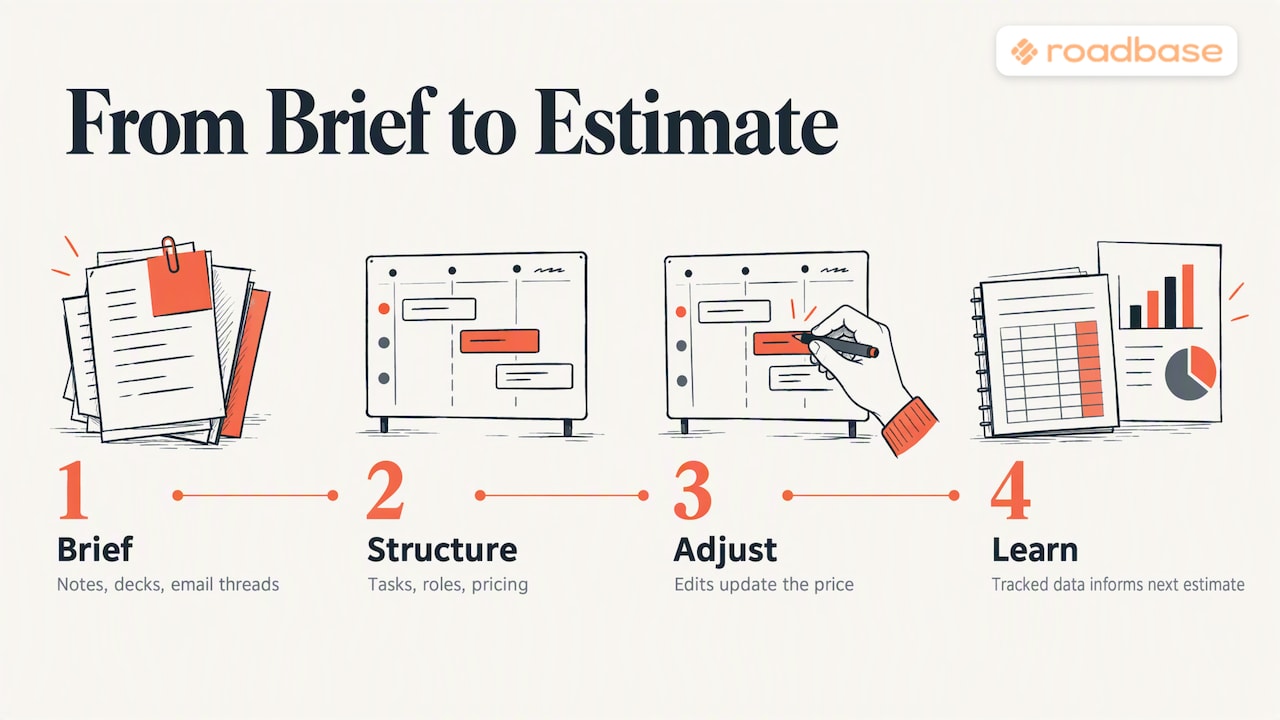
Roadbase lets you paste a brief or attach a PDF, then creates an editable first draft of phases, tasks, roles, hours, and timing. You can review and adjust that plan, supply role costs and bill rates, and inspect labor, overhead, expenses, contingency, target margin, and the quote alongside the visual timeline. The inputs and final judgment are yours.
Once work begins, tracked task hours can be compared with estimated hours. Relevant estimate-versus-actual history can inform a later draft by role when enough correctly linked data exists. That gives the next quote a more useful starting point; it does not change the fee already agreed with this client.
Try it on your next brief
Have a real brief or PDF ready? Bring it into Roadbase, review the draft phases, roles, hours, and quote, then export the plan you are happy with as a proposal PDF. See the plans and pricing for the current options, or follow our six-step AI project scoping playbook to prepare the brief. Explore Roadbase when you are ready to put the next quote together.
A practical checklist before you send the quote
- Is each phase clear about its deliverables, roles, and estimated hours?
- Does the bill rate reflect your costs, realistic billable time, overhead, and target margin?
- Have you stated the base for any percentage fee and kept it free of circular items?
- Is the internal risk allowance tied to defined uncertainty rather than unapproved extra scope?
- Does the proposal state assumptions, included revisions, and how additional work will be agreed?
- Can you explain and recalculate a proposed change before asking the client to approve it?
A client can approve a clear baseline. If that baseline changes, show the effect and get agreement on the revision.
FAQ
Is dynamic project pricing the same as dynamic pricing in marketing?
No. Retail or marketing dynamic pricing can change a product's price with demand, inventory, or competitors. Here, the term means a project quote built from visible work and assumptions, with a reviewed change process when the agreed scope changes.
Will clients accept a price that can change?
Acceptance depends on the client and the proposed change. Give them a defined baseline, explain the added work and its price, and ask for agreement before proceeding. Your internal hours or risk forecast does not change their fee automatically.
How much contingency should I add to a quote?
Choose one allowance from the specific delivery risks and your own cost history. A practitioner's 10% to 20% range is its own rough practice, not a universal percentage. Keep client-requested additions separate and agree their scope and price. The Innovatrix staged-service example is useful for reducing uncertainty through discovery, not for setting a contingency percentage.
Do I need software for dynamic proposals?
No. A careful spreadsheet can support a simple quote. A planning and quoting tool can help when several phases, roles, expenses, and revisions make the assumptions harder to maintain, or when you want to compare tracked task hours with estimates and export a proposal PDF.
Sources
- Dynamic Pricing on Proposals, Portal Help Center
- Best practices with Resource Management, Smartsheet Learning Center
- AI Automation Agency Pricing: How to Price & Sell (2026), Innovatrix Infotech
- Pricing: fixed price + T&M hybrid, Dev to Agency
- The Long-Term Benefits of Transparent Pricing, Crema
- How Much Does Microsoft Dynamics 365 Implementation Really Cost in 2026?, MS Dynamics World