

Project Margin for Small Agencies: Track Costs Through 10% Discounts

Project margin is (revenue minus the costs you choose to include) divided by revenue, times 100. It tells you how much of a project's price remains after those costs. A $25,000 project with $18,000 in delivery costs leaves $7,000 in gross profit, a 28% project delivery margin. That number is useful before you quote and while you deliver, as long as you keep the cost boundary consistent.
TL;DR:
- Name the cost basis each time you compare project margins. Delivery margin and a measure that also allocates general overhead answer different questions.
- Count project labor, subcontractors, direct expenses, and support caused by the job once. Match reimbursed costs with the corresponding revenue.
- In the example below, a 10% discount takes margin from 30% to 22.22%. Adding 20 unplanned hours to that discounted job takes it to 12.96%.
- Review the price, remaining work, and cost assumptions as the project changes. Choose a review rhythm and trigger that fit its pace and risk.
- Work backward from a target margin to test a quote, then check the scope and assumptions before you send it.
Table of Contents
- Which Margin Should You Be Tracking?
- How to Calculate Project Margin Step by Step
- What Actually Counts as a Delivery Cost
- Running Margin as a Live Signal, Not a Postmortem
- Mistakes That Quietly Inflate Your Margin
- Benchmarks and Turning Margin Targets Into Rates
- Why Margin Discipline Beats Margin Guesswork
- Review a Project Quote With Roadbase
- FAQ
- Sources
Which Margin Should You Be Tracking?
The word "margin" gets used loosely. Before you compare two jobs, check what each number counts.
Project delivery margin is project revenue minus the costs of doing that job, divided by project revenue. Include the labor, subcontractors, expenses, and project-induced support in your stated cost basis. It helps you test a bid and see how delivery changes the picture.
Overhead-adjusted margin also allocates a share of general business costs, such as office rent or administration. The allocation method can vary, so write down the method when you use it. Firm net margin looks across the business after its wider expenses. Neither is interchangeable with one project's delivery margin.
For a quote, start with a clear project cost basis, then separately ask whether the resulting price contributes enough to general overhead and the business. Keep those labels consistent in your spreadsheet and proposal. If the difference between margin and markup is still slippery, see our guide to markup formulas.
How to Calculate Project Margin Step by Step
The arithmetic is short. The harder part is deciding which revenue and costs belong in the same scenario.
Step 1: Set the revenue assumption. Before a contract is signed, use the price you plan to quote and label it as a scenario. Once agreed, use the contracted price including agreed changes and discounts.
Step 2: Total the costs in your chosen basis. Include the project-specific labor, subcontractors, software, materials, travel, and support you identified. Count each item once.
Step 3: Subtract costs from revenue. The result is gross profit in dollars for that cost basis.
Step 4: Divide that gross profit by revenue and multiply by 100. That is the project margin percentage.
Suppose you quote a brand identity project at $18,000. Fully loaded design hours, a freelance illustrator, and stock licensing add up to $12,600. Gross profit is $5,400, so margin is $5,400 / $18,000 = 30%.
Now test the same job in sequence. A 10% discount reduces revenue to $16,200 while cost stays at $12,600. Gross profit becomes $3,600 and margin is 22.22%. If the discounted job then needs 20 more hours at a $75 loaded cost per hour, add $1,500 to that scenario's cost. Cost becomes $14,100; gross profit is $2,100; margin is 12.96% ($2,100 / $16,200). Keep the discounted price in that final calculation. Changing the revenue baseline halfway through would answer a different question.
A spreadsheet can track this with revenue, cost categories, a total cost cell, and =(Revenue-Costs)/Revenue. Our freelance margin calculator is another way to work through the formula.
What Actually Counts as a Delivery Cost
Missing an activity or underestimating its duration can make a bid's cost basis too low. Project management guidance distinguishes direct costs, overhead caused by a project, and general administrative costs. Use that distinction to build a cost list you can actually review:
- Direct labor. Estimate the hours for each role and apply the internal cost you intend to use. For employees, a loaded rate may include pay, payroll costs, benefits, and an allocation for paid nonbillable time. For your own work, choose and state a consistent cost assumption rather than treating your hours as free.
- Subcontractor and freelancer fees. Use expected fees for the work described, then revise them if the brief or supplier quote changes.
- Project-specific software, licenses, and materials. Include purchases or usage that this job causes. Do not automatically charge an entire shared subscription to one project.
- Travel and client expenses. Add the expenses the work requires, including any costs you intend to pass through.
- Reimbursed costs. If a client reimburses an expense, include the expense in costs and the matching reimbursement in revenue when you calculate margin. Leaving either side out distorts the ratio.
- Project-induced support. Count project management time or other support required for this job. Keep general office overhead separate unless you explicitly choose an allocated-overhead measure.
- A chosen contingency. Add a reserve for identified uncertainty, such as unclear review rounds or supplier pricing, and state the assumption. Its size should follow the job's risks rather than a universal percentage.
Practical habit: Keep the loaded-rate assumptions beside the quote, with a date and a reason to revisit them. Then you can see which cost changed instead of reconstructing an old bid from memory.
Running Margin as a Live Signal, Not a Postmortem
Margin is more useful while there is still work to plan. Recalculate it when the contracted price, remaining hours, subcontractor fees, or expenses change. Keep the inputs simple:
- Current revenue: the agreed price after discounts and approved changes, plus any reimbursed revenue included in your cost basis.
- Current cost assumptions: loaded labor costs and the project expenses you chose to count.
- Work done and work left: actual hours and expenses to date, plus an estimate for the remaining delivery. Recorded time alone cannot tell you the final cost.
Choose a review rhythm that suits the project. A short motion job with tight approval windows may need a check at each handoff; a longer engagement may use a regular review. You can also choose a margin-change trigger in advance and label it as your own decision rule. When the figure moves, inspect the remaining scope and costs, then discuss an agreed change where the work has changed. It is a prompt to make a decision, not a fix by itself. For a broader small-team view, see our guide to KPIs into agency tracking. Operational guidance on projected margin offers an additional commercial perspective on monitoring; the calculation here uses the stated inputs above.
Mistakes That Quietly Inflate Your Margin
An incomplete input can make the calculation look reassuring even when the formula is right.
- Using base pay as the whole labor cost. That may omit payroll costs, benefits, and paid nonbillable time. State how you built your loaded rate.
- Counting a reimbursed expense on only one side. Include its cost and the matching reimbursement in revenue. Margin is measured against price, so changing either side changes the ratio.
- Comparing different cost bases. A delivery margin and an overhead-adjusted margin should carry different labels.
- Forgetting work likely to be needed. Revisions, production coordination, and supplier handoffs can take hours even when they are not individually billed.
Before sending a bid, check the role costs, expected expenses, contingency assumption, scope boundaries, and revision process. If projected margin changes during delivery, first find the changed input. Then revisit the work remaining, the way it is staffed, or a proposed change with the client. A cheaper assignment only helps if it still suits the work and the agreement.
Benchmarks and Turning Margin Targets Into Rates
The 2026 SPI Professional Services Maturity Benchmark, as summarized by sponsor Deltek's benchmark data, reports project margin of 37.7% in 2025, up from 35.9% in 2024 for its surveyed professional-services firms. That is context for a different mix of businesses, not a target band for a creative freelancer or small studio. Your own cost basis, market, risk, and capacity matter more to a particular quote.
To test a margin target, work backward from cost. With $14,000 in your stated delivery costs and a 35% target, divide by 0.65: $14,000 / 0.65 = $21,538.46. If quoting whole dollars and you want to clear 35%, round up to $21,539. That is a calculation from the chosen assumptions, not a verdict on what the client will accept. Check the scope and price together before deciding what to quote.
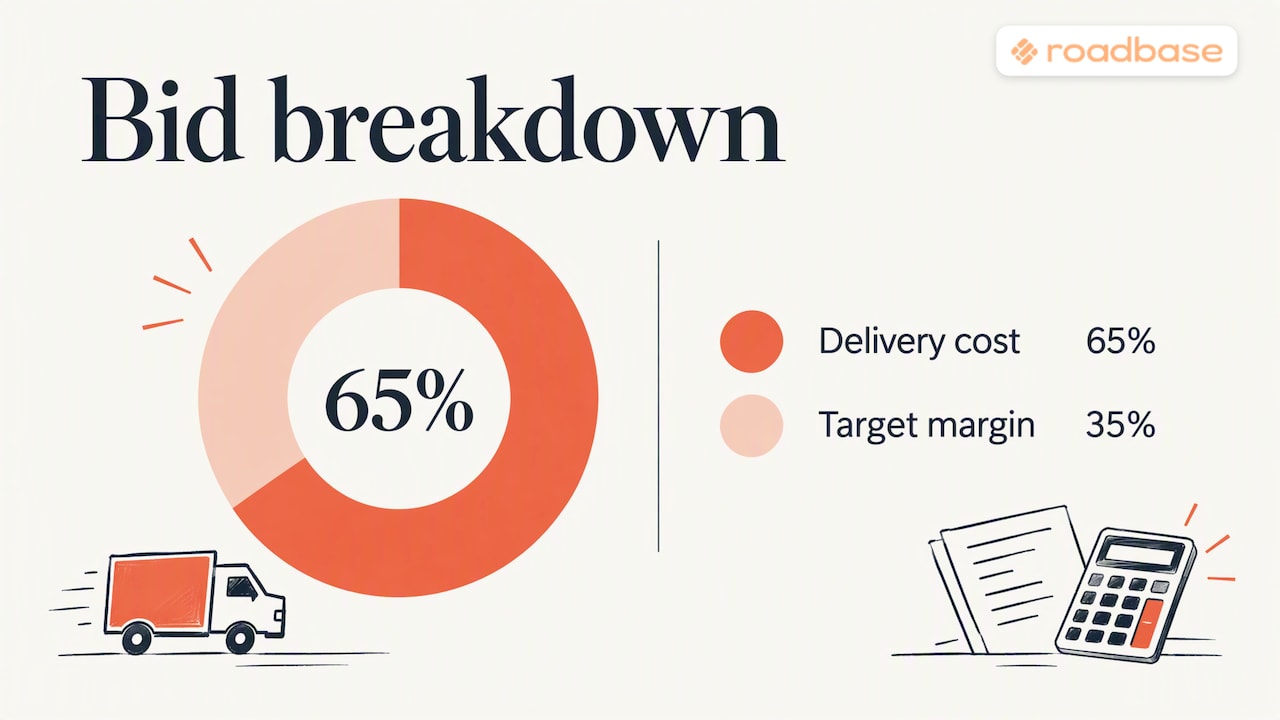
For work with uncertain revisions or outside production costs, write down a pricing floor and the assumptions behind it. If those assumptions change, recalculate. Teams exploring longer-term pricing and cost practices can also look at gross margin improvement programs as optional commercial reading; they do not establish a project margin target for this quote.
Why Margin Discipline Beats Margin Guesswork
A bid gives you one opportunity to check the numbers before the client sees a price. Start with the work in the brief, cost the roles and expenses needed to deliver it, and compare the resulting margin with your own target. Then carry the same cost definitions into delivery so later comparisons mean the same thing.
That small amount of bookkeeping also makes a change conversation clearer. If a second concept round adds design hours, you can show which assumption moved and what it does to the remaining budget. It gives you a basis for discussing scope and price while there is still a decision to make.
Review a Project Quote With Roadbase
Have a real client brief, notes, or a PDF to price? Start a draft plan in Roadbase: paste the brief or attach the PDF to make an editable first draft of phases, tasks, roles, hours, and timing. Review it against the actual work, then adjust the plan and quote.
Use your own role costs and rates to review labor, overhead, direct expenses, contingency, and target margin behind the quote. When the plan and price are ready, export the reviewed proposal PDF. During delivery, you can track time against a project or task and compare recorded task hours with the estimate. See current pricing for the available plans, or Visit Roadbase to learn more.
FAQ
How do you calculate a 30% profit margin?
Divide your stated cost by 0.70 to find the price for a 30% margin. If delivery costs are $14,000, the price is $14,000 / 0.70 = $20,000. Gross profit is $6,000, and $6,000 / $20,000 = 30%. Check what is included in the $14,000 before using the result in a quote.
How do I calculate the selling price of a product or project?
Start with the costs you intend the price to cover. Divide that cost by (1 minus your target margin as a decimal). For example, a 35% target means dividing by 0.65. Then review the scope, risk, and market before deciding on the quoted price.
What is a good gross margin for a project?
There is no single useful percentage for every project. Choose a target using your own cost basis, general overhead needs, delivery risk, and pricing context. The 37.7% 2025 benchmark for surveyed professional-services firms is context, not a recommended band for creative freelancers or small agencies.
How do you calculate gross margin dollars?
Subtract the costs in your stated project basis from revenue. That dollar result is gross profit; margin is that result divided by revenue, expressed as a percentage. At a $21,539 price and $14,000 cost, gross profit is $7,539 and margin is just over 35%.
Sources
- Professional Services Benchmarks - Deltek
- Project Margin Calculation: The Formula That Tells You If a Project Is Worth It - CentSight
- Project Budget Margin Calculator - CalculatorHub
- 9.1 Project Costs - Project Management, 2nd Edition