

Protect Margin: Estimate Review Checklist for Freelancers & Agencies
Run this checklist before you send any client proposal: confirm scope and deliverables are measurable, roles and hours have been considered, pricing includes a contingency buffer you can explain, and one named approver is working to a defined timeline. Attach a short change-order form so that scope changes can be discussed and priced rather than absorbed. Tools can help you turn a brief into a draft to review, but the review discipline remains the important part.
TL;DR:
- Most estimates should include a contingency buffer of 20 to 30 percent, adjusted for factors like client familiarity, scope clarity, and project complexity.
- Confirm that all deliverables are measurable, exclusions are explicit, and a clear change-order process is in place.
- Adjust timelines for brief clarity, stakeholder approval chains, and client review time so the proposed schedule is grounded in stated assumptions.
- Use a checklist to review calculations, scope, roles, and approvals before sending proposals.
- Roadbase can turn a pasted brief, notes, or PDF into an editable work breakdown and quote draft; review and adjust it before exporting a proposal PDF.
Table of Contents
- What Should Be In An Estimate Review Checklist?
- How Do You Verify Pricing And Margin Before Sending?
- What Goes Into A Scope Of Work And Change Order?
- How Do You Check Timeline And Capacity Are Realistic?
- Final Quality Check Before You Hit Send
- Common Pitfalls And Red Flags In Estimate Reviews
- Techniques For Estimating Risk And Uncertainty
- Comparison With Industry Benchmarks Or Historical Data
- Tools And Templates For Conducting Effective Estimate Reviews
- Communication Tips For Discussing Estimates With Stakeholders
- Author Perspective: Why Estimate Discipline Protects Margin
- How Roadbase Automates Your Estimate Review
- Sources
- FAQ
What Should Be In An Estimate Review Checklist?
An estimate review checklist is the set of checks you run on a proposal before it leaves your inbox, not after the client has already signed and started asking for "just one more thing." Most freelancers and small agencies skip this step because the estimate feels finished once the numbers add up. The numbers adding up is the smallest part of the job.
The checklist below groups everything into six areas. Work through them in order. Each one catches a different failure mode, and skipping one just moves the damage further down the project timeline.
Scope and deliverables
- Every deliverable is objective and measurable ("12 social posts, 1080x1080, delivered as PNG" beats "social content").
- Exclusions are written down explicitly, not implied.
- Acceptance criteria state what "done" looks like for each deliverable.
Roles, hours, and capacity
- Every task has a named owner, not a generic "team" line.
- Hours are estimated per role, not as one lump total.
- A team-capacity reality factor is considered so booked hours do not assume a full 40-hour week.
- Non-billable overhead (meetings, status updates, internal reviews) is included, not assumed away.
Pricing, margin, and contingency
- Line items are checked against the subtotal for math errors.
- A contingency percentage is applied based on real risk factors, not a flat habit number.
- An effective-hourly-rate check shows what the price represents once every hour is counted.
Timeline and decision cadence
- Milestones map to calendar time, not just execution hours.
- Expected client review turnaround is stated in the proposal itself.
- One named approver is identified before the proposal goes out.
Revision rounds and change control
- The number of included revision rounds is stated in writing.
- A short change-order form is attached and referenced in the proposal text.
Final quality checks
- Quote number, issue date, and validity window are all present.
- Document versions are consistent, and an internal reviewer has checked hours and margins before sending.
A 15-item pre-send quote checklist built for service businesses covers similar territory: client details, deliverables breakdown, payment schedule, and acceptance wording all belong on your list too.
Pro Tip: Keep a physical or digital copy of this checklist next to your proposal template. Reviewing from memory is exactly how "confirm exclusions" gets skipped on a Friday afternoon.
How Do You Verify Pricing And Margin Before Sending?
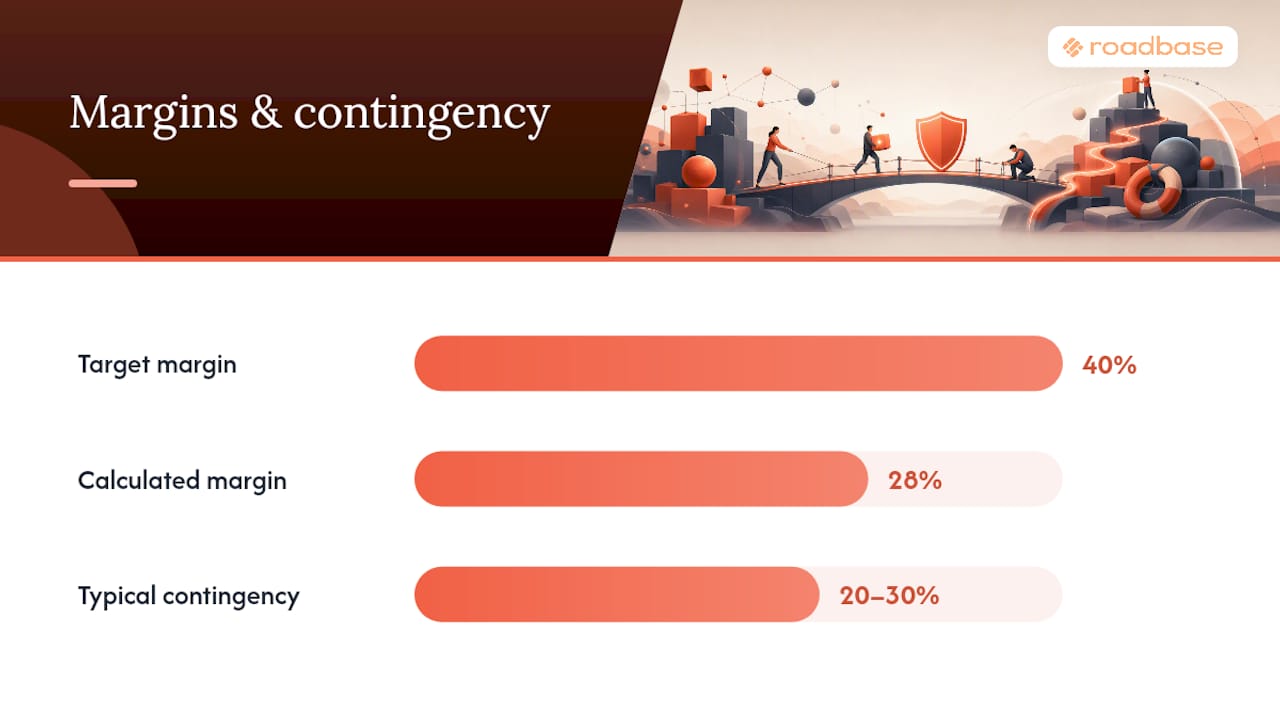
Confirm your margin math before you second-guess the fee itself. Margin is calculated as (Price minus Estimated Delivery Cost) divided by Price, expressed as a percentage. If your target margin is 40% and the math comes back at 28%, the estimate needs work before the client sees it.
Contingency should not be a habit number pulled from the last proposal. Score it against five factors: client familiarity, scope clarity, novelty of the work, number of dependencies, and timeline pressure.
| Risk factor | Low risk | High risk |
|---|---|---|
| Client familiarity | Repeat client | First-time client |
| Scope clarity | Locked brief | Vague brief |
| Novelty | Work you've done before | New service or medium |
| Dependencies | Self-contained | Relies on client assets/approvals |
| Timeline pressure | Flexible deadline | Fixed launch date |
More factors landing in the high-risk column can justify a higher contingency percentage, often toward the top of the 20 to 30% buffer range agencies use as a baseline.
Run one more check: the effective-hourly-rate test. Divide total price by total hours including non-billable work. If that number sits below your minimum acceptable rate, revisit the assumptions, scope, or fee before sending. Then decide your billing model, fixed fee or time-and-materials with a cap, and write down why you chose it.
What Goes Into A Scope Of Work And Change Order?
A proposal benefits from a clear scope of work. The SOW scaffold has four parts, and all four should appear in every proposal regardless of project size:
- Overview - one paragraph on the project's purpose and context.
- Deliverables - the measurable list from your scope checklist.
- Exclusions - what is explicitly not included.
- Change-order clause - one sentence stating that scope changes require written approval and a price adjustment.
Attach a short change-order form alongside the SOW. It only needs five fields:
- Requested change
- Impact on scope
- Cost impact
- Timeline impact
- Approval line (name and date)
That five-field format is short enough to issue quickly and specific enough to be unambiguous. Frame it to clients as "we can do that, here's the impact" rather than a rejection. On retainer engagements, the change-order clause matters more than the deliverables list since scope shifts monthly. On one-off projects, the exclusions section carries the most weight because there is no next cycle to renegotiate in.
Present the SOW plainly: "This proposal is valid for 14 days. Signing below confirms the scope, deliverables, and exclusions listed here." Use terms and acceptance language appropriate to your agreement and jurisdiction.
How Do You Check Timeline And Capacity Are Realistic?
Convert your execution hours into calendar time using three adjustments, not a gut-feel deadline.
- Score brief clarity. Rate the brief locked, mostly clear, or vague, then apply the matching multiplier: 1.0 for locked, 1.3 for mostly clear, 1.7 for vague.
- Count approvers and apply the approver multiplier. One decision-maker may move faster than a larger review chain, so make the assumption visible.
- Discuss the client's stated turnaround. Ask how fast they can review drafts and base the schedule on their working history where it exists. Optimism bias can affect project estimates.
- Apply a team capacity reality factor. Account for overhead when converting hours to calendar days rather than treating every available hour as execution time.
Pro Tip: Write your brief-clarity and approver assumptions directly into the proposal. When a client pushes back on the timeline, you can review a stated assumption together.
Final Quality Check Before You Hit Send
Run this last pass after the estimate is otherwise finished. It catches administrative mistakes as well as pricing mistakes.
- Assign a unique quote number and issue date, and export a clean PDF version.
- Set a validity window, typically 7, 14, or 30 days, so the proposal has a clear review period.
- Confirm the payment schedule and deposit amount are tied to specific milestones, not vague phases.
- Attach the change-order form and SOW as part of the same document package.
- Include clear acceptance wording appropriate to your agreement rather than relying on a verbal "sounds good."
- Have an internal reviewer, even if that is just you on a second pass a day later, confirm hours, margins, and hidden costs one more time.
Common Pitfalls And Red Flags In Estimate Reviews
The most expensive mistake in estimate reviews is treating the first draft as the final draft. A number that felt right at 4pm on a Friday deserves a second look after a night's sleep, especially on unfamiliar project types.
Watch for these red flags before sending:
- Round numbers with no math behind them. If your total is a suspiciously clean figure, build it from actual line items.
- Missing exclusions. If you cannot name three things this project does not include, clarify the proposal.
- No named approver. A proposal sent to a distribution list instead of one decision-maker can invite conflicting feedback and stalled approvals.
- Contingency copied from the last job. A buffer that is not tied to this project's actual risk factors is just a guess wearing a percentage sign.
- Non-billable time absent from the math. Coordination, meetings, and invoicing belong in the delivery picture.
- Revision rounds left undefined. "A couple of rounds of feedback" is not a number. Write the actual count.
Most of these pitfalls share a root cause: the estimate was built once and never re-checked against a second pair of eyes or a second day's judgment. A five-minute pass against a fixed checklist can catch them early.
Techniques For Estimating Risk And Uncertainty
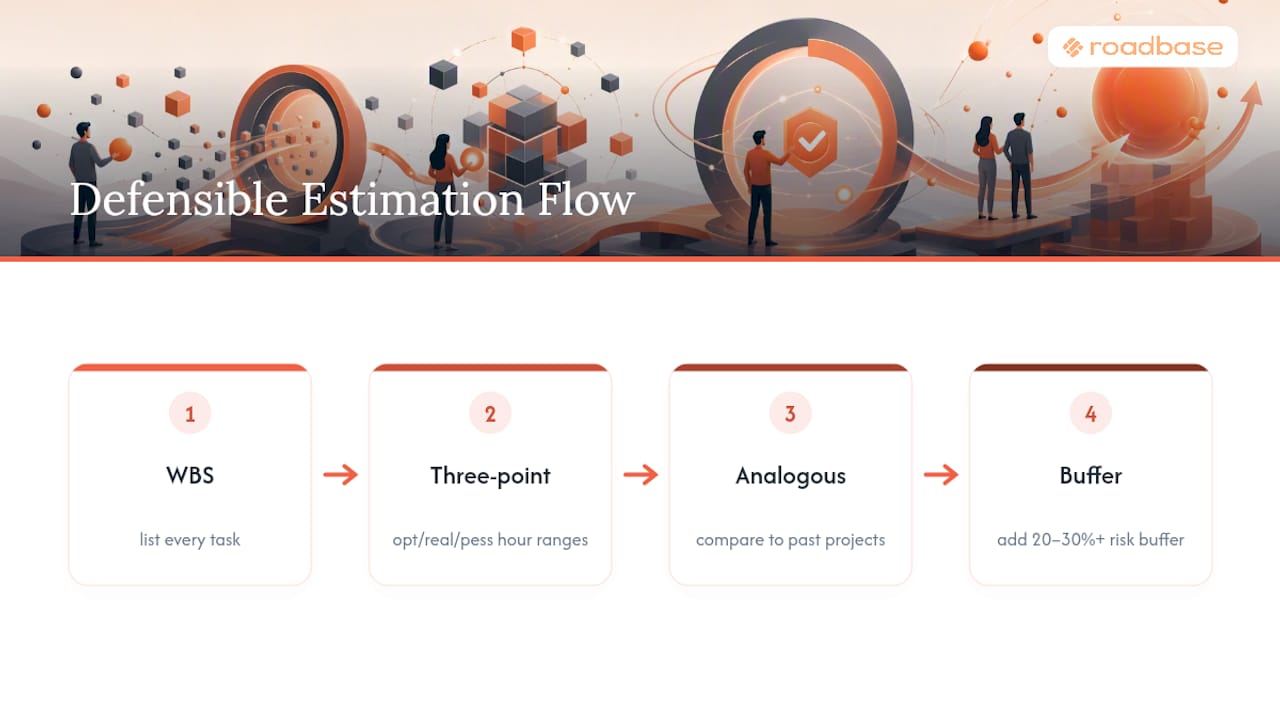
Bottom-up estimation starts with a work breakdown structure: list every task, estimate hours per task, then sum the total rather than starting from a client's stated budget and working backward.
Three-point estimation adds a layer bottom-up alone misses. For each task, estimate an optimistic, realistic, and pessimistic hour count, then weight toward the realistic middle. This surfaces tasks where your uncertainty range is wide, which is where contingency deserves attention.
Analogous estimation, comparing the current project to a similar past one, works well once you have a handful of completed projects to reference. It works poorly on your first few projects in a new category, where you have no comparison point and should lean harder on bottom-up buffers instead.
Layer a buffer on top of whichever method you use. A base buffer of 20 to 30%, adjusted upward for higher-risk projects, gives you room to discuss the unknowns a task list cannot capture: client indecision, unexpected technical constraints, or a stakeholder who joins the review process in week three.
The techniques matter less than the discipline of using more than one. An estimate built purely from gut feel has no uncertainty range at all. An estimate built from a WBS plus three-point ranges plus a scored contingency has a range you can explain and review.
Comparison With Industry Benchmarks Or Historical Data
One creative project-management benchmark says execution time is typically only 30 to 40% of total calendar time on a given project. The rest is brief refinement, stakeholder review, revision cycles, and waiting on decisions that are not yours to make.
That benchmark is a useful prompt to check your own estimates. A two-week calendar window built entirely from 40 execution hours assumes little review friction, which may not match the work.
Historical data from your own projects can be a useful benchmark once you have it. Tracking estimate versus actual on each project gives you context to review in future quotes, project category by project category. Roadbase's estimate versus actual tracking lets you track time against a project or task and compare actual with estimated hours. With sufficient relevant, correctly linked task data, role-level estimate-versus-actual context can inform a later AI draft.
Tools And Templates For Conducting Effective Estimate Reviews
A checklist works whether it lives in a notebook, a shared doc, or dedicated software. What matters is that it is the same checklist every time, not a slightly different mental pass depending on how busy the week is.
For manual review, a shared template covering scope, roles and hours, pricing, timeline, and change control gets you most of the way there. Pair it with a standing SOW template and a five-field change-order form saved as a reusable document, so you are filling in specifics rather than rebuilding structure on every proposal.
For teams scaling past a handful of projects a month, manual templates can get harder to maintain. AI-assisted scoping tools can give you an editable starting work breakdown from a raw brief, then leave the review to you. In Roadbase, paste a brief or attach a PDF to draft phases, tasks, roles, estimated hours, timing, and estimate reasoning. Review the work breakdown, set and adjust your own role costs and billable rates, then export the reviewed plan and quote as a proposal PDF.
The template matters less than whether you actually run it every time. Build the habit of running it on every proposal, and even a simple spreadsheet version gives you a consistent starting point for review.
Communication Tips For Discussing Estimates With Stakeholders
Present assumptions, not just totals. A price with no visible logic invites negotiation on the number itself. A price built from stated assumptions, brief clarity, approver count, and revision limits gives everyone something concrete to review.
State the approver structure out loud before work begins. "This estimate assumes one round of consolidated feedback from a single approver" sets an expectation the client can agree to or discuss now.
Frame contingency with its basis. Clients can better assess "this includes a buffer for dependency-related risk" than a line item labelled simply "contingency" with no context attached.
When a change request comes in mid-project, lead with capability before cost. Framing a change order as "we can do that, here is the impact" keeps the conversation collaborative and makes the next decision clear.
Put revision limits in writing early, not when round three starts.
Author Perspective: Why Estimate Discipline Protects Margin
Renegotiating a project mid-delivery is where freelance margin can disappear, not in the original pricing. A checklist that makes scope, hours, and approver assumptions visible gives you a better starting point for those discussions. The habit worth building is a short estimate-versus-actual review while a project is still active, so the next estimate can be considered with current context.
- Nicolas Robertson
How Roadbase Automates Your Estimate Review
Roadbase gives you a reviewable starting point for a real client brief. Paste notes or attach a PDF to create an editable first draft of the work breakdown with phases, tasks, roles, estimated hours, timing, and estimate reasoning. Review the assumptions, costs, role rates, and quote, then adjust the plan before exporting a proposal PDF.
A visual timeline keeps timing, roles, hours, and pricing in one project model, and a simple project/task status board can carry approved work forward. Bring a real brief, notes, or PDF to Roadbase, create an editable first draft, review the assumptions and quote, and adjust it before exporting a proposal PDF.
If you are running this checklist manually today, try Roadbase on your next proposal. Start with the brief you already have, review the draft, make the decisions that belong to you, and export a proposal PDF when it is ready.
Sources
- How to estimate creative project timelines (Creative Project Management)
- Agency scope creep prevention - SOW framework (Digital Applied)
- Quote review checklist - Ququ Blog
- Agency project estimation guide (AgencyPro)
FAQ
What Is An Estimate Review Checklist?
It's a structured pre-send review covering scope, roles and hours, pricing and margin, timeline, revision rounds, and change control, run before a proposal reaches the client.
How Much Contingency Should A Creative Estimate Include?
Most agencies use a base buffer of 20 to 30%, scored upward for factors like an unfamiliar client, a vague brief, or a tight deadline.
What Should Be In A Change-Order Form?
Five fields are enough: requested change, impact on scope, cost, timeline impact, and an approval line.
How Do I Estimate Realistic Timelines For Client Approvals?
Apply a brief-clarity multiplier (1.0, 1.3, or 1.7) and an approver multiplier based on how many stakeholders review the work, then discuss the client's stated feedback turnaround using any relevant prior history, per creative timeline estimation guidance.
Can Software Handle Parts Of This Checklist Automatically?
Roadbase can turn a pasted brief, notes, or PDF into an editable work breakdown with phases, tasks, roles, estimated hours, timing, and estimate reasoning. Review and adjust the draft, including your role costs and billable rates, then export the reviewed plan and quote as a proposal PDF.