

Protect Client Budgets: 5 Step Cost Plus Pricing for Agencies

Cost-plus pricing starts with an agreed cost base and adds a fixed fee or markup. For an agency taking on uncertain, phased work, that can make the estimate easier to explain and adjust as the work develops. The catch is that a client needs to know which costs qualify, how they're documented, and when spending needs another conversation.
TL;DR:
- Cost-plus can suit work whose scope becomes clearer after discovery, provided both sides can review the costs.
- Define reimbursable costs, records, billing cadence, change approvals, and any ceiling in the agreement.
- A fixed price gives a clearer total when deliverables and assumptions are stable. Cost-plus makes the cost base more visible but needs more recordkeeping.
- Build the estimate from role-level hours and internal costs, then show overhead and the fee basis separately.
- Compare the models against this client's scope and appetite for price uncertainty. A later fixed-price quote may make sense once the work is better understood.
Table of Contents
- What cost-plus pricing is: formula, allowable costs, and accounting basics
- When to choose cost-plus versus fixed-price, T&M, or value-based pricing
- Cost-plus variants and the contract controls that make them workable
- Step-by-step implementation checklist for pricing cost-plus projects
- Comparing cost-plus, fixed-price, T&M, and value-based pricing
- Worked example: a cost-plus calculation and proposal template
- How tooling and repeatable processes reduce estimation error
- Piloting cost-plus: an honest take on the transition
- Turn a brief into a reviewable cost-plus estimate
- FAQ
- Sources
What cost-plus pricing is: formula, allowable costs, and accounting basics
The simple version is agreed reimbursable cost plus an agreed fee. That fee might be a percentage of the cost base or a fixed amount. The agreement has to say what enters the base; an agency can't assume every expense it incurs will be reimbursed. Salesforce's explainer on cost-plus pricing offers a general description of the method, but the actual cost categories and payment terms come from the project agreement.
Those categories might include:
- Direct labor: project hours valued at a stated internal cost rate or other agreed labor basis.
- Contractors and subcontractors: outside specialists hired for the engagement.
- Third-party spend: licenses, printing, media, or production purchases tied to the work.
- Materials: physical goods used for a deliverable.
- Allocated overhead: an agreed share of costs such as general software, insurance, and administration, with a stated allocation method.
Keep markup and margin separate. A 25% markup on a $100 cost base adds $25, making the price $125. The $25 is 20% of that price, so the gross margin is 20%, before considering any cost omitted from the base. NetSuite's comparison of fixed-price and cost-plus models is useful background reading; in your proposal, state whether a percentage uses cost or selling price as its denominator.
When to choose cost-plus versus fixed-price, T&M, or value-based pricing
Start with what the agency and client can know before work begins. A branding project may have a defined identity deliverable but an uncertain number of stakeholder reviews. A packaging rollout may know its SKU count yet still depend on supplier proofs. Those unknowns affect how much price certainty either side can reasonably promise.
- Consider cost-plus when the work develops in phases. Discovery can establish the next stage while the client sees an agreed cost basis, records, and approval points. It works poorly if the agency can't record and explain actual costs.
- Consider fixed-price when the boundaries are stable. A clear deliverable, revision allowance, and client responsibilities let the agency quote a total the client can plan around. Changes still need a stated process.
- Consider time and materials when hours and rates are the useful unit. The client pays for agreed time and materials, usually at stated billable rates. That is different from reimbursing a defined internal cost base plus a fee.
- Consider an outcome-based fee when the result can be defined and measured. Both sides need to agree on the measure and what each can influence. Our piece on value-based pricing for creative projects explores that discussion.
The right model depends on the scope, records available, and how the client wants to handle uncertainty. No formula by itself tells you what a client will accept or whether the fee covers all of your costs.
Cost-plus variants and the contract controls that make them workable
It helps to distinguish a private agency agreement from federal procurement. In the US federal system, FAR Subpart 16.3 describes cost-reimbursement contracts, including cost-plus-fixed-fee, and conditions for reimbursing allowable incurred costs. That system has its own rules and oversight; an ordinary private creative contract is governed by its own terms and applicable law. Separately, FAR Subpart 16.4's incentive-contract discussion shows how federal incentive and award fees can be tied to specified targets or evaluations. These are useful distinctions when discussing fee design, not templates that automatically apply to an agency client.
For a private engagement, put the operating terms in writing:
- Define which labor, contractor, third-party, and overhead costs qualify, including any exclusions and allocation method.
- Say what time and expense records the client receives, when it may review them, and how disputed items are handled.
- Set the billing cadence, such as monthly or at agreed milestones.
- Define approval thresholds and a change process for new work or costs beyond the initial assumptions.
- If there is a not-to-exceed ceiling, state whether it covers cost, fee, expenses, or the total price, and what happens before the ceiling is reached.
Fee incentives deserve a separate look. FAR 16.102(c) prohibits a cost-plus-a-percentage-of-cost system in covered federal contracting. In GAO decision B-211213, a federal ceiling did not cure payment terms that GAO found to be a prohibited percentage-of-cost arrangement. That federal prohibition does not make every private agency percentage markup unlawful. It does highlight a practical question: if the fee rises whenever actual cost rises, what encourages efficient spending? A fixed fee, a tightly defined cost base, approval thresholds, or a negotiated incentive can change that balance. Choose the terms deliberately.
Step-by-step implementation checklist for pricing cost-plus projects
A cost-plus proposal becomes easier to review when the calculation and the operating rules are visible together. Use these five steps as a working sequence:
- Estimate role-level labor. List the work, the roles involved, and realistic hours for each stage. Use relevant past hours where you have them. Label internal cost rates separately from billable rates so the cost base doesn't quietly become a sales-rate estimate.
- Define direct expenses and overhead. Itemize likely contractor and third-party costs. Explain which general costs are allocated to the project, the percentage or method used, and its denominator. Review the inputs when staffing or delivery changes.
- Model the fee and a range of outcomes. Show whether the fee is fixed or calculated as a percentage of the agreed base. Recalculate for plausible changes in hours and expenses; a quoted margin on one estimate isn't a guarantee of the eventual result.
- Write the controls with the numbers. State eligible costs, records, billing dates, client review rights, approval thresholds, and any ceiling. Define how extra work or a ceiling change is proposed and accepted.
- Compare actuals with the plan. Track project time and expenses, review the difference at milestones, and discuss a likely overrun before it arrives. That review gives both sides a chance to adjust scope, budget, or the next phase under the agreed process.
A single "40 hours of design" line makes it hard to see whether strategy, concept development, or production artwork needs the time. A role-by-role estimate helps locate the labor assumption; the project record and client discussion reveal whether revisions, delayed inputs, or added work caused a later variance. Our guide to tracking project profitability goes further into comparing estimated and actual work.
Check recurring tools used specifically for delivery, too. This breakdown of what sales tech actually costs per rep is a reminder to inspect per-seat assumptions, not an agency cost benchmark. Use your own license terms and decide with the client which expenses belong in the project base.
Comparing cost-plus, fixed-price, T&M, and value-based pricing
Compare proposals using the same scope and assumptions first. Then ask what each pricing model makes predictable and what it leaves open:
- Budget certainty: a fixed price states a total for defined work. Cost-plus and time and materials can vary with actual work unless an effective ceiling or phase limit is agreed.
- Cost risk: under cost-plus, the client may carry more variability in approved reimbursable costs. Under fixed price, the agency bears more of the cost of delivering the agreed scope. Contract changes can alter either position.
- Records and administration: cost-plus needs a clear cost base and records to support it. Time and materials needs credible hours, rates, and expense records. Fixed price still needs scope and change control.
- Outcome incentives: a measurable outcome fee can align payment with a result, but measurement, timing, and each party's influence must be agreed.
- Client experience: showing cost categories can build confidence; unexplained allocations and open-ended approvals can undermine it.
The NetSuite fixed-price and cost-plus comparison gives more context, but use the actual project terms to compare offers. A cost-plus bid with a broad cost base and no effective limit can't be compared fairly with a fixed-price bid that excludes several deliverables. Align scope, responsibilities, eligible expenses, review rounds, and change terms first.
A blended model may fit a particular project: for example, a fixed fee for a defined discovery stage followed by a separately approved cost-plus production phase. That can give the client a decision point without claiming either side has guaranteed downside protection.
Worked example: a cost-plus calculation and proposal template
Suppose an agency is estimating a website redesign with uncertain content migration. For this hypothetical calculation, $75, $90, and $110 per hour are assumed loaded internal labor costs, not client billable rates. The project manager works 20 hours at $75 ($1,500); the designer works 60 at $90 ($5,400); and the developer works 80 at $110 ($8,800). Direct labor is $15,700.
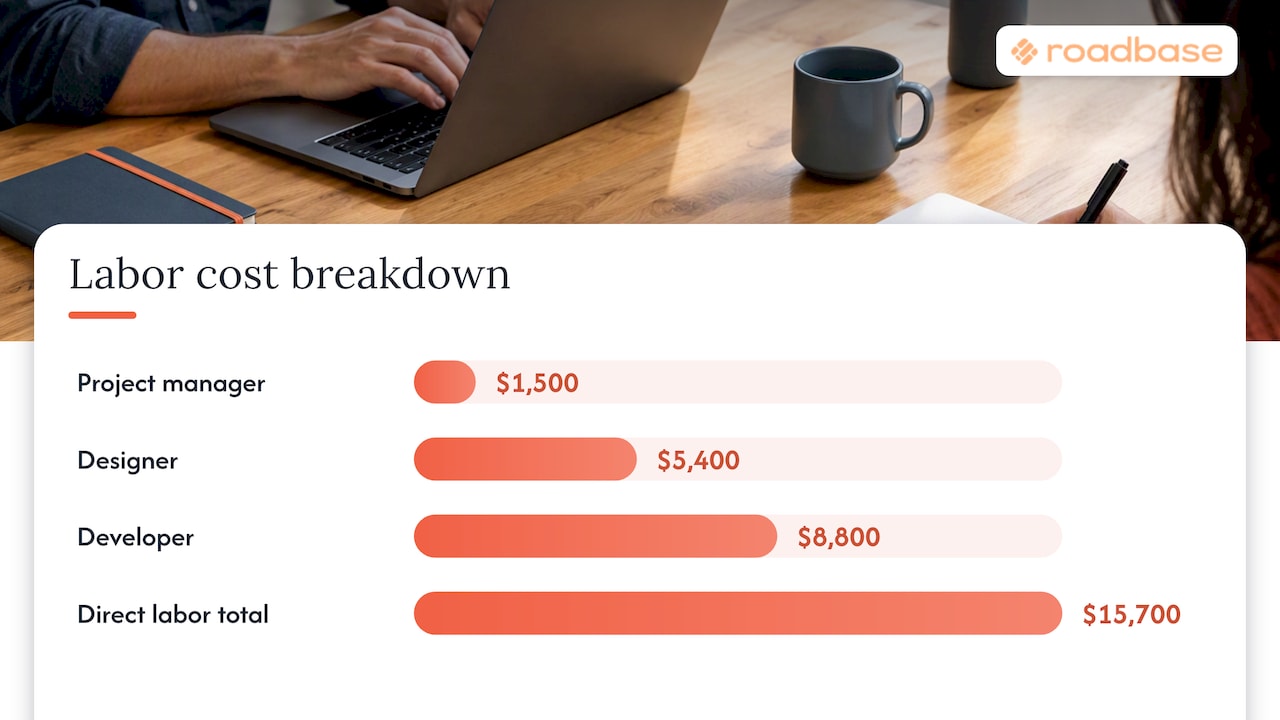
Add a $400 stock photo license and a $600 CMS plugin fee. Direct cost is $16,700. Assume the parties agree to allocate overhead at 10% of direct labor only: $1,570. The illustrative cost base is therefore $18,270 ($16,700 direct cost plus $1,570 overhead). With a fixed $3,000 fee, the estimated price is $21,270. The fee is about 14.1% of that estimated price, before any cost outside this simplified model; it is not a promised margin.
For a client-facing proposal, show:
- Each role's hours and loaded cost basis, plus the direct expenses.
- The 10% overhead method and its $15,700 labor denominator.
- The $3,000 fixed fee and $21,270 estimated total.
- A proposed $24,000 not-to-exceed total price, if both sides accept it, covering reimbursable cost and fee. State how the agency requests approval before work would exceed that total.
- Milestone reviews where the parties examine recorded cost, remaining work, and any requested change.
The ceiling is a negotiated term, not a prediction that the work will finish at $24,000. A fee that instead marks up actual costs would need its own stated denominator and incentive review. Our proposal pricing table templates offer ways to present the lines without hiding the assumptions.
How tooling and repeatable processes reduce estimation error
A repeatable estimate helps an agency notice missing categories and inconsistent inputs. It still needs someone to check the scope, the numbers, and the agreement. A useful process has:
- A task breakdown with a role and estimated hours for each piece of work.
- A separately documented list of costs the client agrees to reimburse.
- An approval point in the agreement before changed work or spending goes ahead.
- Recorded project hours that can be compared with the estimate.
Roadbase can turn pasted brief text or an attached PDF into an editable draft of phases, tasks, roles, hours, and timing. Review and adjust that draft against the real brief. You can supply role costs and rates, then review labor, overhead, direct expenses, contingency, and target margin alongside the quote. Those inputs and the proposed cost terms still need your judgment. During delivery, tracked project or task hours can be compared with estimated hours; that comparison makes variance visible for the next discussion.
Piloting cost-plus: an honest take on the transition
Try the model on one project where uncertainty is real and the client is willing to review the cost base. Agree on records, a billing rhythm, approval thresholds, and any ceiling before work begins. Then compare the estimate with actual hours and expenses at each phase boundary. A pilot gives you evidence about whether the paperwork is manageable and whether the pricing terms make sense for both sides.
After that, decide again. If a type of project becomes predictable, a fixed price may be simpler for the client to budget and for the agency to administer. If uncertainty persists and the records remain useful, cost-plus may continue to fit. Either way, make the next pricing decision from the work you actually observed, not from a rule that every agency must graduate to another model.
Turn a brief into a reviewable cost-plus estimate
Have a real brief or PDF to price? Start a draft in Roadbase, then review and adjust the phases, roles, hours, and timing. Add your own role costs and rates; check the labor, overhead, direct expenses, contingency, and target margin before exporting the reviewed plan and quote as a proposal PDF. Keep the agreed reimbursement rules and approvals in the project agreement.
You can visit Roadbase for the broader workflow. If you work solo or with a small creative team, our industry page for freelance project estimates shows how to take a brief toward a quote. The pricing page has current plans when you're ready to try it.
FAQ
What company uses cost-plus pricing?
Cost-plus appears in different settings, including federal procurement and some private construction, consulting, or creative engagements. For an agency, the useful question is whether its particular project has an agreed cost base, usable records, and enough uncertainty to justify a variable final price. Salesforce's cost-plus overview describes the general method, though the contract terms determine how any one engagement works.
What is a disadvantage of cost-plus pricing?
The final price can rise as eligible actual costs rise, so the client has less certainty than with a fixed price for defined work. The agency also has to maintain records both sides can understand. Clear cost definitions, review points, and an agreed ceiling can limit uncertainty, depending on how the agreement is written.
How does cost-plus pricing work?
The parties define which project costs are reimbursable and how those costs will be recorded. The agency then charges that agreed cost base plus the stated fixed fee or percentage markup, subject to any approval process or ceiling in the contract. An estimate is a planning number; actual payment follows the agreed terms.
Who pays for mistakes in a cost-plus contract?
The agreement determines which costs qualify and how avoidable rework, client-requested changes, and overruns are handled. A clear approval process and ceiling give both sides a point to review the work before more cost is incurred.
Sources
- Fixed Price vs. Cost Plus: Which Is Better? | NetSuite
- FAR Subpart 16.4 - Incentive Contracts
- Cost-plus pricing explainer | Salesforce