

Enforceable Kill Fee Clauses for Freelancers: Templates & Workflow
A project cancellation can leave a freelancer with finished work, committed expenses, and time that is hard to refill. A kill fee clause gives the client and freelancer a way to agree in advance on what happens to those costs. The useful question is what event triggers payment, how the amount is calculated, and how payments already made are credited.
TL;DR:
- Define the cancellation event, notice method, and effective date before work starts.
- Choose a fee structure that fits the project stages and costs you can explain, rather than assuming one standard percentage.
- Separate payment for completed work from a reasonable amount for commitments left by cancellation, and credit any deposit once.
- Record stage approvals, expenses, payments, and the final calculation if the project ends early.
- Use the sample below as a discussion draft, then have the agreed language reviewed for the governing jurisdiction.
Table of Contents
- What Is a Kill Fee Clause and When Does It Apply?
- How Much to Charge: Flat, Tiered, and Hybrid Models
- What Makes a Kill Fee Clause Clearer to Review
- Sample Kill Fee Clause Language You Can Adapt
- How to Invoice and Collect After a Client Cancels
- When to Accept, Push Back, or Walk Away
- How Clear Project Stages Support a Cancellation Discussion
- Make Cancellation Terms Part of the Project Conversation
- A Planning Workflow for Clearer Project Stages
- Sources
- FAQ
What Is a Kill Fee Clause and When Does It Apply?
A kill fee is a negotiated payment term for a defined project cancellation. It often addresses a client ending an assignment after work begins. A general cancellation term may also cover an exit before work starts. The name matters less than the event, amount, and other obligations the parties actually agree to.
First distinguish a client's agreed right to end a project from a breach of contract. A termination-for-convenience clause can define a permitted exit and its agreed payment terms; a claimed breach may raise different remedies. Cornell's explanation of a contractual right to cancel is a useful starting point for that distinction. Neither a late cancellation nor a major scope cut automatically activates a kill fee. The agreement needs to say whether the event is covered and how it is handled.
That detail matters in creative work. A motion designer may have booked a sound editor; a packaging freelancer may have paid for mockups; a brand designer may have reserved a week for concept development. The clause can account for completed work and documented, nonrecoverable commitments, with a separate discussion of any cancellation amount for unused reserved time. Keep those categories clear so the same loss is not charged twice.
How Much to Charge: Flat, Tiered, and Hybrid Models
There is no standard percentage that makes a kill fee fair or enforceable. These are ways to organize a commercial proposal, each worth testing against the work and commitments in the actual project:
- Flat amount. A fixed sum can be simple for a short assignment with predictable preparation costs. It is harder to explain if it stays the same whether the client cancels before the first draft or just before delivery. Show what the amount is meant to cover.
- Staged amount. Define a separate amount or formula for each agreed stage, such as concept development, production, and final preparation. Stage names, acceptance points, and the effect of a partial approval should be clear before the project begins.
- Earned work plus commitments. Price completed work under the agreed rate or fee schedule, add approved nonrecoverable expenses, then consider a distinct, reasonable cancellation amount for a documented commitment such as reserved capacity. State what is already included in another line so the calculation does not double count it.
For a short article or design task whose delivered work is easy to price, payment for that work may be enough; a separate termination amount may add little. For a production job with specialist bookings and reserved dates, the parties have more to discuss. A client can reasonably question a charge that has no clear connection to the commitments or foreseeable loss it is meant to address.
What Makes a Kill Fee Clause Clearer to Review
Start with the event: who may cancel, how notice is sent, when it takes effect, and whether a reduction in scope counts as cancellation of a named phase. Then define how completed work, committed expenses, deposits, and any separate cancellation amount interact. A clear calculation helps both sides understand the deal and document what is owed.
Where a stated amount is treated as liquidated damages, a court may examine whether it is a reasonable forecast rather than a penalty. Cornell's liquidated-damages overview, its penalty-clause explanation, and American Bar Association guidance on liquidated damages explain that general distinction. The ABA discussion comes from construction contracts, so it is a guide to the issue, not a rule for every freelance engagement. Calling a charge the price of a cancellation right does not settle how it will be treated under the governing law.
Put the terms in the project agreement where both parties can see them. Some places require a written contract for covered freelance work: New York City's freelance worker guidance is one local example. An absent signature does not, by itself, erase every possible payment claim; Cornell's discussion of implied-in-fact contracts describes how conduct can matter. A signed, clear agreement is still a much better record for the cancellation terms the parties intended.
Finally, address the work product. Say what happens to drafts and final deliverables, and what the client may use after paying the relevant amount. Ownership and permission to use a work are separate choices. In the United States, 17 U.S.C. 204 as published by the Copyright Office requires a signed writing for a transfer of copyright ownership. That rule does not supply a universal cancellation clause, so the parties should handle rights explicitly in their own agreement.
Sample Kill Fee Clause Language You Can Adapt
The following is a discussion template, with choices left open on purpose. It is a way to check whether the parties have covered the moving parts, not wording that becomes enforceable when blanks are filled. The parties should choose the terms together and obtain local professional review for the governing jurisdiction before using them.
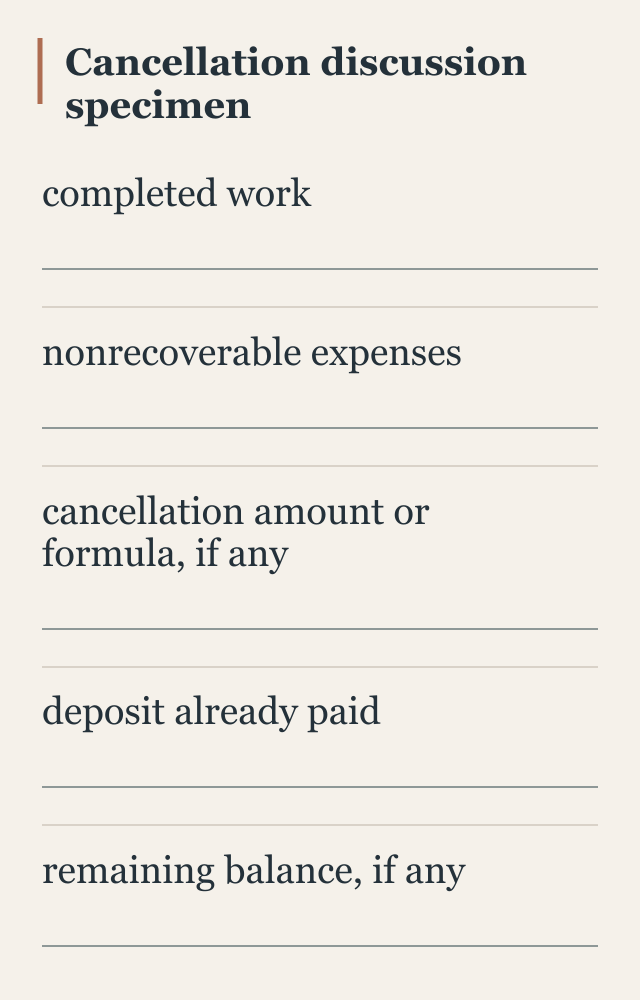
Cancellation discussion specimen
This agreement is governed by the law of [governing jurisdiction]. The project stages, deliverables, and prices are listed in [work and fee schedule].
The Client may cancel [the project / a named remaining stage] by giving notice to [recipient and notice method]. Cancellation takes effect on [effective date rule]. A reduction in scope counts as cancellation only if [the specific reduction and affected stage, if agreed].
At that date, the Client will pay [how completed work is valued and its calculated amount] for work completed under the schedule and [which approved, committed, nonrecoverable expenses qualify and their calculated amount]. The parties also agree to [a separately stated reasonable cancellation amount or formula, if any, and what commitment it covers]. An item already counted as completed work or an expense will not be counted again in that separate amount.
Apply [deposit already paid and how it is credited] against the total amount due, without crediting it twice. The remaining balance, if any, is due [payment due date or date rule] after [what calculation and supporting records will be sent].
The Freelancer will provide [which completed or draft deliverables, if any]. The Client's right to use each deliverable, and any ownership transfer, is [agreed usage-rights and ownership treatment, including any payment condition]. Other obligations on termination are [any agreed handover or return requirements].
The blanks are the negotiation. For an hourly assignment, the completed-work line might use approved hours and the agreed rate. For a fixed-fee brand project, the work and fee schedule might name concept and rollout stages. Check that an expense is truly committed and nonrecoverable, that the deposit is credited to the right line, and that any separate amount reflects a real commitment. New York City's model freelance agreement illustrates how a local form leaves key commercial terms to be completed; it does not endorse this specimen or a particular fee.
How to Invoice and Collect After a Client Cancels
When a project ends, make the calculation easy to follow. Keep the signed agreement and current work schedule, the cancellation notice, stage approvals, time or delivery records, receipts for committed expenses, and a record of deposits and other payments. A message is most useful when it clearly shows who sent it and when.
Send the client an itemized calculation that cites the agreed terms: the effective date, completed-work amount, eligible expenses, any separate cancellation amount, deposit credit, and balance due. Use the deadline the parties selected, then follow the agreement's reminder or dispute process if payment is late. If the amount is contested, local law and the actual agreement determine the available route; a qualified local adviser can assess the claim. There is no universal invoice deadline or predictable collection window.
When to Accept, Push Back, or Walk Away
Discuss the cancellation term while the project plan is still being agreed. A useful opening is: "If you need to stop after we reserve these production dates, how should we handle work already done and the commitments we cannot unwind?" It names the issue without treating cancellation as an accusation.
- Accept a simpler term when the assignment is short, work can be priced on delivery, and there are few commitments beyond it. A clean earned-work rule may be more useful than a separate fee.
- Push back on gaps when the draft ignores specialist bookings, gives no notice method, leaves deposit treatment unclear, or grants use of unfinished work without saying what is paid for it. Suggest specific language tied to the actual project stages.
- Pause or walk away when the parties cannot agree on a material payment or rights question. That is a commercial decision based on this client and project, not a prediction that they will fail to pay.
The goal is a term both sides can calculate from the same records. An arbitrary number may be easy to type into a contract but difficult to explain later.
How Clear Project Stages Support a Cancellation Discussion
A staged scope gives the parties names for work that might otherwise blur together. In a packaging assignment, for example, "concept system approved" and "production artwork for three SKUs started" describe different commitments. The project plan can show who approves each stage, which work is priced within it, and what expenses depend on it.
That clarity supports the conversation and the later calculation; it does not make a fee automatically enforceable. A proposal that explains phases and costs, as in this Roadbase planning and pricing article, can provide a practical starting record. The cancellation terms themselves still belong in the parties' reviewed agreement.
Make Cancellation Terms Part of the Project Conversation
The easiest time to discuss cancellation is when the work schedule is still open. Show where the client can approve a stage, where a specialist cost becomes committed, and what happens if the brief changes enough to remove later phases. Add those choices to the agreement and keep the linked project scope guide handy when defining the work itself. Clear terms make a difficult conversation more concrete if it ever becomes necessary.
A Planning Workflow for Clearer Project Stages
Start with the real brief and draft the phases, tasks, roles, hours, timing, and quote. Review them with the client until the work and price make sense. Those stages give you a useful reference when discussing a separate cancellation term with the client and local adviser.
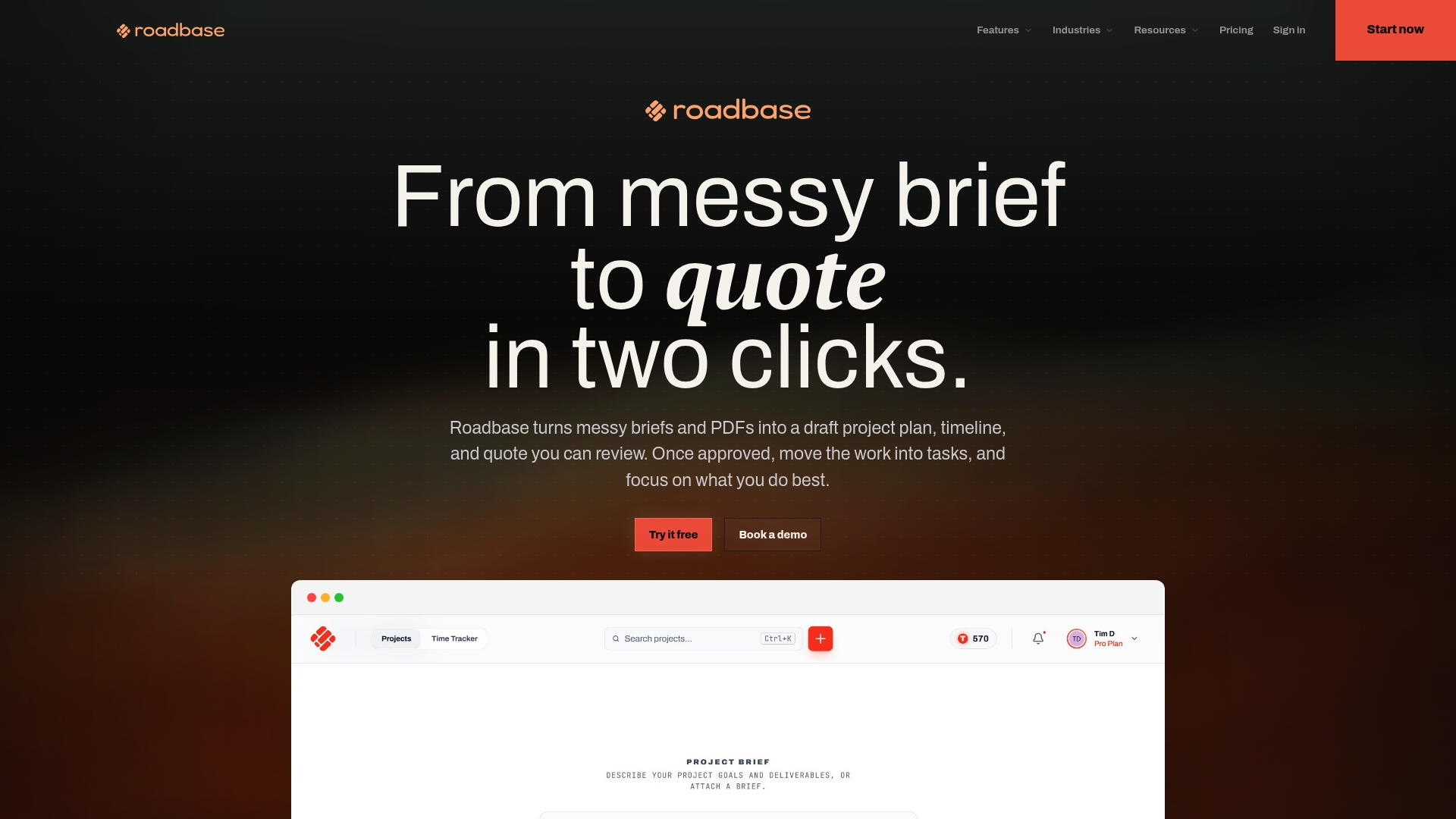
If you have a brief in your notes or a PDF, explore Roadbase: paste the brief or attach the PDF, review and adjust an editable draft work breakdown and quote, then export the reviewed plan as a proposal PDF. You can also view the current plans. Bring the stage and cost decisions from that plan into the separate agreement discussion.
Sources
For a closer look at why the amount and circumstances matter, see the American Bar Association's discussion of liquidated damages. It uses construction contracts as examples, but the reasonableness question is useful to bring to a local review of your own terms.
Further reading and comparison
These guides offer other ways to think about cancellation terms. Read their examples alongside your own project stages, commitments, and agreement.
- LegalClarity guide to kill fees
- Delivvo guide to freelance cancellation clauses
- Bracton guide to kill fee questions
- GigLawGuide overview of freelance kill fees
FAQ
How much should I charge for a kill fee?
Start with the project's work schedule and the commitments cancellation would leave behind. A flat amount, a staged amount, or completed work plus documented commitments can each be discussed. There is no universal percentage; make the chosen calculation clear and have the term reviewed under the governing law.
Does a client have to pay a cancellation fee?
It depends on the agreement, the event, and the governing law. A clearly agreed cancellation term gives both sides a starting point, but its amount and treatment may be disputed. Payment for completed work can raise a separate question even without an express kill fee.
What if the client cuts only part of the scope?
Check whether the agreement treats removal of a named stage as cancellation of that stage or as a change to the project. Record what work is complete, which commitments can be canceled, and the price adjustment both sides accept before proceeding.
What records matter after cancellation?
Keep the agreed contract and work schedule, dated notice, stage approvals, work records, receipts for committed expenses, and payments already received. Send an itemized calculation showing each amount and deposit credit against the contract's due-date rule.
Does a deposit replace a kill fee clause?
A deposit is money already paid; a cancellation term explains what is earned and what, if anything, remains due after an agreed exit. The agreement should say how the deposit is applied to completed work, expenses, and any separate cancellation amount so it is not counted twice.