

Acceptance Criteria Examples for Creative Projects and Deliverables
Acceptance criteria are the pass/fail conditions a deliverable must meet before a client signs off. Written before work starts, they turn "we'll know it when we see it" into a short list anyone can check. Below you'll find examples for websites, apps, brand work and content, plus formats, the difference from requirements and a definition of done, and how to carry criteria into your estimate. Roadbase builds an editable first draft of phases, tasks, roles and estimated hours from a brief. Review that draft against the criteria you and the client have agreed before preparing the quote.
TL;DR
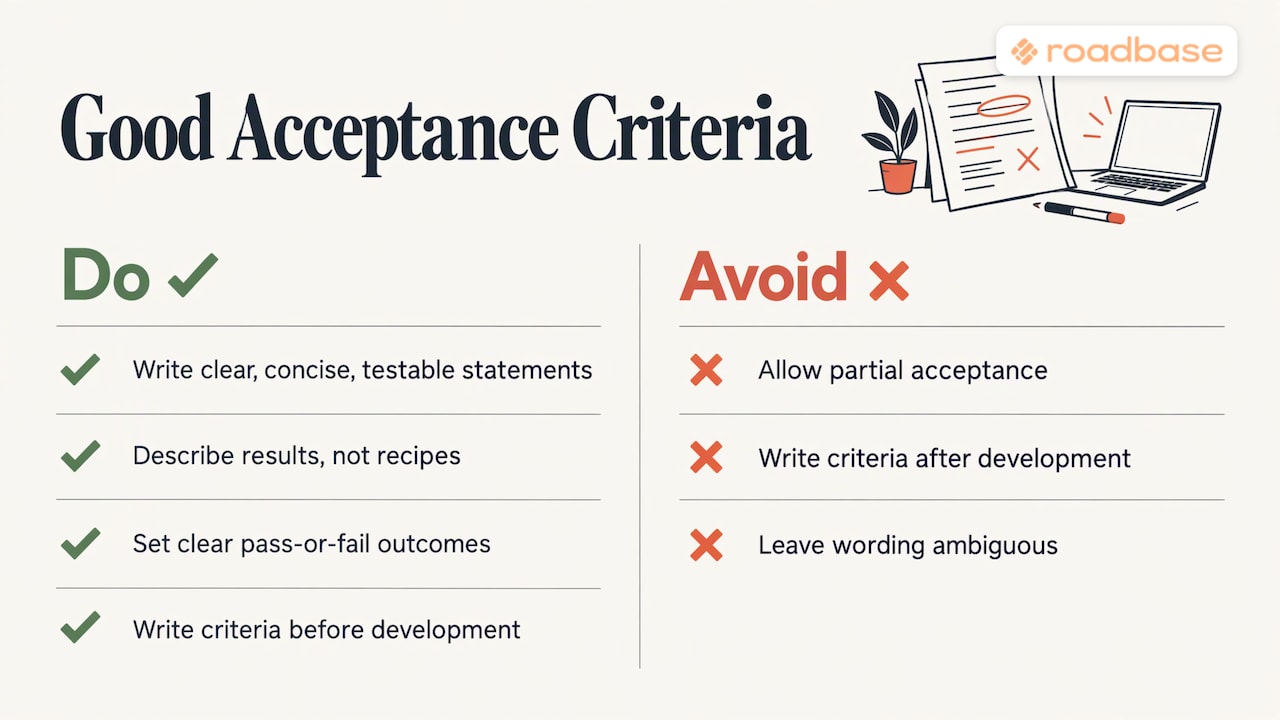
- Good criteria are clear, testable statements with a pass/fail result, agreed before work begins.
- Replace vague words ("fast," "modern," "user-friendly") with a number or something observable.
- Use a checklist for straightforward output checks and Given/When/Then where a scenario helps explain behavior.
- Acceptance criteria describe a deliverable; a definition of done provides a shared completion baseline.
- Use the criteria when estimating testing and review work, and agree revision limits separately.
Table of Contents
- What acceptance criteria are, and what makes one good
- Acceptance criteria examples you can adapt
- Writing acceptance criteria step by step
- Which format: checklist, Given/When/Then or rules
- Acceptance criteria vs. requirements
- Acceptance criteria vs. definition of done
- Putting criteria into your estimate and proposal
- Common mistakes
- Prepare your quote in Roadbase
- Perspective
- FAQ
- Sources
What acceptance criteria are, and what makes one good
Acceptance criteria make the expected result observable: what the client will be able to see or do when you hand over the work. The business analysis and Scrum practitioner sources discussed below distinguish these specific checks from broader needs and shared completion standards. Atlassian also offers a practitioner guide to acceptance criteria.
Agree the checks before implementation so both sides can use them when planning and reviewing the work. A useful criterion names the result, the conditions for checking it and what counts as passing. Related public-sector reading: Ohio OBM's guidance on acceptance criteria.
A practical check: could someone who did not write the criterion decide pass or fail without asking you? Jama Software's Mario Maldari offers a similar practical check and suggests the person who will verify the work sketches a test from each criterion before work starts. In a client project, that person is often the client.
Acceptance criteria examples you can adapt
Software stories offer useful examples. Here are the same ideas adapted for the work creative teams quote. Thresholds are illustrative: set yours from the brief.
Website page or landing page
- The page matches the approved layout and supports the agreed interactions in the browser versions and viewport sizes recorded in the brief. For this example, agree specific versions of Chrome, Safari, Firefox and Edge and test widths of 360 px, 768 px and 1440 px.
- Ordinary body text has a contrast ratio of at least 4.5 to 1 against its background. This is one accessibility check, not proof of full WCAG conformance. For a related agile-story example, see Practical Test Geeks.
- The contact form sends submissions to the client's address and shows a confirmation message.
- If a required field is empty, the form shows an error beside that field and does not submit.
Agree copy-supply deadlines and revision rules as separate scope terms. For example, the client supplies final copy before build, and the proposal defines how later copy changes are handled.
Logo or brand identity
- Delivered as vector (SVG and PDF) and PNG, in full color, one color and reversed versions.
- The mark stays legible at 24 px wide and at 1 inch wide in print.
- A usage sheet covers clear space, minimum size and the color codes.
A separate scope term could include three initial concepts and two rounds of consolidated revisions before the client selects one direction. Those limits describe the service being bought rather than the final file checks.
Video or motion piece
- Runtime is 30 seconds, plus or minus 2 seconds.
- Delivered at 1920 x 1080 pixels for landscape and 1080 x 1920 pixels for portrait.
- Both versions include burned-in captions and a separate caption file.
- Final audio is mixed with no clipping, and music licenses are included in the handover.
- Colors use the values in the approved brand guide version named in the brief.
- The logo uses the approved master file named in that guide.
Content or copywriting
- Article is 1,200 to 1,500 words, with the target keyword in the title and first paragraph.
- Every statistic carries a source link.
- Delivered as an editable document.
Agree the revision allowance separately; for this example, the quote includes one round of tracked-change revisions.
Web or app feature
Software examples show how specific a criterion can get. These are the authors' illustrative scenarios, not general performance targets or security recommendations. Clearly's examples for a login include a redirect to the dashboard within 2 seconds and an account lock after 5 failed attempts. Search results in the same set return within 500 ms, with a defined zero-result state. Vantage's password reset example has a reset email within 2 minutes and an expired-link message after 24 hours.
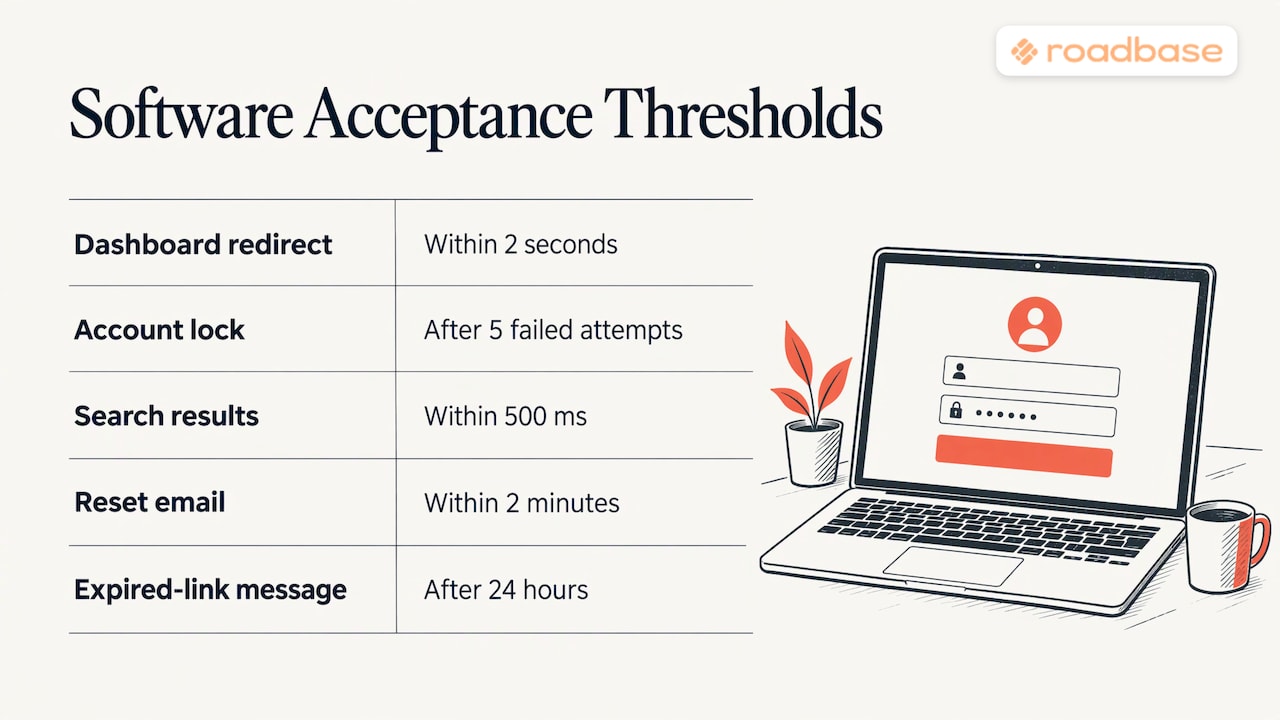
Notice the pattern: each condition has a number or visible outcome, and failure paths sit alongside successful ones. For timing checks, agree the device, connection, workload and point at which timing starts and stops.
Writing acceptance criteria step by step
- Start from the deliverable, not the task. Name the single thing being handed over (a homepage, a 30-second spot). Criteria for "design phase" are too broad to test.
- Write the happy path first. What does the client see when it works?
- Add the failure paths. What happens with an empty field, a missing asset, an unsupported browser?
- Define the test conditions for each threshold. A time or size limit needs a known test context; a confirmation message may simply need to appear. TestMu AI's guide includes numerical examples, but your brief should determine the values.
- Keep one condition per line. If a line needs several "ands," split it.
- Describe the result, not the method. "The form shows a confirmation after a successful submission" leaves room to choose the implementation. If speed matters, add a timing target and its test conditions.
- Agree them in writing before work starts, with the person who will approve the work.
Keep the list readable, but let the deliverable determine its length. A simple file handover and a booking flow need different checks. Practical Test Geeks offers another agile-story example; use it as a prompt rather than a universal minimum or maximum. Split a deliverable when it contains independently reviewable outcomes, not merely because its checklist exceeds a count.
This is where estimating and criteria meet. Criteria can imply work such as cross-browser checks and accessibility fixes. Estimate that work alongside the separately agreed revision allowance so the hours are visible in the quote. Roadbase turns a brief into an editable first draft of tasks, roles and estimated hours. Review that draft against the agreed criteria, then adjust the hours and role rates and review overhead, contingency and target margin while preparing the quote. For a fuller intake routine, see our project scoping checklist.
Which format: checklist, Given/When/Then or rules
ProdPad offers examples of three formats: Given/When/Then, checklists, and rules-based "If X, then Y."
| Format | Useful for | Example |
|---|---|---|
| Checklist | Static file and handover checks | Delivered in SVG and PNG; legible at 24 px |
| Given/When/Then | Behavior that branches | Given a visitor leaves a required field empty, when they submit, then an error appears beside the field |
| Rules (If X, then Y) | Conditional outcomes | If a search finds no matches, the page displays the agreed empty-state message |
SprintFlint provides bullet and scenario examples. For a creative project, choose the format that makes the check easiest to understand: a logo package may need a checklist, while a checkout flow may benefit from scenarios. These are options, not an exhaustive set of formats.
If you need a template, keep it to four lines per deliverable:
- Deliverable: what is handed over
- Criteria: enough pass/fail lines to cover the agreed outcome
- Out of scope: what is not included
- Revision rounds: how many, and what counts as one
The last two lines record scope and process boundaries. Use them when assessing a change request if the client asks for something new.
Acceptance criteria vs. requirements
Requirements describe needs and constraints at different levels, from project goals to individual features. Acceptance criteria make a particular expected outcome checkable; they can also refine the requirements themselves. Howard Podeswa's agile business analysis guide notes that in agile work criteria serve both as requirements and as the basis for acceptance testing.
A simple split:
- Requirement: "The site must let customers book a consultation."
- Acceptance criteria: "A visitor can pick an available slot; a successful booking shows the agreed confirmation; a booked slot cannot be selected again."
The requirement states the need. The criteria state the evidence.
Acceptance criteria vs. definition of done
Scrum.org explains that acceptance criteria are specific to each backlog item, while the definition of done applies to every item before it counts as complete. A deliverable can meet its specific criteria while still missing a shared handover check. For another practitioner comparison, see Asa's blog.
A creative team can adapt this distinction as a shared studio completion baseline. The following are studio examples, not mandatory Scrum rules:
- Files are named and organized to your handover convention.
- Work is proofread and checked against the brand guide.
- Source files and licenses are in the project folder.
- The client has received a handover note with usage rights.
- Time and expenses are logged against the project.
Acceptance criteria add deliverable-specific checks. Teams can review and adapt their shared baseline, and reuse relevant criteria when another brief calls for the same result.
Putting criteria into your estimate and proposal
Put the agreed checks where the client can review them alongside scope and price. Name the actual contrast target and browser test matrix, and list revision allowances as separate process terms. This makes the quoted work easier to discuss.
A workable routine:
- Read the brief and name the deliverables. Resolve missing inputs with the client before treating them as settled scope.
- Write the checks for each deliverable and agree who will verify them. Keep revision limits and client responsibilities in the scope terms.
- Allocate roles and hours to the work, including testing and the agreed revision allowance. Make those tasks visible in the estimate.
- Review overhead, contingency and target margin. Clarify loose criteria rather than relying on a buffer to cover an undefined outcome.
- Share the reviewed proposal and the agreed criteria with the client. Check that both documents describe the same scope.
In Roadbase, paste the brief or attach a PDF to get an editable first draft of the project plan. Review the phases, tasks, roles and estimated hours against the checks you have agreed, adjust the rates and quote assumptions, and export the reviewed plan and quote as a proposal PDF. Keep the written criteria available alongside that proposal for the client's review. Our guides on turning a messy brief into a clean quote and software integration scope and estimates show the same flow on real project types.
Once criteria exist, test thinking belongs before the build too. The Tech Lead Handbook argues that a criterion you cannot describe as a test before implementation is not yet clear enough. For related reading on a different workflow, see this piece on agency SEO automation.
Common mistakes
- Vague adjectives. "Clean," "modern," "intuitive." Replace with a reference (matches the approved mockup) or a measure.
- Prescribing the method. "Use a carousel" is a design instruction; "shows three featured projects" is a criterion.
- Escape clauses. Jama's guidance flags phrases like "as appropriate" and absolutes like "100% reliable" as unverifiable.
- Writing them after the work. Criteria drafted late describe what you made, not what the client needed.
- No failure paths. Clients find the empty state, the slow connection, the missing image.
- Counting instead of checking coverage. A longer list may be necessary. Remove duplicates and split independently reviewable outcomes where that helps the client assess them.
Prepare your quote in Roadbase
Bring the brief you already have to Roadbase. Paste it or attach a PDF, then review the draft phases, tasks, roles and estimated hours against the acceptance criteria you have agreed. Adjust the quote, review overhead, contingency and target margin, and export the reviewed plan and quote as a proposal PDF.
Relevant past estimates and correctly tracked hours by role can inform a later draft; you choose the final assumptions and price. See Roadbase pricing for current options.
Perspective
We find it useful to discuss acceptance criteria while preparing the quote. Asking how a client will check a deliverable often reveals work that deserves its own time allowance: testing a form, preparing another file format or reviewing captions.
That is where Roadbase fits into our planning. Its editable draft gives us phases, tasks, roles and estimated hours to review against the brief and the checks we have agreed. We still need to write those checks, discuss them with the client and decide what the work should cost.
Our advice: agree the outcome before quoting, give the review work a place in the estimate, and revisit unclear conditions before committing to them.
Nicolas Robertson
FAQ
What is a good example of acceptance criteria?
For a brand identity: "Delivered as SVG, PDF and PNG; legible at the agreed 24 px test size; includes a usage sheet with clear space, minimum size and color codes." These are illustrative checks to agree for the brief. A two-round revision allowance belongs in the scope terms alongside them.
How many acceptance criteria should a deliverable have?
Use enough checks to cover the agreed outcome, including relevant failure paths. There is no universal minimum or maximum. Remove duplicates, and consider splitting a deliverable when it contains outcomes the client can review independently.
Who writes acceptance criteria?
You propose them, and the client confirms them. Agreeing in writing before work starts matters more than who holds the pen, since the person approving the work needs to accept the conditions.
Can I reuse acceptance criteria between projects?
Yes. Keep a base list per deliverable type (landing page, logo, video) and adjust numbers and formats to each brief. A shared completion baseline can also be reused and reviewed as your studio's work changes.
Sources
- Atlassian: Acceptance criteria explained
- Ohio OBM: Developing and Using Acceptance Criteria
- Jama Software: Acceptance Criteria
- Practical Test Geeks: Agile Stories
- Clearly: Acceptance Criteria Examples
- Vantage: Sample User Stories
- TestMu AI: Acceptance Criteria Examples
- ProdPad: Acceptance Criteria Examples
- SprintFlint: Acceptance criteria formats
- InformIT: Specifying Features and Their Acceptance Criteria
- Scrum.org: A Simple Example Of A Definition Of Done
- Asa: Definition of Done vs Acceptance Criteria
- Tech Lead Handbook: Acceptance criteria