

Project Scoping Checklist for Creative Projects
A project scoping checklist is the list of questions you answer before you price or start a job: why the project exists, what you will deliver, what you will not, what limits apply, and how everyone will agree the work is done. For creative freelancers and agencies, the checklist below covers ten checks, and gives you a written scope to work from when you price the job. In Roadbase, paste a brief or notes or attach a PDF to generate an editable draft with phases, tasks, roles, hours and timing. Review it against what you confirmed with the client.
TL;DR
- A scope checklist works when it ends in a written scope the client approves and that says what is in, what is out and what "done" means.
- The five core components are objectives, deliverables, boundaries and exclusions, constraints, and acceptance criteria.
- Define a revision round, the number of options and the page or asset counts in writing before you quote.
- Price from the scope: tasks, hours, overhead, then a risk buffer sized to how clear the brief is.
- Any request outside the scope gets a written change order with revised cost and timeline.
Table of Contents
- What a project scoping checklist is for
- The checklist: ten checks before you quote
- From brief to scope: a worked example
- Turning the scope into an estimate
- Where checklists fail in practice
- Confirming scope and handling change
- Our perspective
- Put the checklist to work in Roadbase
- FAQ
- Sources
What a project scoping checklist is for
Scope is the detailed description of a project's goals, deliverables, tasks, budget and timeline. University of Phoenix notes that settling it early sets expectations about what is in and out of the project and gets teams and stakeholders on the same page before work begins. PMI describes the scope statement as a written basis for project decisions.
A checklist is the tool that gets you to that statement. Use it to settle details early, including who approves the final files.
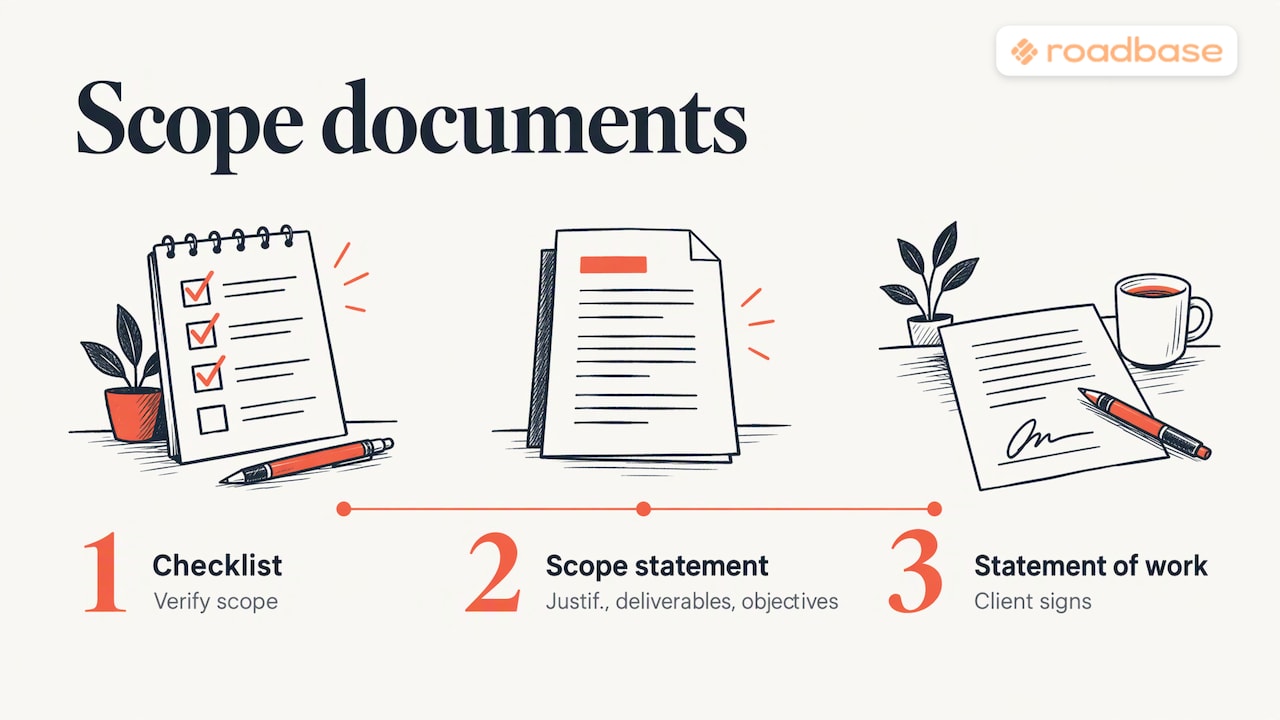
You may also see the scope checklist compared with a scope statement and a statement of work. The checklist is what you verify. The scope statement is the document that results, and PMI describes its three major parts as justification, deliverables and objectives. A signed statement of work is one way to confirm the agreed scope. The guide on what to put in a statement of work shows the kind of information that aligns stakeholders before work starts.
The checklist: ten checks before you quote
Work through these in order. Each check gives you a decision to confirm before you quote.
1. Purpose and objectives
Ask why the client wants this project and what changes if it succeeds. Write objectives that can be measured. The Georgia Technology Authority's project charter asks for SMART objectives, and the US Department of the Interior's project requirements document is another example of a template for documenting project requirements.
Example: "Refresh the brand" is a wish. "Deliver a logo, color palette and type system that the client's team can apply to its website and sales deck by the launch date" is an objective.
2. Deliverables, itemized
List every file, format and asset. Count them. A logo project, for instance, might be three initial concepts, two revision rounds, vector source files, a one-page usage sheet and PNG, SVG and PDF exports. If a deliverable has no number or format, it is not yet scoped.
This is also where a work breakdown structure starts: major deliverables at the top, tasks underneath.
3. Limits on each deliverable
Creative work grows through quantity. Fix the number of design options in the first presentation, the detail per option, copy length, page counts and the number of elements. Creative Agency Book recommends listing these limiting factors in every estimate, along with the process and payment terms.
4. Exclusions
Write down what is not included. Typical exclusions for creative projects: stock licensing, photography, print production, translation, ongoing maintenance, extra languages or formats. Spelling out exclusions helps the client see which parts of the job they may need to arrange separately.
5. Constraints and assumptions
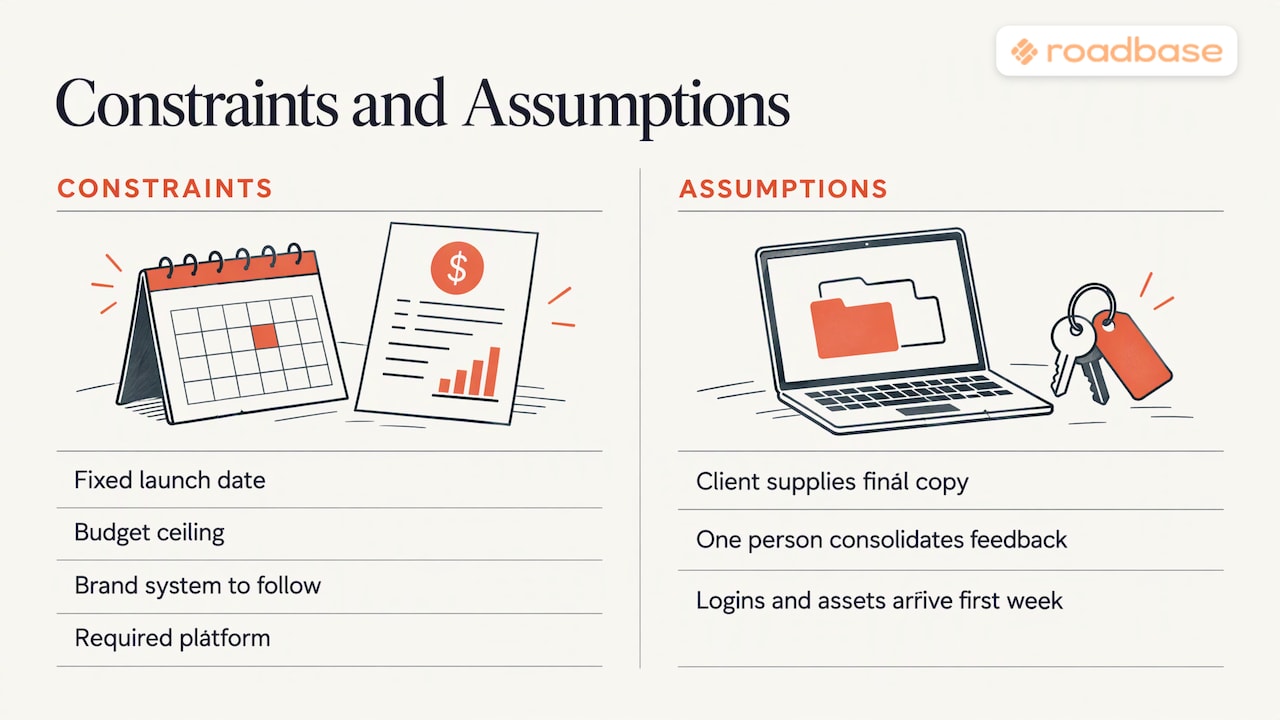
Constraints are fixed limits: a launch date, a budget ceiling, a brand system you must follow, a platform. Assumptions are things you expect to be true without anyone saying so. The Georgia template describes them as items the team expects to be available without being stated, which is exactly why they cause trouble when they turn out false.
Common assumptions in creative work: the client supplies final copy, one person consolidates feedback, logins and assets arrive in the first week.
6. Acceptance criteria
Parallel's design scoping guide gives a practitioner example of defining acceptance criteria. Decide who approves, by what date, and against what standard. "Approved by the marketing director in writing" is a criterion. "The client is happy" is not.
7. Revision rounds, defined
Stating "two rounds of revisions" is not enough. Define a round. One way to define a round is a single batch of consolidated feedback. Ten comments sent together can count as one round. Write down how many rounds are included and quote additional rounds before starting them.
8. Roles, responsibilities and timeline
Name who does what on your side and on the client's. Note the client's responsibilities too: feedback turnaround, asset delivery, approvals. Add milestones with dates. The Interior template is one example of how to record project requirements. For a small studio, you can use a short list of milestones, owners and dates.
9. Budget, pricing model and risks
Choose the pricing model before you quote: fixed fee, hourly, retainer or milestone-based, as Indeed's scope-of-work guide lists them. Then list risks. An existing design system may save setup time. Five stakeholders who disagree on what to approve could add time to each review. If you need a cost map first, see our project budget breakdown.
10. Change control and sign-off
Agree how changes will be handled and get the client's written approval of the scope before work starts. A signed scope is one option, as the Project Management Formula checklist illustrates. The Georgia charter calls for sponsor approval to add deliverables.
From brief to scope: a worked example
Take a typical brief: "We need a new website for our dental software product. Modern look, about ten pages, launch in the spring." Here is how the checklist converts it.
| Checklist item | What the brief said | What you write down |
|---|---|---|
| Objective | Modern look | Design a marketing site that supports demo requests, launching in spring |
| Deliverables | About ten pages | Eight page designs plus two templates, desktop and mobile layouts, handoff files |
| Limits | None | Two initial concepts for the home page only, then one direction for all other pages |
| Exclusions | None | Copywriting, photography, development, analytics setup |
| Assumptions | None | Client supplies final copy by week two, one consolidated feedback contact |
| Acceptance | None | Written approval from the product lead at each milestone |
| Revisions | None | Two rounds per milestone, a round being one batch of consolidated changes |
The brief had no limits, no exclusions and no acceptance standard. Leaving those decisions open could lead to unpaid hours if the client expects work you left out of the quote.
Turning the scope into an estimate
Use the written scope as the starting point for the estimate.
- List deliverables explicitly. Rewrite the client's request as the itemized list above.
- Break each into tasks with hours. Include revisions and communication overhead, not just design time. One 2026 freelance estimating guide, Damongo's, shows a landing page design totaling 16 hours that includes 2.5 hours of revisions and 1.5 hours of communication.
- Add a risk buffer sized to clarity. Damongo suggests sizing contingency to the uncertainty in the brief. Use what you know about the project and what you learned on similar jobs.
- Check the starting point. Parallel's guide suggests asking whether the client already has a design system. Find out which parts you can use before you estimate the work.
- Choose the pricing model and review margin. Our estimate review checklist walks through that last pass, and how to estimate project hours before quoting covers step two in more detail.
When the project involves dependencies, such as content that must arrive before layouts, or a build phase that waits on design approval, record them. Budget time for coordination, feedback and handoff between whoever owns each step.
Where checklists fail in practice
Keep the checklist open when you build the estimate and confirm the scope. Four practical problems to watch for follow.
- Answers stay vague. "Standard revisions" is not an answer. Numbers and definitions are.
- The checklist lives in a different file from the estimate. The scope says two concepts, the spreadsheet prices three.
- No one reconciles discovery with scope. Requirements gathered in calls never reach the document. Good requirements work means understanding needs, then analyzing, prioritizing and validating them, and a growth-driven design approach treats discovery as something to test rather than guess.
- Sign-off happens after work begins. The client may start expecting work you have yet to agree or price.
Spreadsheets can hold a checklist and a few line items. They struggle once a project has phases, roles, dependencies and margin to track together. We cover that in creative project pricing beyond spreadsheets.
Confirming scope and handling change
Use the approved scope as a reference when the client asks for something new.
In its guidance on additional services under a contract, the AIA advises identifying the change, telling the client, getting authorization and documenting it. The record should show where the change came from, its cost and schedule impact, and the client's decision.
In practice:
- Name the request as outside the scope, politely and in writing.
- State what it adds in hours, cost and calendar time.
- Offer options: add it, swap it for something in scope, or defer it.
- Proceed only after written approval.
Parallel recommends documenting the revised timeline and cost in a written change order for out-of-scope requests. Our change request template and our guide to preventing scope creep in creative projects give ready wording.
Frame changes as the client's decision, not your objection. The client has the right to make informed decisions and the responsibility for the budget, so a clear summary of cost and schedule lets them decide quickly.
Our perspective
Keep the scoped deliverables beside the estimate. If the client asks for a third concept after you priced two, review the affected tasks, role hours and price before you agree to the change. In Roadbase, you can review those hours with the estimate and adjust overhead, expenses, contingency and target margin as needed.
Put the checklist to work in Roadbase
Have a real brief ready? Bring it into Roadbase, review the draft phases, tasks, role hours and quote against your checklist, then export the reviewed plan as a proposal PDF. Our six-step AI project scoping playbook shows the flow from raw brief to scope.
See the Roadbase pricing page for current plans and what each includes.
FAQ
What should a project scope checklist include?
At minimum: objectives, deliverables, boundaries and exclusions, constraints, and acceptance criteria. Add assumptions, roles, milestones, budget, risks and a change control process. Longer checklists, such as ProjectManagerTemplate's 14-area version, break the same ground into finer items.
How is a scope checklist different from a scope statement?
The checklist is the set of questions you verify while defining the project. The scope statement is the written result that the client reviews and signs. Use the checklist to make sure nothing is missing, then write the statement from the answers.
How detailed should the scope be for a small project?
Keep every element but shorten each. A one-week project can have a half-page scope as long as it lists deliverables with counts, exclusions, the revision definition and who approves. Skipping acceptance criteria is the shortcut that costs most.
When should I get the scope signed?
Before any work starts. The signature is what turns the scope from your understanding into the client's agreement, and it gives you a reference point when a change request arrives.
Sources
- How to Define Project Scope, University of Phoenix
- Developing a complete project scope statement in 2 days, PMI
- Scoping out a scope statement, PMI
- How to Scope a Design Project, Parallel
- Project Requirements Document, US Department of the Interior
- Project Charter Template, Georgia Technology Authority
- How to Prevent Scope Creep, Creative Agency Book
- Freelance Project Estimates 2026, Damongo
- A Step-by-Step Guide to Creating a Scope of Work, Indeed
- Project Scope Checklist, ProjectManagerTemplate
- Change Management: Establishing Your Firm's Contract Policies, AIA Contract Documents
- Project Management Checklist Template, Project Management Formula
- What to Put in Your Statement of Work
- Growth Driven Design