

Project Budget Breakdown: 6 Steps to Map Costs Before Estimating
A project budget breakdown connects deliverables to the people, expenses, overhead, and risks behind their cost. For a defined creative brief, a deliverable-led work breakdown structure (WBS) gives you a useful place to start. Then you can choose an estimating method, check the totals, and set a baseline you can revisit as work progresses.
TL;DR:
- Break the agreed deliverables into work packages that can be estimated and tracked, without counting the same work twice.
- Put direct labor and expenses beside a documented overhead allocation; note which costs change if the work changes.
- Use the best available evidence for each estimate, from comparable work to task hours and supplier quotes, and write down the assumptions.
- Add a reserve for a named in-scope risk when the evidence calls for it. A percentage alone does not explain the risk.
- Compare the baseline with recorded costs, commitments, remaining work, and progress at a cadence that suits the project.
Table of Contents
- Cost Categories You Must Capture in Every Breakdown
- Step-by-Step Checklist: Build a Project Budget From Scope to Baseline
- Estimation Techniques and Choosing the Right One for Your Project
- Work Breakdown Structure: Linking Deliverables to Budget and Accountability
- Contingency and Reserves: Size Them From Risk, Not a Fixed Percent
- Tracking and Reporting: Baseline, Reforecast, and Variance Controls
- Templates and a Short Worked Example to Get Started Quickly
- Practitioner Perspective: Where a Draft Helps Budgeting
- Try Roadbase: Turn a Brief Into a Reviewable Plan and Quote
- FAQ
- Sources
Cost Categories You Must Capture in Every Breakdown
Before you total the estimate, decide where each cost belongs. Direct costs attach to the project: the hours spent on a deliverable, a contractor's fee, a location rental, or stock footage licensed for the job. Overhead covers shared costs allocated through your studio's documented method, such as general software and insurance. Coordination can be direct project labor when you can identify the time spent on this project; it needn't be buried in overhead.
Fixed costs stay the same within the stated scope, such as an agreed rental fee. Variable costs move with hours, quantities, or changes to the deliverables. The distinction helps when a client asks for another cutdown or an extra review round: you can see which lines need a fresh estimate.
Check for costs that rarely arrive as neat line items in a brief:
- Coordination and supervision: Schedule the actual time needed to brief specialists, gather feedback, and prepare approvals.
- Rework: State the review rounds included, then consider the cost of a plausible in-scope revision.
- Delay: Note dependencies that may add rental, crew, or holding costs.
- Travel, shipping, and procurement: Put expected expenses beside the work that causes them.
Link each cost to a deliverable or record the allocation method. That makes the roll-up explainable when someone asks where the total came from.
Step-by-Step Checklist: Build a Project Budget From Scope to Baseline
These six steps work once the deliverables are defined well enough to estimate. For an early brief with major unknowns, write down assumptions and use a range until the work is clearer.
- Define deliverables and build a WBS. Break the agreed work into packages that can be assigned, estimated, and tracked. The GAO Cost Estimating and Assessment Guide uses a product-oriented WBS to connect scope, cost, and schedule in federal programs. The organizing idea is useful for a small studio too.
- List the work and resources for each package. Note the roles, hours, contractors, materials, equipment, and client inputs. Give each package an accountable owner, even when several people contribute.
- Collect rates and outside costs. Use your actual internal role costs or a documented fully burdened cost where relevant. Get supplier quotes for outsourced work. A project calculator can be a way to explore quantities, but its result is not a supplier quote or evidence of your own costs.
- Estimate quantities and roll up subtotals. Multiply hours or units by the relevant cost, then add direct expenses and your overhead allocation. Place costs on the schedule when timing matters.
- Allow for identified risk. Estimate a response cost for a plausible in-scope event, such as an extra edit pass after a planned client review, and state the assumption.
- Approve a baseline and a review point. Record the assumptions, total, and who can approve changes. Decide when you will compare the baseline with recorded costs and remaining work.
Pro tip: A short WBS dictionary entry can name the deliverable, accountable owner, acceptance criteria, estimate, and included review rounds. Our work breakdown structure guidance for creative teams expands on that step.
Estimation Techniques and Choosing the Right One for Your Project
An estimate can draw on several kinds of evidence. Bottom-up estimating adds the hours, quantities, and costs of work packages. It is useful when the deliverables are clear enough to break down. Analogous estimating starts with a relevant past project and adjusts for differences. Parametric estimating applies a rate to a measurable unit, such as the cost per finished video version, when the rate and unit are comparable. Top-down estimating allocates from a known ceiling, which can guide an early conversation but does not prove the work can be delivered for that amount.
Use the method that matches what you know. A studio might begin with a comparable production, build a bottom-up edit estimate once footage and versions are defined, and check a repeatable line against a per-version rate. The GAO guide describes these methods in a federal estimating context; your rate and scope evidence still determine whether a particular result is useful.
Before you accept the total:
- Record the rate source. Identify an internal cost, a supplier quote, a relevant past job, or an explicit assumption.
- Check comparability. A previous shoot with one location is weak evidence for a three-location brief unless you adjust for the difference.
- Expose uncertainty. Separate known quantities from quantities that depend on client decisions.
The point is to give a reviewer a path back from the total to the work and evidence behind it.
Work Breakdown Structure: Linking Deliverables to Budget and Accountability
A deliverable-led WBS groups the work around what the project will produce. PMI's explanation of the WBS describes the 100% rule: child elements should account for the work represented by their parent, without leaving work out or counting it twice.
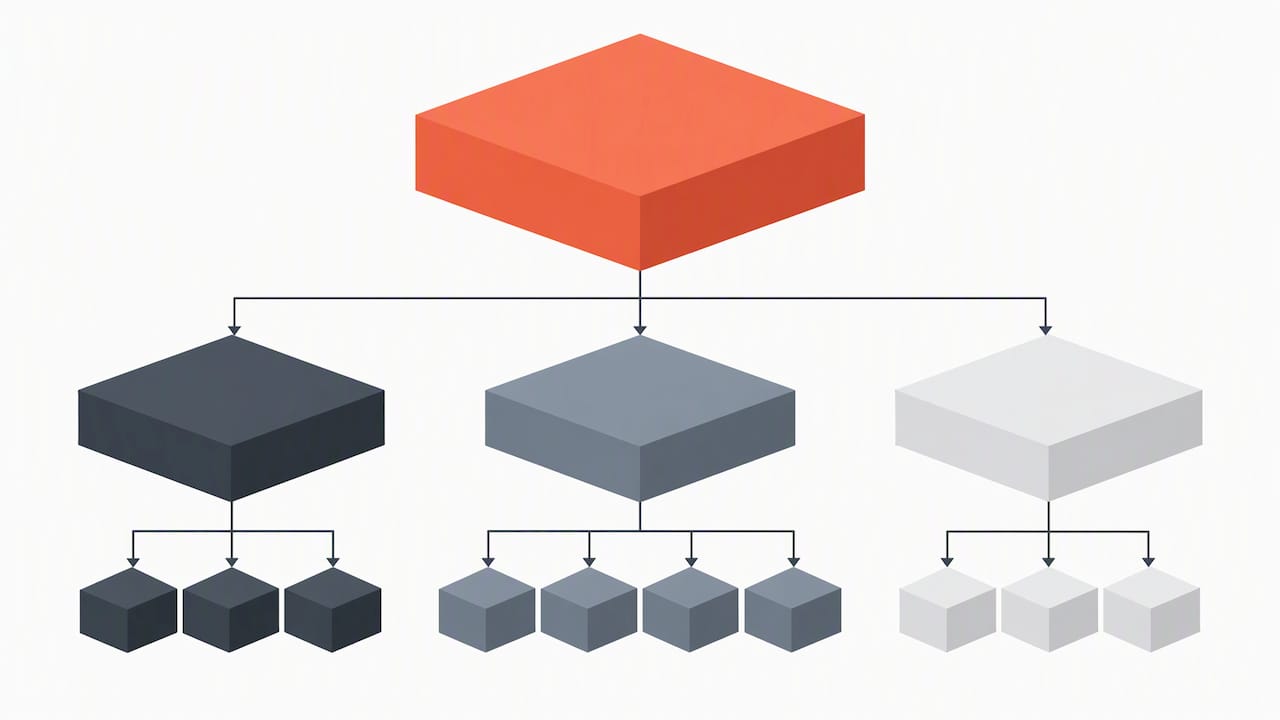
Stop breaking a package down when it is specific enough to assign, estimate, and track without turning the budget into a task-by-task diary. A motion project's "final film" might contain editing, sound, grade, and delivery versions. One person can be accountable for the package while several specialists do the work.
For each package, record the deliverable, owner, acceptance criteria, hours or units, direct expenses, and budget. On a larger program, formal control accounts combine scope, schedule, and cost for performance review; the GAO guide describes that federal-program structure. A small studio can use the simpler package roll-up without adopting every formal control.
Contingency and Reserves: Size Them From Risk, Not a Fixed Percent
A reserve is easier to defend when you can name what it covers. If a planned client review could reasonably require another short edit pass within the agreed scope, estimate that response and show it separately from the base edit hours. If the brief is too uncertain to identify the work, revisit the scope assumptions before presenting a firm baseline.
To size a useful allowance:
- List plausible in-scope risks. Name the event and the work it would create.
- Estimate the response. Use hours, quantities, or outside costs you can explain.
- State how the reserve is used. Agree who reviews a draw on it and how the baseline is updated.
- Revisit it as work progresses. A risk may disappear, materialize, or change as approvals arrive.
The GAO guide discusses uncertainty and management reserve in its federal-program setting. A separate discretionary reserve may suit a larger engagement, but it is not an automatic second line for every small creative job. Our guide to how to pick a defensible contingency reserve has a creative-project example.
Tracking and Reporting: Baseline, Reforecast, and Variance Controls
The baseline is the approved cost plan and its assumptions. Compare it with what has been recorded and what remains to be done. On a short edit, a review after each client feedback round may be more useful than a calendar rule. On a longer production, regular checkpoints can make a forecast change visible while there is still time to discuss it.
At each checkpoint, ask:
- What has been spent or recorded? Include project labor and expenses with evidence available so far.
- What is committed but not yet billed? A booked supplier or location can affect the forecast before an invoice arrives.
- What work remains? Check deliverables and progress, then update the cost to finish.
- What changed? Separate use of an in-scope risk allowance from new client work that needs its own scope and budget approval.
The resulting forecast is your current best estimate of the final cost, not a promise. The GAO guide recommends updating estimates with actual costs in its program context. For creative work, our tracking estimate versus actual spend guide goes deeper on comparing a baseline with the work. Roadbase can show tracked project and task hours against estimated hours; expense commitments and the full cash forecast still need their own review.
Templates and a Short Worked Example to Get Started Quickly
A working budget table can use these columns: phase or WBS code, deliverable, owner, hours or units, unit cost, direct subtotal, and assumption. Keep shared overhead and contingency as separate lines so they are visible in the roll-up.
Suppose a small motion studio is planning one short film with an agreed treatment, edit, and delivery package. For illustration, all three phases use a blended internal role cost of $80 per hour. That is a studio cost assumption, not a client billable rate.
| Phase and deliverable | Accountable owner | Hours | Internal cost | Labor subtotal |
|---|---|---|---|---|
| Treatment and pre-production | Producer | 10 | $80/hour | $800 |
| Edit and review | Editor | 20 | $80/hour | $1,600 |
| Finish and delivery versions | Motion designer | 15 | $80/hour | $1,200 |
| Direct labor | 45 | $3,600 |
Add $300 for a direct project expense, such as a quoted stock-footage license; $300 as the studio's documented overhead allocation; and $250 reserved for a named in-scope risk, one additional short edit pass after the planned client review. The internal cost budget is $3,600 + $300 + $300 + $250 = $4,450. Place the phase costs on the expected schedule if you need a cash timing view.
That $4,450 is not the client quote. A quoted price needs the studio's billable rates, target margin, and commercial judgment, with the deliverables and assumptions checked before it is sent. The software integration scoping example and annual report pricing breakdown show how this sort of roll-up changes in other fields. For a fixed-price job, decide how the in-scope allowance is covered in the quote; for a time-and-materials job, keep it visible in the internal forecast and the client conversation where relevant.
Practitioner Perspective: Where a Draft Helps Budgeting
A spreadsheet can add the numbers, but the difficult part often comes earlier: translating a brief into deliverables that can be estimated. A first draft of phases, tasks, roles, and hours can give a producer something concrete to challenge. Check it against the actual brief, review rounds, supplier costs, and your own cost data before treating the result as a budget. Use the draft to spot a missing review round or specialist handoff while the estimate is still easy to change.
Try Roadbase: Turn a Brief Into a Reviewable Plan and Quote
If you have a real brief or PDF and want to see the work beside the numbers, start a Roadbase project. Paste the brief or attach the PDF to create an editable first draft of phases, tasks, roles, hours, and timing. Review and adjust the packages against the deliverables before you quote.
Use your maintained role costs and rates to price the estimated hours, then review overhead, direct expenses, contingency, and target margin behind the quote. Keep those inputs current as you adjust the plan and price. When the plan and price are ready, export the reviewed proposal PDF. During delivery, tracked task hours can be compared with the estimate so the next review starts with recorded time.
For technical work, our software consulting estimate tools page applies the same plan-and-quote approach. You can compare Roadbase plans or explore Roadbase before starting.
FAQ
What should a project budget include?
For a defined project, include the labor and outside costs needed for the deliverables, a documented overhead allocation if you use one, and an allowance for identified in-scope risks where warranted. State the assumptions, owners, and timing needed to review the total. The categories will vary with the work.
What is the 70-10-10-10 budget rule?
The phrase is used for different suggested splits, so check what each number is meant to cover before applying it. For a specific project, estimate its deliverables and costs, then make any reserve reflect the risks you can name. A fixed split cannot substitute for that work.
What are the 7 elements of a project plan?
One useful planning checklist is scope, schedule, budget, quality expectations, resources, risks, and communication. It is a way to prompt review, not a required seven-part standard. The budget should reflect the deliverables, resource plan, and risks for this project.
How do I calculate the budget for a project?
List the deliverables, estimate the hours or units and their internal costs, add direct expenses and your documented overhead allocation, then include a response cost for any identified in-scope risk. Check the arithmetic and assumptions, place costs on the schedule if needed, and approve the total as a baseline. Price the client quote separately.
Sources
- Cost Estimating and Assessment Guide - U.S. Government Accountability Office
- Work breakdown structure: define the work before you build it - PMI