

Good, Better, Best Pricing: How to Build Three Tiers That Sell
Good, better, best pricing gives a client three ways to buy a service: a focused offer, a broader one, and an expanded one. The choice works best when each option solves a real version of the client's problem and the price reflects the work behind it. You can use the same idea for a branding project, a packaging rollout, or a software plan. The hard part is making the differences clear without guessing at costs or inventing a middle option simply to steer the sale.
TL;DR
- Give each tier a clear scope and price. Additive tiers are easy to read, but a stated tradeoff can be useful too.
- Set each price from its own estimated labor, expenses, overhead allocation, and contingency. There is no universal price-gap ratio for creative work.
- For a target gross margin, use
price = estimated cost / (1 - target gross margin). Check the estimate and the resulting margin for each option. - Give the tiers names and real differences in scope that help the client compare them; each option should work on its own.
- Define practical boundaries such as revisions, timing, support, and rights so the client knows what each quote covers.
Table of Contents
- What good, better, best pricing is
- How to set the price gaps
- Good, better, best compared with other pricing models
- Naming your tiers
- What the decoy effect really does
- Fences: keeping the tiers intact
- Good, better, best for AI and software plans
- Where Roadbase sits
- The perspective from Roadbase
- How to build three tiers for a client proposal
- Try it on your next quote
- FAQ
- Sources
What good, better, best pricing is
Good-better-best (GBB) is a way to show three distinct packages: entry, middle, and expanded. You may also see it called Goldilocks pricing or three-tier pricing. The packages give a buyer useful alternatives to compare, each with its own scope and price.
A single fixed quote asks the client to accept or decline one scope. Three quotes can instead show what changes if the budget, deliverables, or support change. That only helps if all three are credible offers.
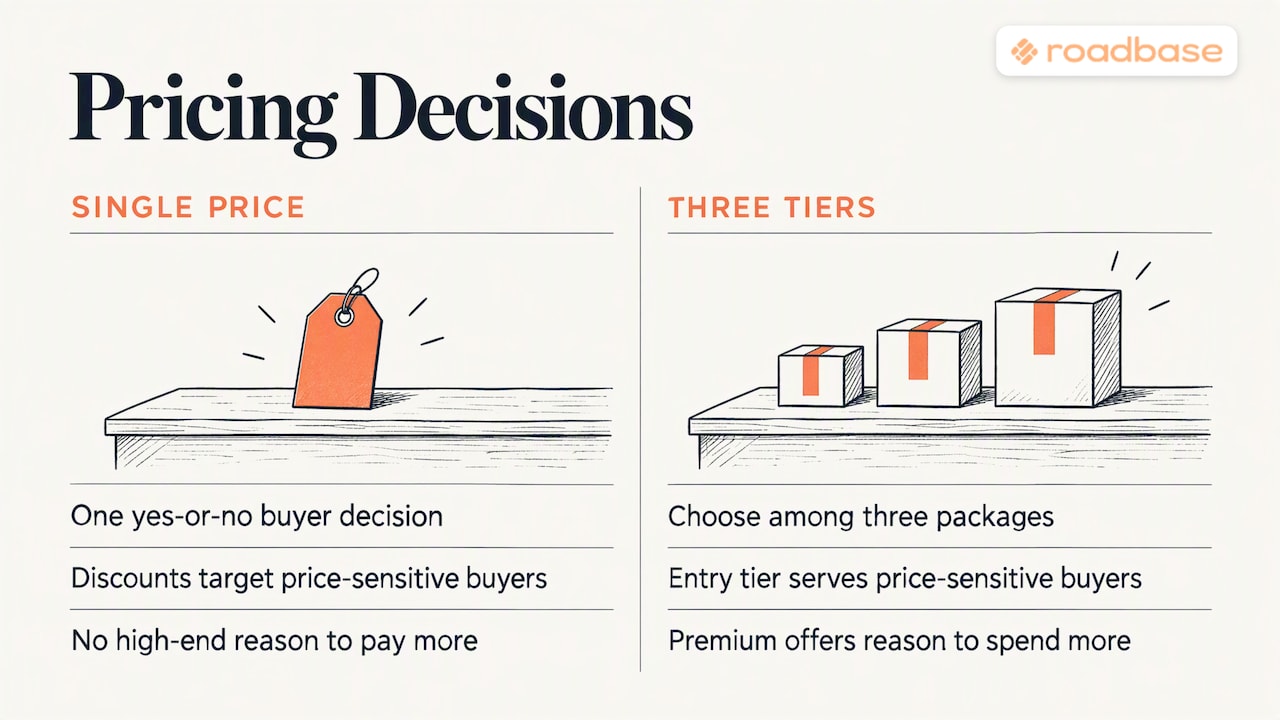
Harvard Business Review's account of the approach describes packages as an alternative to blanket discounting when customers want different levels of value. Once you have those alternatives, estimate the work behind each one so the choice makes sense for your client and for you.
The more-for-more rule
An easy pattern is "more for more": each step includes the preceding scope plus something the client values. A substitution can work as well. If a faster delivery replaces an extra concept route, say so plainly; the client should be able to compare the tradeoff without decoding a feature grid.
A branding studio might start with these options:
| Tier | What the client gets | When it may fit |
|---|---|---|
| Good | Logo and color palette, two revision rounds | A focused identity for a small launch |
| Better | Good plus a type system, brand guidelines, and a third revision round | A team that needs a repeatable identity system |
| Best | Better plus collateral templates, launch assets, and a defined support window | A larger rollout across several touchpoints |
These are examples, not a standard template. The number of concepts, decision-makers, rights, revision rounds, and delivery dates should come from the actual brief and your capacity.
How to set the price gaps
There is no magic distance between tiers. A larger step may be fair when it adds substantial work; a small step can still be confusing when the added deliverable has little value to the client.
Zuora's good-better-best discussion looks at subscription tiers. For a creative quote, let the added work and its value to this client guide the gap. Start with the work in each offer:
- Estimate the hours by role and the cost of delivering them, using your actual role costs. Add project expenses, an overhead allocation, and contingency where they belong.
- Set a target gross margin and calculate a candidate price as
estimated cost / (1 - target gross margin). The resulting modeled margin is(price - estimated cost) / price. For ideas on arranging deliverables across tiers, see AgencyPro's package guide. - Estimate the added work in Better and Best separately. Don't assume an upgrade inherits Good's cost or margin unchanged.
- Compare the quotes with what this client values and what you can deliver. A market comparison may prompt another look at scope, positioning, or costs; it doesn't diagnose underpricing by itself.
For example, a web designer estimates 40 hours at a $75 loaded delivery cost per hour. If that $3,000 includes the costs being modeled, a 40% target gross margin gives a candidate price of $3,000 / 0.6 = $5,000. At $5,000, the modeled gross margin on that $3,000 estimate is 40%. If expenses, overhead, or contingency sit outside the $3,000, add them before making that calculation.
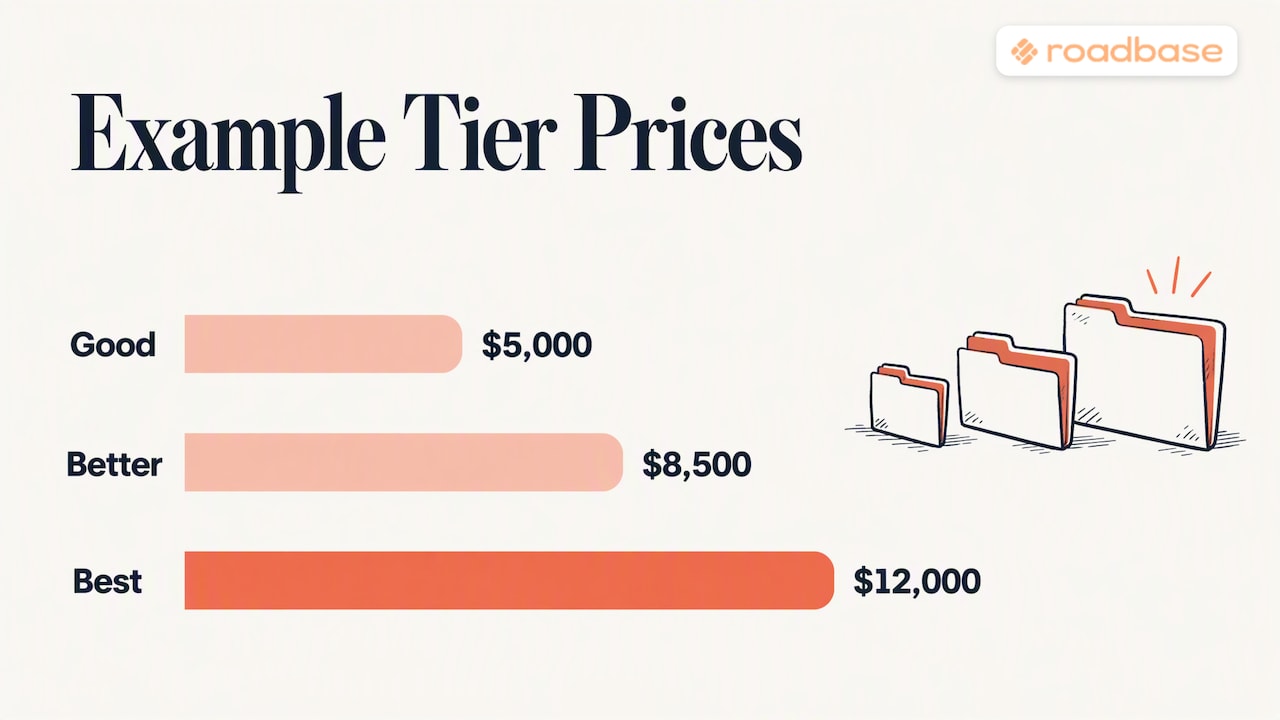
- Good, $5,000: a five-page site and two revision rounds.
- Better, $8,500: add CMS setup, basic SEO structure, another revision round, and a training call.
- Best, $12,000: add custom illustrations, analytics setup, and a defined period for post-launch changes.
The latter two prices illustrate a possible offer ladder; their margins are unknown until their own labor and other costs are estimated. Our freelance profit margin calculator is a further place to work through the distinction between margin and markup.
Good, better, best compared with other pricing models
Three packages are one way to present a quote. The right model depends on how well you can define the work and how the client wants to buy it.
| Model | Useful when | Tradeoff to manage |
|---|---|---|
| Good, better, best | The client has meaningful scope or service-level choices | Each option needs its own estimate and clear boundary |
| Single fixed price | One scope is already clear and sufficient | Assumptions and change requests still need to be explicit |
| Hourly | Duration or the work itself is uncertain | The buyer's total spend can vary |
| Retainer | There is continuing work with an agreed boundary | Define what is included and how extra work is handled |
| Usage-based | Software usage is measurable | Buyers need a way to forecast likely spend |
Models can mix. A B2B SaaS pricing case description shows one way to combine packages with per-user and usage pricing. For a client service, you could similarly package a defined project scope while pricing separately for work whose quantity is uncertain.
For the proposal itself, see our proposal pricing table guide and broader professional services pricing guide.
Naming your tiers
Names shape how a buyer reads the choice, but they won't repair unclear scope. Research on hierarchical labels in tiered plans found that superior-sounding labels changed choices in its studied settings, including a shift toward cheaper options. Choose names that describe the work instead of trying to steer a client toward one tier.
For a branding brief, descriptive names such as "Launch," "Identity System," and "Full Rebrand" may make the scope easier to scan than metals or generic rankings. Name the deliverables underneath as well: a label should help the client understand the offer, not make them guess what they receive.
What the decoy effect really does
The decoy effect is the idea that a clearly inferior option can make a neighboring option look more attractive. The effect changes across the kinds of choices and descriptions studied, as this discussion of decoy pricing explains. For a client proposal, give each option a purpose instead of adding a weak tier to make another look good.
In a proposal, style, trust, timing, rights, and review work can all matter. Make every tier useful in its own right. If the client chooses Good, it should still be work you are prepared to deliver at that price.
Fences: keeping the tiers intact
A package boundary tells both sides what the quote includes. Commercial pricing and packaging commentary calls it service-level leakage when higher-service work is routinely given under a lower-tier price. For a creative business, the practical answer is to write the boundary in terms the client can use:
- Revision rounds. Say what counts as a round, how many are included, and how extra rounds are priced.
- Turnaround. Promise a faster schedule only when the team and client approvals can support it.
- Contact and support. Define meetings, response expectations, and the support window if they differ.
- Usage rights. State the project-specific rights and licensing terms for the work being quoted.
- Deliverable limits. For packaging, video, or events, name quantities such as SKUs, cutdowns, or on-site days.
The entry offer should solve a real problem, even if its scope is smaller. SBI's SaaS pricing report considers what belongs in an entry plan. For a creative proposal, define the smallest scope that still meets the client's stated need.
Good, better, best for AI and software plans
Software packages often use access or usage limits rather than project deliverables. AI features make the choice more specific: what is available in each plan, how usage is measured, and what a buyer can expect from it. BCG's analysis of AI software pricing explores those choices. Spell out the actual feature and usage difference for the buyer instead of relying on a broad "AI included" label.
If you are deciding where an AI feature belongs, estimate its real costs and test whether users value it at that level. A three-tier approach to assessing AI investments can prompt questions about expected return and risk; use your own usage and cost figures to answer them.
Where Roadbase sits
Roadbase is a quote-first planning and pricing workspace for creative freelancers and small teams. Its current plans and any extra AI use are described on the pricing page; check that page when you compare subscriptions. Our guide to AI tokens explains the usage side in more detail.
For a client quote, Roadbase can take pasted brief text or an attached PDF and give you an editable first draft of phases, tasks, roles, and estimated hours. You can then review those assumptions, price hours using the role costs and rates you supply, and check labor, overhead, expenses, contingency, and target margin beside the quote. Once the plan reads correctly, you can export the reviewed plan and quote as a proposal PDF.
The perspective from Roadbase
Our view is to understand the work before choosing the three prices. List the phases, roles, hours, review rounds, and known expenses; then decide which scope belongs in each option. A quote becomes easier to explain when the client can see what each step adds and you can see what it costs to deliver.
Roadbase helps turn a brief into an editable work breakdown and quote draft. To compare Good, Better, and Best, review and adjust the scope and cost assumptions for each proposed offer. The six-step AI project scoping playbook has a fuller account of reviewing a draft plan. Every tier should stand as a service you would be comfortable delivering at its quoted price.
How to build three tiers for a client proposal
- Scope the project. List the deliverables, tasks, roles, estimated hours, approvals, and unknowns. Our agency quoting process guide shows a way to structure that review.
- Cost the base work. Use the role costs you actually carry, plus direct expenses, overhead allocation, and a considered contingency. A neat tier table cannot rescue an incomplete estimate.
- Choose a target margin. Use
cost / (1 - target gross margin)to model a price, then check what the resulting number means for this brief. Repeat after changing the scope. - Build useful alternatives. Put the essential outcome in Good, add work with a clear reason in Better, and reserve a broader delivery or service level for Best. If one option trades speed for breadth, show the tradeoff.
- Check each price gap. Compare the added price with the added work and value. A ratio alone cannot tell you whether the step is fair or clear.
- Write the boundaries. State revision rounds, timing, support, quantities, assumptions, and any project-specific rights.
- Present the offers side by side. A clear pricing table helps the client see the actual differences.
- Review responses over time. After several proposals, look at which scopes clients understood, what they requested, and how delivery compared with the estimate. Adjust the offers using those observations, not a presumed ideal tier mix.
A client choosing Good may simply have a narrower need. Ask what drove the choice before concluding that another tier or price is wrong.
Try it on your next quote
Have a real brief, notes, or a PDF? Put it into Roadbase to get an editable plan and quote draft. Review the phases, hours, costs, and margin assumptions; then adjust the work for each offer you want to show the client. When a version is ready, export the reviewed proposal PDF. You can compare current plans on the Roadbase pricing page. For examples in other disciplines, see the pages for software consultants and web and app studios.
FAQ
Is three tiers always the right number?
No. Three can show a focused, broader, and expanded version of an offer, but one fixed quote may be enough for a clearly scoped job. Two or four can also fit if the differences are meaningful. If you are packaging software, SaaS tiering examples give you structures to compare. Choose the number that makes your client's decision clearer.
Should the middle tier be the most profitable?
It should be a useful, viable offer, but it does not have to earn the highest margin. Estimate the costs and margin of every tier separately. If clients prefer one option, find out what they value about it before changing the other packages.
How big should the gap between tiers be?
There is no universal percentage or 2x ceiling for creative proposals. Estimate the work and cost of each tier, set a price against your target margin, then check whether the added scope and price make sense to the client.
Does good, better, best work for freelancers?
Yes, when you can describe distinct, deliverable scopes. A freelancer might offer a focused identity, an expanded system, and a larger rollout. For a single clear task, one quote can be simpler; for uncertain ongoing work, an hourly or bounded retainer arrangement may fit better.
Sources
- The Good-Better-Best Approach to Pricing, Harvard Business Review
- Mastering the Good-Better-Best Strategy, Impact Pricing
- Tapping into subscriber psychology with good-better-best, Zuora
- How to create agency service packages, AgencyPro
- A B2B SaaS pricing transformation case description, RNG Strategy Consulting
- The impact of hierarchical labeling in tiered pricing plans, springerprofessional.de
- Decoy Effect Pricing, Money&Planet
- Pricing and Packaging Strategy for B2B Offers, Acustrategy
- 2025 State of SaaS Pricing, SBI Growth
- Rethinking B2B Software Pricing in the Era of AI, BCG
- Tiered Pricing Strategy Guide for SaaS, Maxio