

48 Hours to a Reliable Agency Quoting Process Using AI
A practical quoting workflow is to capture the brief, break the work into tasks, estimate it, review the pricing, and share the proposal when the details are ready. Use a paid discovery phase whenever the scope is genuinely unclear.
TL;DR:
- Define deliverables and exclusions before you estimate, then record the assumptions that shape the quote.
- Bottom-up estimation involves delivery expertise at task level and is useful when a project needs that level of detail.
- Present options when they clarify meaningful choices in scope, timing, or deliverables.
- Agree an internal follow-up rhythm so the client knows how to ask questions and what happens next.
- Roadbase can turn pasted brief text or an attached PDF into an editable draft work breakdown and quote; review and adjust it before exporting a proposal PDF.
Table of Contents
- What Is the Agency Quoting Process, Step by Step?
- Which Estimation Method Should You Use?
- Should You Offer Tiered Pricing Options?
- How Do You Write Scope That Prevents Disputes?
- How Fast Should You Send a Proposal, and What Comes After?
- What Tools Actually Manage Quotes Well?
- How Do You Get the Right Information Before Quoting?
- How Do You Handle Pushback on Price?
- What Legal Terms Belong in Every Proposal?
- What Does a Well-Structured Quote Look Like?
- Who Should Approve a Quote Before It Ships?
- What AI Actually Changes in the Brief-to-Quote Workflow
- Automate the Quote Workflow With Roadbase
- Sources
- FAQ
What Is the Agency Quoting Process, Step by Step?
The agency quoting process turns a client brief into a proposal you are ready to share. The useful sequence is the same across most creative and project-based work.
- Capture the brief reliably. Use an intake form, a recorded discovery call, or a single shared notes document. Confirm assumptions in writing before you estimate anything.
- Break the work into a WBS. Split the project into phases, then tasks, then subtasks, each tied to a specific deliverable. A website redesign might break into discovery, wireframes, design, development, QA, and launch.
- Estimate hours per task. Whoever does the work should weigh in on the estimate whenever possible. A designer's view of a "quick logo tweak" can surface detail a project lead might miss.
- Choose the contracting model. Decide fixed-price, time-and-materials, or a phased hybrid, and decide whether to quote a paid discovery phase before committing to the full scope.
- Assemble the proposal. Structure it around a summary, the proposed solution, deliverables, investment, timing, and next steps.
That structure helps a reader understand what is being proposed. A proposal that leads with the client's problem and the work you plan to deliver, instead of your company history, is easier to review. A guide on turning messy briefs into clean quotes is useful companion reading for the same sequence.
Which Estimation Method Should You Use?
Four methods cover many projects. Pick the method that matches the information you have and the level of uncertainty in the work.
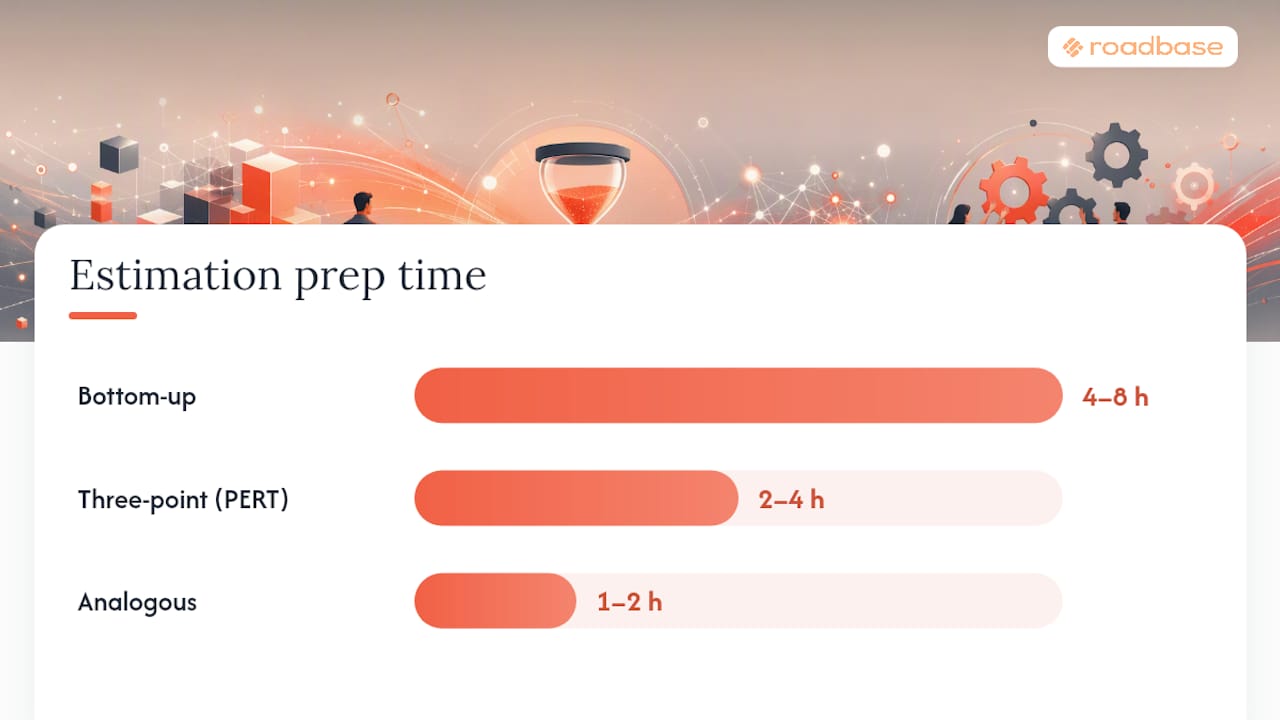
- Bottom-up estimation sums hours at the task level. It calls for input from people close to the delivery work and suits projects that need a detailed breakdown. The AgencyPro estimation guide is companion reading on the method.
- Analogous estimation uses a similar past project and adjusts for scale, team, and scope differences. It is useful when the comparison is genuinely relevant.
- Three-point (PERT) estimation considers optimistic, likely, and pessimistic cases. It can be useful when a task has material uncertainty.
- Top-down estimation starts from a budget ceiling and works backward. Treat it as an early conversation tool, then test it against the work that would actually be delivered.
Contingency: identify the assumptions and risks that could change the work, then decide what contingency is appropriate for this quote. Record the reasoning so it can be reviewed with the estimate.
Once you have hours, review the labor, overhead, direct expenses, contingency, and target margin using cost and rate inputs you maintain. Compare with relevant past work where the inputs are comparable. A piece on estimating project hours before quoting is companion reading on that conversion.
Should You Offer Tiered Pricing Options?
Offer options when they make a real difference in the work, timing, or deliverables. The point is to give the client clear choices, not to steer them toward a predetermined option.
Structure tiers around outcomes and deliverables, not a feature checklist:
- Basic: the minimum viable version of the deliverable, with a clear boundary around what is included.
- Recommended: the version you would propose for the stated brief and assumptions.
- Premium: added scope, timing, or support that changes the work in a material way.
Match the contracting model to the risk profile. Fixed-price works when the WBS is solid and the scope is well defined. Time-and-materials suits open-ended or evolving work. A phased hybrid can separate discovery from later work.
Build an "investment at a glance" table near the pricing section: tier name, price, timing, and what is included. State the quote's validity window and any start-date assumptions that matter. Decision-makers often scan this section first.
How Do You Write Scope That Prevents Disputes?
Specific scope gives both sides a clearer basis for reviewing the work. It does not replace appropriate agreement or legal review.
- Make deliverables countable. Instead of "social media graphics," write "12 Instagram carousel graphics, 3 revision rounds included, delivered as layered PSD and PNG files."
- Write explicit exclusions. State what is not included: stock photography licensing, paid ad spend, third-party plugin costs, translation into additional languages, or other project-specific items.
- Set revision limits and approval points. Name the client-side approver, describe the review process, and state any timing assumptions that affect the plan.
- Define change-request handling. Describe how work outside the listed deliverables will be discussed, estimated, and documented before it is added.
- Watch for red flags before you quote. A client who cannot name a decision-maker, a brief that changes on every call, or a scope that keeps expanding during discovery may need a paid discovery phase before a full quote.
A guide to preventing scope creep in creative projects offers companion reading on writing clearer scope language.
Pro Tip: Put your exclusions list on the same page as your deliverables list, not buried in an appendix. Clients are more likely to see it while they review the price.
How Fast Should You Send a Proposal, and What Comes After?
Set a response rhythm your team can meet without rushing the review. The agency proposal guide is companion reading, but the right timing depends on the brief and the work needed to scope it.
Present live when it is useful, whether on a call or in person, and invite questions about scope or pricing. A practical follow-up plan can be simple:
- Confirm receipt and offer to walk through the proposal.
- Check whether questions relate to scope, timing, or pricing.
- Agree the next review point rather than relying on an open-ended chase.
- Update the proposal only when the underlying brief or assumptions change.
Use any available information as a prompt for a conversation, not as proof that the client has reached a decision. Whether a proposal proceeds or not, record what you learned about the brief and the estimating process.
What Tools Actually Manage Quotes Well?
A spreadsheet can work for a simple quote. As a project gains phases, dependencies, and revision cycles, the important question is whether the team can still review the same assumptions, work breakdown, and quote inputs.
For a brief with more moving parts, look for a workspace that keeps an editable work breakdown, role-based estimated hours, and quote inputs together for review. Choose tools based on the workflow you need, including how you maintain your own costs and rates.
Where completed task data includes correctly linked tracked time, Roadbase can pass role-level estimate-versus-actual context into a later AI draft. That context depends on the relevant data being present; it is not an automatic correction or a promise that a later estimate will be accurate.
How Do You Get the Right Information Before Quoting?
Bad estimates often begin with incomplete inputs. A structured intake makes the gaps visible before you assign hours.
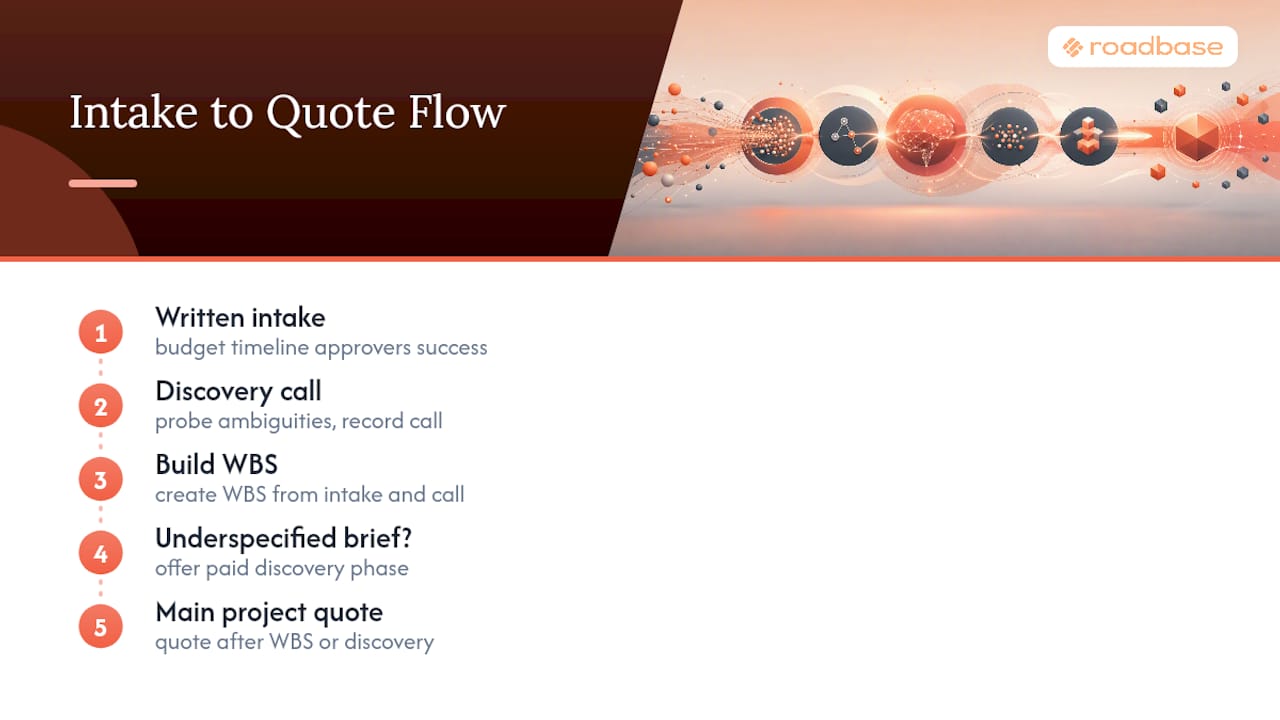
Use a written intake form for each inquiry, covering budget range, timing constraints, decision-makers, and what success means to the client. Follow it with a discovery call to clarify ambiguous points, and keep the notes in one place.
Ask about budget range early. Ask who signs off on the work and how many stakeholders will review deliverables. Ask what "done" looks like in the client's own words. Those answers shape the assumptions you need to document.
If a brief is still underspecified after intake and a call, consider a paid discovery phase rather than treating unknowns as settled scope.
How Do You Handle Pushback on Price?
Objections during quoting often relate to price, timing, or uncertainty about scope. Treat each as a request to clarify the work and assumptions.
When a client says the number is too high, ask what budget they expected and what they are comparing it with. If the scope needs to change, discuss the affected deliverables or phases rather than changing a number without changing the work.
When a client wants a faster timeline, discuss the scheduling assumptions, availability, and implications for the proposed work. Do not promise a timeline until the team can review it.
When a client is unsure about the approach, use a relevant past example or explain the proposed phases. Keep the conversation tied to what will be delivered and what needs review.
What Legal Terms Belong in Every Proposal?
Proposals and agreements serve different purposes, and legal requirements vary by jurisdiction and engagement. Treat this section as general educational guidance, not legal advice.
Before work begins, make sure the parties understand the deliverables, exclusions, review points, change-request handling, and the next action. For terms about payment, ownership, liability, cancellation, or governing law, use an agreement appropriate to the engagement and obtain legal review where needed.
Clear, plain language helps people discuss the commercial arrangement, but it does not replace legal advice or a suitable agreement.
What Does a Well-Structured Quote Look Like?
A useful quote gives a client a clear way to review the proposed work. Here is the anatomy, section by section:
Summary: two or three sentences restating the client's problem in your own words.
Proposed solution: the approach you recommend, written for a decision-maker skimming on a phone.
Deliverables: a countable list, phase by phase, tied to the WBS you built earlier.
Investment at a glance: the pricing table with tiers, what is included in each, and the validity window.
Timeline: milestones and timing assumptions, including when client input or review is needed.
Next steps: the specific discussion or action needed to move the proposal forward.
A one-page project might compress this into a single document with a short pricing table. A multi-phase engagement might need a fuller document with a milestone chart. The section order can stay consistent while the depth changes.
Who Should Approve a Quote Before It Ships?
A deliberate review before sharing a quote helps the team check that the proposal matches the brief. Even a solo freelancer can set aside time to re-read the scope, assumptions, and numbers.
For a team, decide who reviews a quote before it is shared. The reviewer can check whether the WBS matches what was discussed with the client, whether assumptions and contingency are visible, and whether the commercial inputs reflect the current rate and cost information.
Make review a normal part of the workflow. A small project can still benefit from a careful check of its phases, assumptions, and current inputs.
What AI Actually Changes in the Brief-to-Quote Workflow
AI can make a first draft easier to start, but it does not remove the need to review the work. Paste a brief or attach a PDF, then use Roadbase to generate an editable first draft with phases, tasks or milestones, roles, estimated hours, timing, and estimate reasoning. Review and adjust the plan, assumptions, and commercial judgment before pricing it or exporting a proposal PDF.
The Roadbase link is useful companion reading for the workflow. The draft is a starting point: the person responsible for the quote still needs to decide whether the work, assumptions, and inputs reflect the engagement.
Automate the Quote Workflow With Roadbase
When a real brief is ready to turn into a quote, Roadbase lets you paste the brief or attach a PDF and generate an editable project-plan draft. Review the phases, tasks, roles, estimated hours, timing, assumptions, labor, overhead, direct expenses, contingency, and target margin, then export a proposal PDF when it is ready.
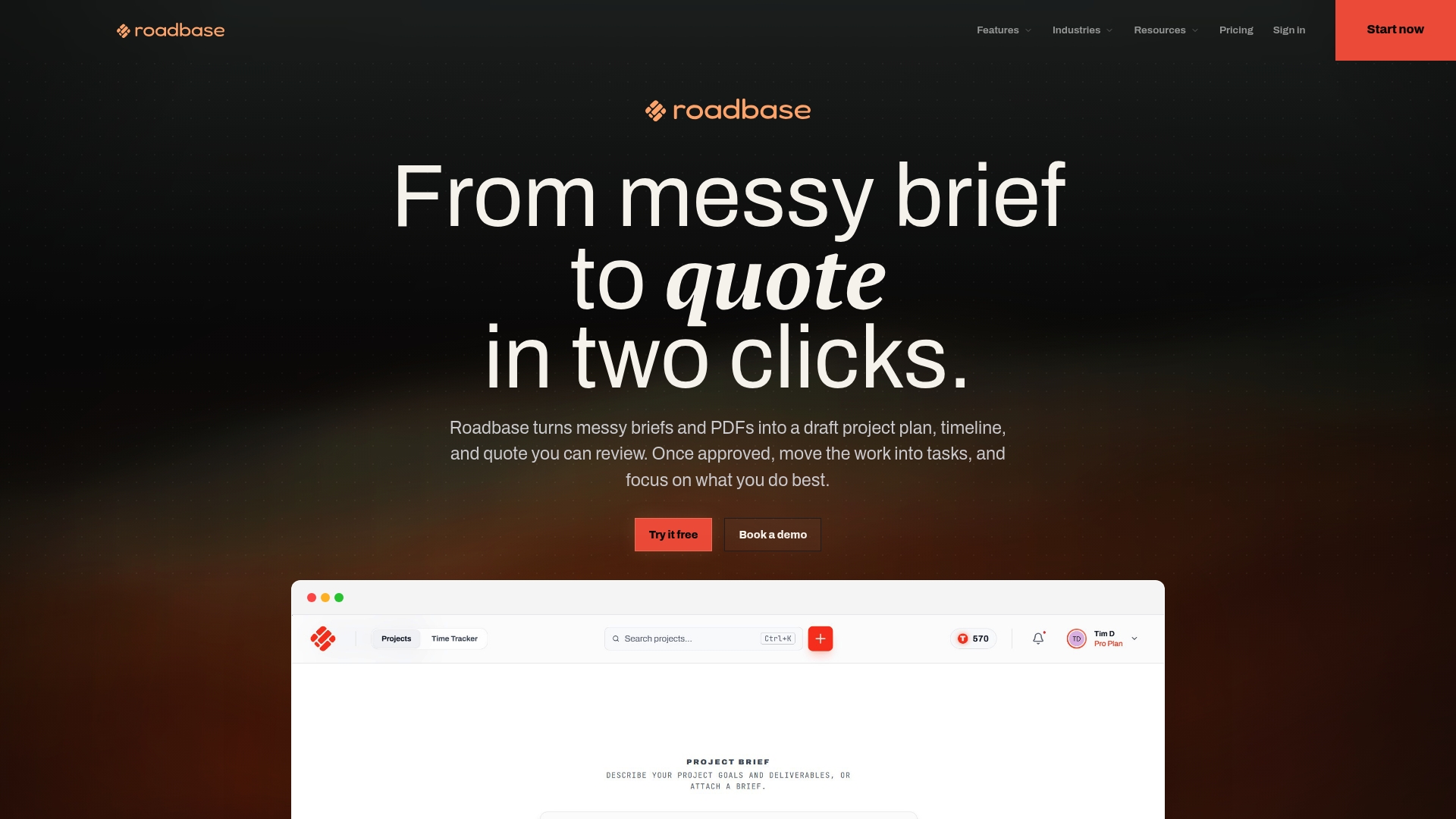
If the brief is real but the work is scattered across notes, bring it to Roadbase. Start with an editable draft plan and quote, review and adjust the details, then export a proposal PDF when it reflects the work you are prepared to deliver.
The freelancer and small agency landing page is a neutral way to explore the workflow for projects like yours.
Sources
- Agency Project Estimation: Stop Losing Money | AgencyPro
- The Complete Agency Proposal Guide 2026: How to Win More Clients | Pitchsite
- How to Write Agency Proposals That Win | Yuktis
FAQ
How Long Should an Agency Quoting Process Take?
Set a timeline that allows for a clear brief, a considered estimate, and a review before the proposal is shared. Larger or multi-phase bids may need more time than a straightforward engagement.
What Is the Most Accurate Estimation Method?
Bottom-up estimation sums hours at the task level and benefits from delivery expertise. Its usefulness depends on the quality of the brief, assumptions, and review.
How Big Should a Pricing Buffer Be?
Decide contingency from the assumptions and uncertainties in this project, then document the reasoning. Review it alongside the scope, costs, and target margin.
Should I Offer Multiple Pricing Tiers?
Offer options when they make meaningful differences in scope, timing, or deliverables and help the client compare the work.
Can AI Tools Speed Up the Quoting Process?
AI can help create an editable draft task breakdown from pasted notes or a PDF. In Roadbase, review and adjust the plan and quote before exporting a proposal PDF; where correctly linked tracked-time data exists, role-level estimate-versus-actual context can inform a later AI draft.