
One Page Proposal: A Fast, Scannable Template That Wins
A one page proposal is a single page that names the client's problem, your solution, deliverables, timeline, price, and next step, all in one place. Use it for early qualification, small or expansion deals, or whenever a buyer asks for something short. It works only when it passes the 30-second scannability rule, shows a three-milestone timeline, quotes a single price, and gets drafted fast.
Key Takeaways
A one page proposal converts fastest when it states one price, three milestones, and a clear next step inside a single scannable page.
| Point | Details |
|---|---|
| Definition matters | A one-pager states problem, solution, deliverables, timeline, price, and CTA on a single page. |
| Pass the 30-second test | Design for a skim: bold the price, deadline, and client name so they're unmissable. |
| Use the right structure | Eight sections, one price, three milestones, and a signature line close the loop. |
| Know its limits | Complex, multi-stakeholder procurements need a longer proposal, not a one-pager. |
| Draft with Roadbase | Roadbase can turn pasted brief text or an attached PDF into an editable draft of the work breakdown, which you review and adjust before exporting a proposal PDF. |
Table of Contents
- What Is a One Page Proposal, and When Should You Use One?
- Why a One-Page Format Wins More Small Deals
- What Goes Into a High-Converting One-Page Proposal?
- How Do You Write a One-Page Proposal Step by Step?
- How Should You Format the Page for a 30-Second Read?
- What Mistakes Sink Most One-Page Proposals?
- Where Can You Get a Template That's Ready to Send?
- A Fill-In Template You Can Use Today
- How Do You Handle Objections Before They're Raised?
- When One-Pagers Actually Work in Practice
- How Roadbase Turns a Messy Brief Into a One-Pager Fast
- Sources
- FAQ
What Is a One Page Proposal, and When Should You Use One?
A one page proposal is a compressed version of a full business proposal: same core intent, one-tenth the real estate. Its job is to confirm alignment, trigger a meeting, or get fast approval, not to close a six-figure enterprise deal on its own. Business proposals share the same basic components everywhere), a title, a problem and solution, pricing, and terms; the one-pager just refuses to let any of them run long.
Reach for it after an early discovery call, when expanding scope with an existing client, for small fixed-price projects, or when a buyer flat-out asks for a summary instead of a deck.
- Do: Lead with the price, use the client's own words in the problem statement, and keep deliverables to a short numbered list.
- Don't: Bury pricing on page two of a "one-pager," pad it with company history, or use it for complex RFPs with multiple stakeholders and approval layers.
Why a One-Page Format Wins More Small Deals
Speed is the whole pitch. A shorter document travels faster inside a buyer's inbox, gets forwarded without editing, and forces you to lead with the client's actual problem instead of your company backstory.
- Decisions move faster because there's nothing to skim past.
- Internal stakeholders forward a single page far more readily than a 12-page PDF.
- The format forces clarity: if you can't state the deliverable in one line, you don't understand the scope yet.
- Friction drops because there's no navigating between sections to find the price.
Design every one-pager to survive the 30-second read test: a busy executive scanning top to bottom should land on price and next step without scrolling. Simple, outcome-focused proposals consistently outperform longer PDFs stuffed with background nobody asked for.
What Goes Into a High-Converting One-Page Proposal?
Every effective one-pager follows the same skeleton. Shopify's guide to business proposals and Adobe's proposal-writing framework both converge on the same core components, just compressed here into one page instead of ten.
- Title -- name, project, and date. No tagline.
- Problem statement -- one to two sentences, in the client's own language, not yours.
- Solution -- three high-level bullets, no jargon.
- Deliverables -- three to five numbered items, each concrete and countable.
- Timeline -- three milestones, dates optional but strongly recommended.
- Investment -- a single price. No tiers, no menu.
- Terms -- validity window and payment terms, one line each.
- CTA and signature -- a clear next action plus a place to sign.
Formatting matters as much as content. Quote the client's own phrase for the problem ("our checkout abandons at 40%" beats "improve conversion optimization"). Number deliverables so they're countable at a glance. Put timeline and pricing in a simple table instead of prose paragraphs.
Bad: "We'll help streamline your operations and improve efficiency." Good: "You're losing 6 hours a week to manual invoice entry. We automate that in three weeks."
Pro Tip: If a deliverable can't be checked off with a yes or no, it's not a deliverable yet. Rewrite it until it is.
How Do You Write a One-Page Proposal Step by Step?
Follow this order and you can move from blank page to sendable draft in under an hour.
- Confirm scope, budget range, and decision-maker with the client before you write anything.
- Draft a title using the project name and client name.
- Write the problem statement using the client's exact words from your notes or call.
- Write three solution bullets tied directly to that problem.
- List three to five numbered deliverables.
- Set three milestones with realistic dates.
- Set a single price and one line of payment terms.
- Write the CTA and add a signature line.
For a genuine fast draft, Adobe's step-by-step proposal process compresses into roughly 30 minutes: five minutes to pull notes together, ten to draft the problem and solution, ten for deliverables and timeline, and five to set price and terms.
Before sending, run this checklist:
- Read it out loud. If you stumble, a client will too.
- Confirm every dollar figure adds up correctly.
- Check that milestone dates don't overlap or contradict each other.
- Cut every sentence that doesn't move the buyer toward "yes."
Pro Tip: Send the draft to a colleague who wasn't on the client call. If they can restate the problem and price in ten seconds, you're done.
How Should You Format the Page for a 30-Second Read?
Layout decides whether your content ever gets read. Use a clear header hierarchy, short paragraphs (two to three lines max), and bold the client's name, the price, and the deadline so they jump out on a skim.
- Leave generous margins and avoid squeezing text edge to edge.
- Use a readable body font at 10 to 11 points, nothing smaller.
- Put pricing and milestones in a simple two-column table rather than a paragraph.
- Skip a full-page logo or letterhead; a small header logo is plenty.
Design research on white space confirms that dense text blocks slow readers down and hurt comprehension, while clear visual hierarchy keeps a reader moving through the page.
Pro Tip: If your one-pager needs two columns to fit, that's a signal to cut content, not shrink the font.
What Mistakes Sink Most One-Page Proposals?
Small errors do more damage on a single page, since there's no room to bury them.
- Vague problem statement -- fix it by quoting the client's own words from your notes.
- Buried pricing -- put the price in its own labeled row, never inside a paragraph.
- Too many deliverables -- cap the list at five; move extras to a follow-up scope document.
- No clear next step -- end with one specific action, not "let us know your thoughts."
- Over-designing -- a heavy template with stock photos reads as filler, not professionalism.
If the deal involves multiple decision-makers, a formal procurement process, or a scope too complex to summarize honestly in five bullets, a longer, multi-page proposal is the right tool instead.
Where Can You Get a Template That's Ready to Send?
Editable one-page proposal templates exist across most common formats, and picking the right one depends on how the client prefers to receive documents.
- Google Docs -- fastest for quick edits and easy client commenting.
- Word -- best when a client's procurement team expects a native document format.
- PDF -- the safest choice for final delivery since layout never shifts across devices.
- One-slide deck -- useful when the proposal doubles as a meeting visual.
Adapt the template to industry without adding length: swap generic deliverable language for sector terms (sprints for software work, revision rounds for creative work), but keep the same eight sections. Roadbase's proposal software guide breaks down which format fits which client relationship in more detail.
A Fill-In Template You Can Use Today
Copy this structure, fill the blanks, and you have a sendable draft in minutes.
[Client Name] x [Your Company] Proposal -- [Date]
Problem: [Client] is currently losing [specific cost/time/impact] because [root cause].
Solution:
- [Bullet 1]
- [Bullet 2]
- [Bullet 3]
Deliverables:
- [Deliverable 1]
- [Deliverable 2]
- [Deliverable 3]
Timeline: Milestone 1 ([date]) -> Milestone 2 ([date]) -> Milestone 3 ([date])
Investment: $[amount], due [terms]
Valid through: [date]
Next step: [Signature line] Approved by: ______________
Filled example: "Acme Co is losing an estimated 6 hours a week to manual invoice entry. We'll build an automated intake flow, integrate it with your accounting software, and train your team, delivered in three weeks for $4,200, due on kickoff and completion." A structured deliverables and milestones template can help you phrase this section for other project types.
Before sending: double-check your math, confirm the validity date hasn't passed, and verify every contact detail is current.
How Do You Handle Objections Before They're Raised?
The one-page format can't accommodate a lengthy FAQ, so the best proposals address objections preemptively, inside the existing structure, rather than adding a new section.
Price pushback usually comes from ambiguity, not the number itself. State the price once, clearly, with what it includes listed right next to it in the deliverables section. A buyer who sees exactly what $4,200 buys is far less likely to ask "why so much" than one staring at a bare figure.
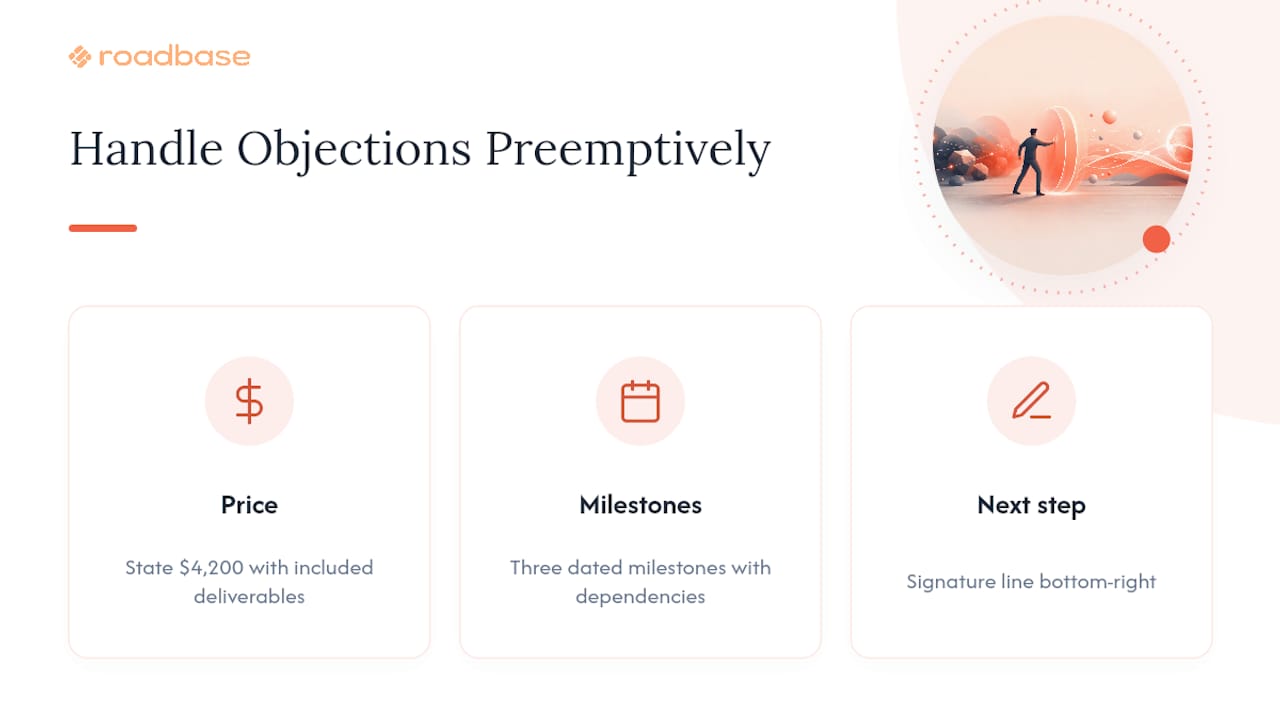
Timeline skepticism gets handled by the milestone table itself. Three dated milestones with visible dependencies read as more credible than a vague "3 to 4 weeks," because they show you've actually thought through the sequence of work.
Scope creep worries, common with clients who've been burned before, get addressed by numbering deliverables tightly. A numbered list implicitly signals "this and nothing more" without needing a defensive paragraph about change orders.
If you know a client will ask about your process or credentials, fold one line into the solution bullets rather than adding a new block. For example: "We'll run this using the same phased approach we used on your last two projects." That's a credibility signal disguised as a solution bullet, and it costs zero extra vertical space.
The objections you can't resolve on the page (contract terms, liability, multi-year commitments) are the clearest sign you've outgrown the one-page format for this particular deal.
When One-Pagers Actually Work in Practice
A one-pager can work well as an early qualification tool when you follow up promptly.
Send the proposal, then follow up within 48 hours with a short note or meeting invite, using the one-pager itself as the agenda. That keeps momentum without requiring a second document.
Turn a Brief into a Reviewable Plan and Quote
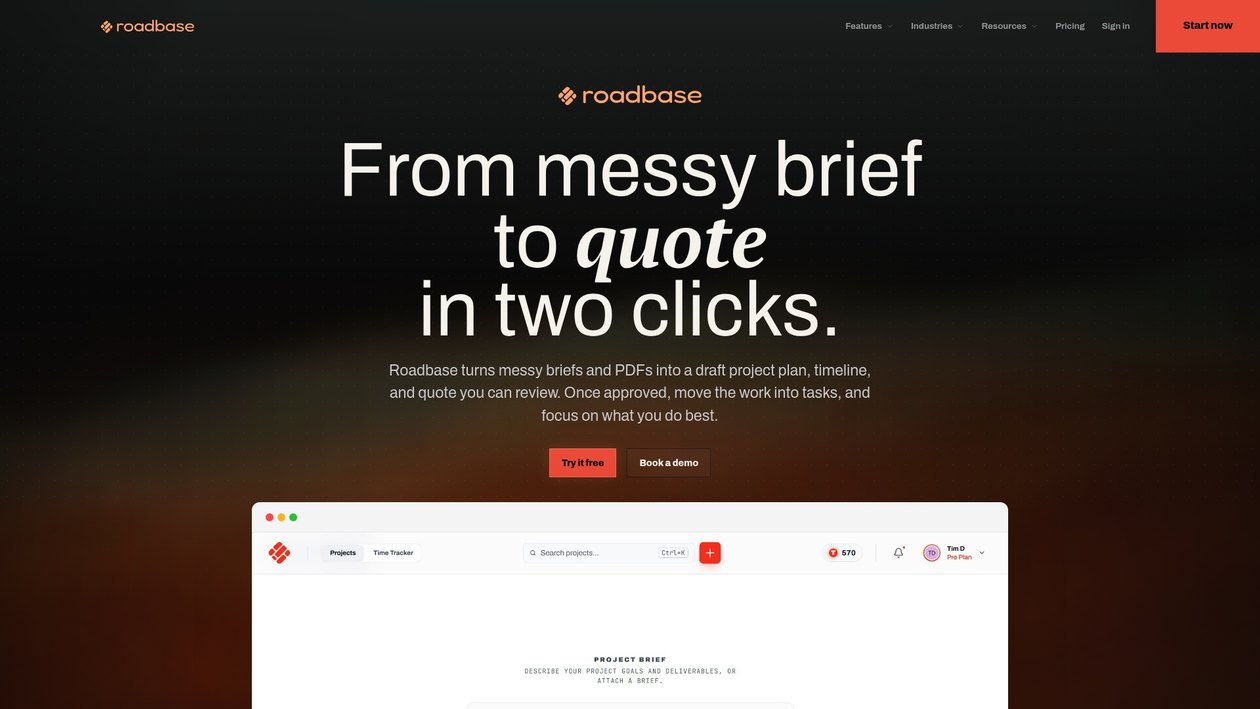
Bring a real brief to Roadbase: paste the brief text or attach a PDF, then use the editable draft of phases, tasks, roles, estimated hours, and timing as a starting point. Review and adjust the plan, then export the reviewed plan and quote as a proposal PDF.
For technical project language, see the software consulting estimates tool. Freelancers can start with the freelancer project estimates page.
Sources
- The importance of white space in graphic design
- How to write a business proposal -- Shopify
- Simple Business Proposal Template That Wins Clients
- Business proposal template: how to write a proposal in 7 steps -- Adobe
FAQ
How Many Pages Should a Proposal Be?
A one-pager is one page, full stop; beyond that, most guides recommend keeping full proposals under ten pages unless a formal RFP demands more detail.
What Is a Good Format for a Proposal?
A good format leads with the price and next step, uses a table for timeline and pricing, and keeps paragraphs short enough to scan in under 30 seconds.
What Are the Five Main Parts of a Proposal?
Most frameworks agree on title, problem and solution, deliverables, pricing and timeline, and terms with a signature, which Adobe's proposal template breaks down in more detail.
Can a One-Page Proposal Replace a Full Contract?
A signature line can make it function as a lightweight agreement, but complex deals still need a full contract covering liability and detailed terms.
How Fast Can You Draft a One-Page Proposal?
A focused draft takes roughly 30 minutes once you have the client's notes in hand. In Roadbase, you can paste brief text or attach a PDF and generate an editable draft of the work breakdown to review and adjust.