

Get Priced Proposals in Minutes With Scope First AI for Creative Teams

AI-assisted estimating can give you a first-pass work breakdown from a messy brief. Review the deliverables, assumptions, exclusions, hours, and commercial choices before you turn that work into an estimate and proposal.
TL;DR:
- A useful AI-assisted estimate starts with clear deliverables, assumptions, exclusions, and deadlines, then gets reviewed against the work you are actually taking on.
- Break each deliverable into tasks and consider the hours for each step rather than relying on a vague brief description.
- Buffer percentages should match project risk: 10-15% for low risk, 15-25% for medium, and 25-40% for high uncertainty.
- Present estimates by emphasizing scope and outcomes before the price, and offer options where they help the client choose the right scope.
- Track actual hours versus estimates and review margin trends as part of your estimating process.
Table of Contents
- What to Capture From a Brief Before You Estimate Anything
- Turning a Brief Into a Priced Proposal, Step by Step
- Choosing Between Hourly, Fixed Fee, Retainer, and Value-Based Pricing
- Setting Buffers and Revision Policy Without Overcharging
- How to Present an AI-Assisted Estimate So Clients Trust the Number
- The Metrics That Tell You Your Estimates Are Working
- The One Rule That Should Govern Every AI-Assisted Estimate
- Turn Your Next Brief Into a Priced Proposal in One Sitting
- Sources
- FAQ
What to Capture From a Brief Before You Estimate Anything
A brief is not a scope, and pricing off a brief alone is how freelancers end up doing $3,000 of work for a $1,500 quote. A proper quote needs deliverables, assumptions, exclusions, revision rounds, timeline, approval structure, and rights spelled out before a single hour gets estimated, according to Creativepool's playbook on pricing creative work. Run every brief through this checklist first:
- The business outcome the client is after, and how they'll measure success.
- Deliverables broken into formats, channels, languages, and sizes (a "social campaign" might mean 6 assets or 60).
- Who approves the work, how many people are in that chain, and how many revision rounds are included.
- What the client owes you: content, brand assets, access, decisions, by what date.
- What's explicitly out of scope, plus who owns the final files and usage rights.
- Any hard deadline that limits how the work can be sequenced.
Skip any of these and the AI tool you're using will happily generate a confident, detailed, and wrong number. Garbage scope in, garbage price out.
Turning a Brief Into a Priced Proposal, Step by Step
Once the scope is written down, the actual estimating follows a sequence that works whether you're doing it by hand or with software. This is the order that matters:
- Rewrite the brief as explicit deliverables. Turn "a new website" into "8 templated pages, 1 custom homepage, CMS setup, and 2 rounds of content revisions." Vague nouns produce vague prices.
- Break each deliverable into tasks and estimate hours. A homepage isn't one line item. It's wireframing, design, review, build, QA, and revisions, each with its own hour estimate.
- Assign rates, add a buffer sized to risk, and build tiered options. More on buffer sizing below. Tiers give the client a way to choose scope instead of asking you to discount.
- Let AI suggest the task breakdown, then check its work. Use an AI-generated task breakdown as a starting point, then check the hours, assumptions, and missing details yourself. AgencyFlo's work with design agencies is a related agency-specific example.
- Produce SOW language and export a proposal. The final document needs assumptions and change control terms written in plain language, not buried in a footer.
The stepwise version of this, including how to size the buffer, is laid out well in Damongo's guide to freelance project estimates: convert brief to deliverables, deliverables to tasks, tasks to hours, then apply rate and buffer. When a project is too undefined to scope confidently, quote a small capped discovery phase, then convert to a fixed fee once you actually understand the work.
Pro Tip: Run the brief through your estimating process twice after clarifying it. Meaningful differences in the task breakdown are a prompt to tighten the brief before you price the work.
Choosing Between Hourly, Fixed Fee, Retainer, and Value-Based Pricing
The pricing model should match the shape of the work, not your default habit. Most freelancers pick one model and force every project through it, which is how exploratory research work ends up underpriced at a fixed fee, or how well-defined production work ends up padded with unnecessary hourly hours.
- Hourly or time-and-materials fits exploratory, undefined work where scope will shift as you learn more, like early-stage brand strategy or a discovery sprint.
- Fixed or project fee fits deliverables you can define tightly: a 10-page website, a 30-second animated spot, a logo package with a set number of concepts.
- Retainers fit ongoing relationships where the client needs continuity and access, not a single deliverable: monthly content production, ongoing design support, or an agency-of-record arrangement.
- Value-based elements make sense when the project carries real commercial upside, such as a landing page redesign tied to measurable conversion lift. Roadbase's guide on when value-based pricing fits a creative quote covers how to judge whether a project qualifies.
AI-assisted drafting removes friction from writing the estimate. It does nothing to change who absorbs the commercial risk if the project runs long. A fixed fee is still a bet on your own scope discipline, whether AI drafted the number or you did by hand.
Setting Buffers and Revision Policy Without Overcharging
Buffers exist to absorb the risk that's already baked into a project, not to pad every quote by an arbitrary percentage. A low-risk project, one where the client is decisive and the deliverables are fully defined, needs a smaller cushion than a project with three approval layers and a client who's still deciding on brand direction.
| Risk band | Typical signal | Buffer range |
|---|---|---|
| Low | Repeat client, defined deliverables, single approver | 10 to 15% |
| Medium | New client, some ambiguity, 2 to 3 approvers | 15 to 25% |
| High | Undefined scope, multiple stakeholders, tight deadline | 25 to 40% |
Buffer sizing tied to risk banding is standard practice in Damongo's estimating guide, and it works as simple arithmetic: hours times rate, plus buffer percentage, equals price. A 40 hour project at $85 an hour is $3,400 base. Spell out how many revision rounds are included in that number, and set a clear per-round rate for anything beyond it. When scope is too uncertain to buffer confidently, quote a capped discovery phase first and convert to fixed fee once the real shape of the work is clear.
How to Present an AI-Assisted Estimate So Clients Trust the Number
The order you present information in changes how a price feels, even when the number itself doesn't move. Lead with the client's business outcome, not your process or your background. Show scope and timeline before you show the price, so the number arrives already justified by what it's buying.
- Open with the outcome the client is trying to achieve, in their language, not yours.
- Place pricing after scope and timeline are fully laid out on the page.
- Offer 2 to 3 options instead of a discount when a client pushes back on price.
- Write change control and licensing terms into the document itself, not a follow-up email.
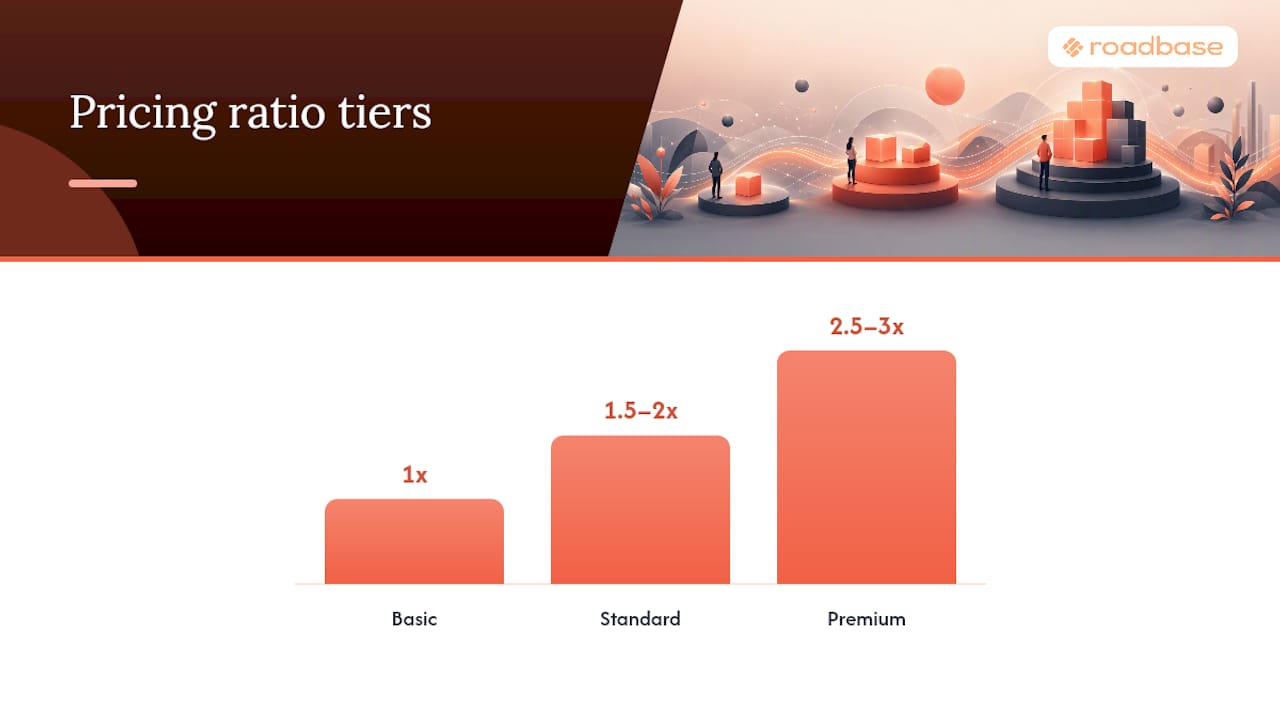
A three-tier structure (Basic, Standard, Premium) gives clients clear scope choices. WhatShouldICharge's freelance proposal guide discusses pricing ratios around 1x for Basic, 1.5 to 2x for Standard, and 2.5 to 3x for Premium. A structured proposal can use distinct sections for the client's situation, your approach, scope, proof, pricing, and next step.
Pro Tip: If a client asks for a lower price, respond with a smaller version of the project, not a smaller version of your rate. "Here's what $2,000 buys instead of $3,500" keeps your hourly value intact.
The Metrics That Tell You Your Estimates Are Working
An estimating process only improves if you're tracking whether your numbers were right, and by how much. Most freelancers quote, deliver, and move on without ever closing the loop, which means the same pricing mistakes repeat project after project.
- Log estimate versus actual hours on every project, plus the resulting margin.
- Track revision overruns separately from scope creep. They have different fixes.
- Record write-offs, the hours you ate rather than billed, and watch for patterns by project type.
- Review the numbers quarterly and recalibrate buffers, rates, or task breakdowns based on what actually happened.
A practical estimating dashboard tracks estimate versus actual hours, margin, and revision overruns. Roadbase's breakdown of what to track offers a related starting point. Use your completed work to look for repeatable gaps between the estimate and the hours recorded. Adjust the next estimate when the pattern is clear. For a related discussion of uncertainty, see 25%.
The One Rule That Should Govern Every AI-Assisted Estimate
AI can help create a draft work breakdown. Review it against the deliverables, assumptions, exclusions, and commercial choices you are prepared to make. Put the project terms you need in the proposal, and use completed-project records to inform the next estimate.
Roadbase turns creative briefs into scoped projects, estimates, and trackable delivery plans.
- Nicolas Robertson
Turn Your Next Brief Into a Priced Proposal in One Sitting
Have a creative brief ready to price? Explore Roadbase to turn creative briefs into scoped projects, estimates, and trackable delivery plans. Review the work, then use that plan as the basis for your proposal.
Sources
- How to price creative work: A playbook for scope, value, and boundaries
- How to Write a Freelance Proposal - Template & Tips | WhatShouldICharge
- Freelance Project Estimates 2026: Accurate Quotes Guide - Damongo
FAQ
What Is AI Pricing Estimation?
AI pricing estimation uses an AI-generated starting point alongside a reviewed work breakdown and estimate. The person pricing the work still checks the deliverables, assumptions, exclusions, hours, and commercial choices.
Can AI Replace Manual Project Estimating Entirely?
No. Roadbase turns creative briefs into scoped projects, estimates, and trackable delivery plans. The person pricing the work still reviews the scope and commercial choices before sending a proposal.
How Big Should My Pricing Buffer Be?
Buffer size should track project risk: roughly 10 to 15% for low-risk, well-defined work, 15 to 25% for medium-risk projects, and 25 to 40% for high-risk or undefined scope.
Should I Charge Hourly or a Fixed Fee?
Use hourly pricing for exploratory or undefined work and a fixed fee once deliverables are locked down; retainers fit ongoing relationships, and value-based pricing fits projects with measurable commercial upside.
What Metrics Should I Track to Improve My Estimates?
Track estimate versus actual hours, resulting margin, revision overruns, and write-offs on every project, then review the trends quarterly to recalibrate rates and buffers.