

Retainers vs Projects: Plan Agency Hiring a Quarter Ahead

Retainers and projects put different commitments around the same work. A retainer can make the next month's contracted fee clearer, while a project gives both sides a defined piece of work to approve. Neither format alone tells you when to hire. This guide compares scope, payment timing, workload, and the evidence worth reviewing if you're planning capacity a quarter ahead.
TL;DR:
- Match the agreement to the work: recurring needs may suit a defined ongoing commitment; a bounded deliverable may suit a project.
- Compare signed fees, expected collection dates, delivery hours, available capacity, margins, and client concentration before treating either model as support for a hire.
- The 2025 project-margin figures discussed below come from SPI Research's professional services sample. They do not compare retainers with projects.
- A small pilot can test demand and delivery assumptions. Pick its scope and review date to fit the client's decision, then use observed work to discuss a continuing arrangement.
Table of Contents
- 1. What retainers and project-based work actually mean
- 2. The argument for retainers: operational and financial benefits for agencies
- 3. The argument for project-based work: when projects are the better business choice
- 4. Financial comparison: margins, volatility, and the benchmarks that matter
- 5. A decision framework for choosing retainers or projects
- 6. Contracts and pricing mechanics that protect your margin
- 7. How to transition between retainers and projects
- 8. What experience teaches about choosing a model
- 9. Pricing and proposing either model without the spreadsheet grind
- FAQ
- Sources
1. What retainers and project-based work actually mean
Before comparing the two models financially, define what each client is buying. The billing label tells you less than the actual scope, timing, and responsibility in the agreement.
A retainer is a recurring fee for a defined service or availability commitment, often reviewed monthly. A fixed-price project sets a fee for agreed work. Time and materials (T&M) bills for time or materials used against agreed terms, while milestone billing divides a project fee among specified stages.
Retainers can take several shapes:
- Hours-banded retainers reserve a stated amount of work in each period, with any rollover or extra-hours treatment made explicit.
- Deliverable-based retainers commit to specified outputs, such as campaign assets or design adaptations, within a review cycle.
- Service-access retainers define the kind of ongoing support and how requests are prioritized.
A project may be a fixed-fee deliverable with a clear statement of work, or it may use T&M when the path is still uncertain. A studio can use both models for different clients or phases. The useful distinction is whether the work repeats in a way both parties can describe and staff.
2. The argument for retainers: operational and financial benefits for agencies
A signed retainer can give an agency a clearer view of committed work and scheduled invoices over its term. That helps planning only when the scope is deliverable, the payment terms are workable, and the client actually pays on time. A recurring fee still needs hours, costs, and collection dates beside it.
For some clients, ongoing work means less time rediscovering brand files, decision-makers, and approval routes. Keeping the right customers can matter to a business; that customer-retention point does not establish that an agency retainer creates more strategic value than a project.
Potential operating advantages are worth testing account by account:
- Familiar work may reduce repeated onboarding, provided the client and team stay reasonably consistent.
- A recurring review rhythm can help both sides choose priorities and notice when requests exceed the agreed commitment.
- Known contracted work can inform a capacity plan, alongside the hours required, other booked work, and the share of revenue tied to that client.
The tradeoff is that a continuing promise uses capacity even when new requests arrive elsewhere. Define the service, request process, and review point in the agreement, then compare actual effort with the fee before renewing.
Pro Tip: Review the agreed work and hours with the client at a cadence that fits the service. Use that conversation to reset priorities or quote additional work.
3. The argument for project-based work: when projects are the better business choice
A project gives the client a bounded decision: approve a particular deliverable, fee basis, schedule, and review process. That can be a good fit for a packaging refresh, a launch film, or a discrete discovery phase. It does not guarantee a faster sale or a stronger margin; those depend on the brief, buyer, estimate, and execution.
The project boundary can also help the agency see what work is already promised and what still needs a new quote. It needs enough detail to handle revisions, dependencies, and approval delays. A vague fixed fee can be harder to manage than a well-described retainer.
Other reasons to consider a project:
- A client has a one-time need or has not yet established recurring demand.
- The team needs to test an unfamiliar workflow before committing ongoing capacity.
- Both sides want evidence from a first engagement before discussing a longer arrangement.
A good first project may lead to continuing work, but that is a new decision. Review the actual hours, outputs, and client demand before proposing a retainer.
4. Financial comparison: margins, volatility, and the benchmarks that matter
For a hiring decision, separate engagement economics from firmwide commitments. Compare the fee and expected cost of each piece of work, then ask how much paid work is signed, when cash is expected, and what capacity remains.
In SPI Research's 2026 benchmark report on 2025 professional services firms, project margin was 37.7% in 2025, versus 35.9% in 2024. The share of firms meeting annual margin targets was 88.8%, versus 86.9% in 2024. These are figures for that professional services sample, not a comparison of project and retainer contracts or a target for every creative agency.
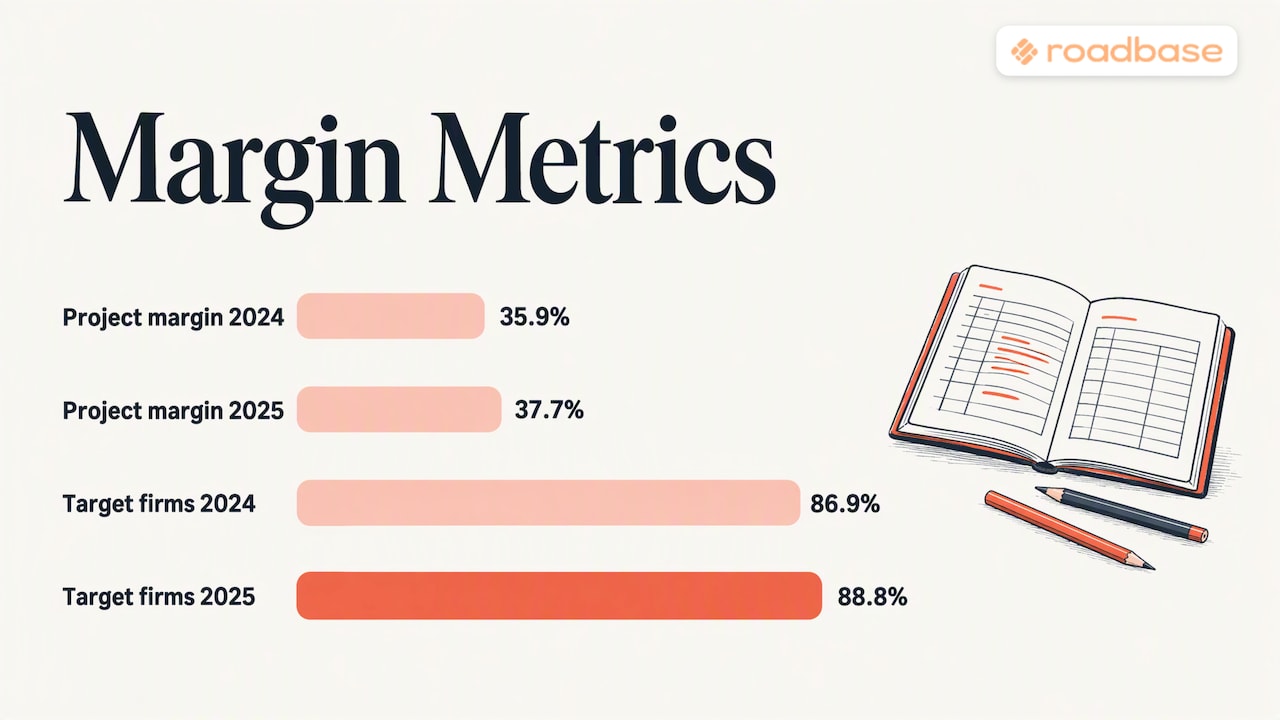
Caption: SPI Research's professional services sample reports 2025 project margin of 37.7% versus 35.9% in 2024, and annual margin-target attainment of 88.8% versus 86.9%. This is not a retainer-versus-project comparison.
Payment cadence changes when receipts are expected, but the agreed invoice date is not the same as cash in the bank. A monthly retainer billed in advance, a project deposit, and project milestones can each create a different cash schedule. Put payment terms and realistic collection timing beside payroll and supplier commitments before expanding the team.
Track a small set of measures for both models:
- Signed recurring fees and contracted project backlog, each with its end date and payment schedule.
- Planned versus actual hours, utilization, and delivery capacity.
- Engagement margin after the labor and direct costs you can attribute.
- Client concentration, so one contract does not silently carry the staffing case.
- Expected collections and committed costs over the review period.
A practical way to track project profitability helps you compare estimated effort with recorded work. Use the numbers from your own engagements when judging which model supports your costs.
5. A decision framework for choosing retainers or projects
Rather than scoring a model in the abstract, work through five questions for the specific client and service:
- Predictability of need: Does the client have repeatable work with a clear request pattern, or one defined problem? Look at past requests and upcoming plans, not an assumed monthly volume.
- Value of continuity: Would keeping the same people and context make the work easier to deliver or review? Identify the actual handoffs and decisions that recur.
- Buying process: What can the client approve now: a bounded first piece of work or a continuing commitment? Ask who signs off and when.
- Budget and payment behavior: Is funding approved by project, period, or another cycle? Match the proposal and invoice schedule to a real approval route.
- Capacity fit: Which roles and hours would the commitment use, and what other signed work needs those people? Check whether the proposed fee covers the work you expect.
If several answers are uncertain, a narrow paid pilot can make the next decision easier. Set its deliverables, review point, and price around the unknowns you need to test. For staffing calculations beyond this choice, use the capacity-planning guide in Recommended.
Pro Tip: Use these questions in the first proposal conversation, then write down what you still need to verify before offering an ongoing commitment.
6. Contracts and pricing mechanics that protect your margin
The agreement should describe the work and the commercial terms clearly enough to guide a real request. One sample service retainer agreement from the Graphic Artists Guild illustrates a monthly statement of work and estimated hours, billing for additional work, advance invoicing, and a specific termination-fee arrangement. It is one example for design services, with terms to evaluate for your own work rather than a standard clause set.
For either model, work through the practical questions with the client:
- What deliverables or service are included, and what assumptions shape the price?
- How will the two sides agree on extra work or changed priorities?
- When are invoices issued and payable, and what happens if the work ends early?
- Who reviews outputs, and how are revisions requested?
The Guild sample's pro-rata termination provision includes a particular period and a replacement-work condition. Choose any termination and payment terms for the actual engagement and review the contract with appropriate counsel when used. On the pricing side, estimate the roles, hours, outside costs, and contingency that the work calls for. An estimate template that builds in contingency can help make those assumptions visible before the fee is agreed.
7. How to transition between retainers and projects
Changing the format of an existing service works best when both sides know which need the new agreement serves. A small pilot is one way to learn that before committing to a recurring fee.
- Choose the question the pilot should answer. Maybe the client wants a reliable monthly asset flow, or the studio needs to learn how many rounds of review the work takes. Name that uncertainty before choosing the fee format.
- Bound the first engagement. Agree on outputs, inputs, roles, review points, payment terms, and a completion date. The pilot length should fit the work and the client's approval cycle; there is no universal 60- or 90-day requirement.
- Record what happens. Track requests, delivered work, actual hours, feedback, and any changed assumptions. Check in often enough to resolve decisions while they still affect the work.
- Make the next offer from the evidence. If demand genuinely repeats, propose a defined ongoing service with a workload and price you can explain. If it does not, continue with bounded projects where they fit.
8. What experience teaches about choosing a model
A useful working rule is to match the promise to the pattern of work. A repeat need with stable boundaries may support an ongoing commitment; a specific need with a clear finish may be easier to price as a project. The client and agency can revisit that choice when the pattern changes.
Keep a short written priority list during either type of engagement. It gives both sides a concrete place to discuss new requests, tradeoffs, and approval decisions. The list helps the conversation; it cannot settle an unclear fee or prevent every disagreement by itself.
If you're considering a hire a quarter ahead, use that quarter as a review window. Put signed work, expected collections, delivery load, engagement margin, and client concentration together. A rising retainer total or backlog figure is useful context, but the staffing decision depends on how those commitments fit the agency's costs and capacity.
9. Pricing and proposing either model without the spreadsheet grind
If you have a real pilot or project brief, bring it into Roadbase as pasted notes or a PDF. Roadbase can draft an editable project plan with phases, tasks, roles, estimated hours, and quote context. Review and adjust the work and its pricing inputs before you decide what to propose.
That first plan gives you something concrete to compare with a proposed ongoing commitment:
- Review role hours and rates, outside costs, overhead, contingency, and target margin beside the work breakdown.
- Use a previous project as a starting template when the work is similar, then recheck the new scope and fee.
- Export the reviewed plan and quote as a proposal PDF. Once work begins, compare tracked time with planned hours to inform the next conversation.
Start with the brief you have, shape a quote you can stand behind, and use the actual pilot or project work to discuss what should continue. You can visit Roadbase to explore the workflow and check current plans and pricing for the option that fits your work.
FAQ
What does a retainer fee actually cover?
It covers the service or availability defined for a recurring period. That might be a band of hours, specified deliverables, or an agreed support process. State what is included, how requests are prioritized, and how extra work is priced so the fee has a clear meaning for both sides.
What are the downsides of using a retainer?
A retainer commits delivery capacity across its term, and the workload can drift if new requests are not reviewed against the agreed service. Compare actual hours and costs with the fee, revisit priorities with the client, and agree how to handle work outside the commitment.
How does project-based pricing compare to retainer pricing on margin?
Neither format has a built-in margin advantage. Compare the fee with the labor and direct costs of your own engagements, including work between project milestones or retainer review periods. SPI Research's 2025 professional services project-margin figure is a sample benchmark, not evidence that one contract model outperforms the other.
How long does it typically take to onboard a client on each model?
There is no reliable standard time for either. A small project may need only a focused kickoff, while a complex project needs more discovery and approvals. A retainer may need setup for requests, priorities, and recurring reviews. Allow time for the actual scope, client context, and decision-makers.
What should I check before locking in a kill fee or notice period?
Decide what happens to scheduled work, fees already earned, advance payments, and any capacity held for the client if the agreement ends. The Graphic Artists Guild provides one sample with a particular pro-rata arrangement and replacement-work condition; choose terms for your engagement and have the contract reviewed with appropriate counsel when used.
Sources
- 2026 PSO Benchmarks: Insights from SPI Benchmark Maturity Report | Deltek
- SERVICE RETAINER AGREEMENT (front) | Graphic Artists Guild (sample contract)
- The value of keeping the right customers | Harvard Business Review