

Rolling Wave Planning: How to Plan and Price in Phases
Rolling wave planning means you plan the work in front of you in detail and the work further out at a higher level, then revisit the plan at set points as the unknowns resolve. For creative freelancers and agencies facing a half-formed brief, one way to quote the work is to commit to a firm scope and price for the first phase, give the later phases a range, and agree when each range becomes a firm quote before that phase starts. This commercial arrangement needs client agreement; refining a plan does not change an agreed fixed total price.
The technique is not a license to skip planning. It is a way of putting the right amount of detail in the right place at the right time. This guide covers what it is, how it differs from progressive elaboration, a worked creative-project example, and how to turn waves into quotes you can discuss with your client.
TL;DR
- Rolling wave planning details the near-term work and keeps future work at a high level, then re-plans at fixed points as information improves.
- It is a form of progressive elaboration: progressive elaboration is the broad idea, rolling wave is the specific planning habit that applies it.
- For creative work, it fits projects where the brief, content or approvals are still unclear: rebrands, websites, campaigns, video series.
- One quoting option is a firm first wave and later ranges with assumptions. Agree the arrangement and re-plan triggers before you start.
- Keep sequencing, risk notes and buffers for the distant phases. High-level is not the same as unplanned.
Table of Contents
- What rolling wave planning is
- Rolling wave planning vs progressive elaboration
- When it fits creative projects
- How to run rolling wave planning, step by step
- A worked example: brand identity plus website
- Turning waves into quotes clients accept
- Risk, buffers and the limits of the method
- Common mistakes to avoid
- How Roadbase supports phased planning
- Our perspective
- FAQ
- Sources
What rolling wave planning is
The Project Management Institute (PMI) describes rolling wave planning as an iterative technique in which near-term work is planned in detail while future work is planned at a higher level. The same guidance notes that project work can sit at different levels of detail depending on where it is in the life cycle.
In plain terms, a rolling wave plan has two parts:
- A frame for the whole project. Phases, major deliverables and rough sequence, so everyone can see the shape of the job.
- A detailed plan for the next horizon. Tasks, roles, hours, owners and dates for the work that is about to start.
Each time a wave finishes, you elaborate the next one using what you learned. Jeff Oltmann, writing in the PM World Journal, puts the principle as matching planning detail to the clarity you have at each phase: better-understood work is elaborated first, and uncertain work stays high level until it comes into focus.
A useful picture is a project as a sequence of horizons instead of one pile of tasks. Only the nearest horizon has task-level detail.
Rolling wave planning vs progressive elaboration
The two terms get used as if they were interchangeable, and that is where the confusion starts.
Progressive elaboration is the general idea that a plan, a scope statement or a requirement becomes more detailed as you learn more, allowing you to refine it. It applies to scope, estimates, designs and risks alike.
Rolling wave planning is a specific technique that applies that idea to scheduling and work breakdown: you detail the near-term work and leave later work coarse. PMI's guidance describes it as a form of progressive elaboration.
| Progressive elaboration | Rolling wave planning | |
|---|---|---|
| What it is | A principle: detail grows as knowledge grows | A technique: plan in horizons |
| What it covers | Scope, requirements, estimates, designs | The work breakdown and schedule |
| Needs a rhythm? | Not necessarily | Yes, planned re-planning points |
| Typical output | A more precise document each time | A detailed next wave and a coarse remainder |
If you remember one line: progressive elaboration is the principle of refining a plan as you learn, and rolling wave planning organizes that work into horizons.
The approach also sits comfortably next to iterative and agile working. For optional related reading, the source draft includes this agile web development whitepaper.
When it fits creative projects
The University of Waterloo's project management office says rolling wave is useful when there is not enough information to build a complete schedule upfront. The team executes, re-plans where clarity has improved, and repeats. The same guide adds that the method is typically used on projects with high uncertainty and needs appropriate risk management.
That describes a lot of creative work. Rolling wave tends to fit when:
- The brief is a direction, not a specification. A rebrand where the strategy work will decide what gets designed.
- Content or assets are not ready. A website where copy, photography or product data arrives late.
- Approvals shape the next phase. A campaign where concept sign-off determines production scope.
- The project is long. A multi-month engagement where the last phase is genuinely hard to see from the first week.
It fits poorly when the scope is already well-defined. PMI's 1996 article notes that reevaluations can stop once the scope is well-defined and enough information is available. A single-deliverable job with a clear brief, such as a one-page flyer or a standard logo package, may need just one detailed plan and a clear quote, with normal tracking and change control.
How to run rolling wave planning, step by step
Here is the routine, with the place each step usually goes wrong.
1. Frame the whole project at a high level
List the phases and major deliverables, in order, with the dependencies between them. A dependency is a relationship or constraint between pieces of work, such as development waiting on approved designs.
PMI's 1998 rolling wave paper recommends producing high-level cost and resource estimates for each horizon before you build detailed work packages for the first one. So even distant phases get a rough number.
Where it goes wrong: treating "high level" as "blank." A phase with no estimate, no roles and no risk note is a surprise waiting to happen.
2. Choose the horizon length
How far ahead should the detailed wave reach? There is no universal answer. Johanna Rothman's book chapter recommends planning a few weeks in detail and rolling the plan forward regularly, and her example uses a three-to-four-week horizon.
For agency and freelance work, the more natural unit is often a phase: discovery, concept, design, build. Pick whichever matches the point where your knowledge will actually change.
Oltmann describes a three-level variant: detailed planning for clear work, moderate planning for work that is approaching, and high-level planning for distant uncertain phases. That middle layer is helpful when your phases overlap.
Where it goes wrong: a horizon so short that you spend half your time re-planning, or so long that the detail is fiction by the time you reach it.
3. Plan the first wave in detail
For the nearest horizon, break the work into tasks and assign each a role and an hour estimate. Include revision rounds explicitly, because they are where hours quietly disappear. If you need a method for the hours themselves, estimating project hours before you quote walks through it, and role-based estimating shows how to price by task and role instead of one blended rate.
Where it goes wrong: estimating the work but not the overhead around it: client meetings, feedback consolidation, project management time.
4. Set the re-plan trigger up front
PMI's 1998 paper recommends establishing a fixed date or trigger for replanning the next time horizon. In creative work, useful triggers can be events such as "concept approved," "content delivered" or "discovery workshop complete," or a calendar date that gives you time to prepare the next wave.
Write the trigger into the proposal. It tells the client when you will review the next scope and fee together, before that phase begins.
Where it goes wrong: leaving the trigger vague, so the re-plan happens only when something has already gone off track.
5. Execute, then elaborate the next wave
When the trigger fires, compare what you planned with what happened: hours used, revisions taken, assumptions that held or broke. Then detail the next wave with that evidence. PMI's 1996 article observes that time and resource projections can become more accurate and confident at each reevaluation as unknowns are resolved.
Where it goes wrong: re-planning from memory alone. Review available evidence: actual hours, approved decisions and new requirements.
6. Update the frame, not just the wave
Elaboration can change the structure above it. PMI's 1998 paper notes that the work-scope baseline and work breakdown structure may be modified to reflect newly added detail. Revisit the later phases and their ranges each time, and agree any changes to commercial commitments with the client.
Where it goes wrong: the detailed wave is updated while the later-phase ranges stay frozen at their original optimism.
A worked example: brand identity plus website
This is an illustrative example, with made-up numbers, to show the mechanics. A small studio is hired for a brand identity and a marketing website. The client has a rough vision, no finished copy and no decision yet on how many page templates they need.
| Wave | Detail level | Contents | Estimate |
|---|---|---|---|
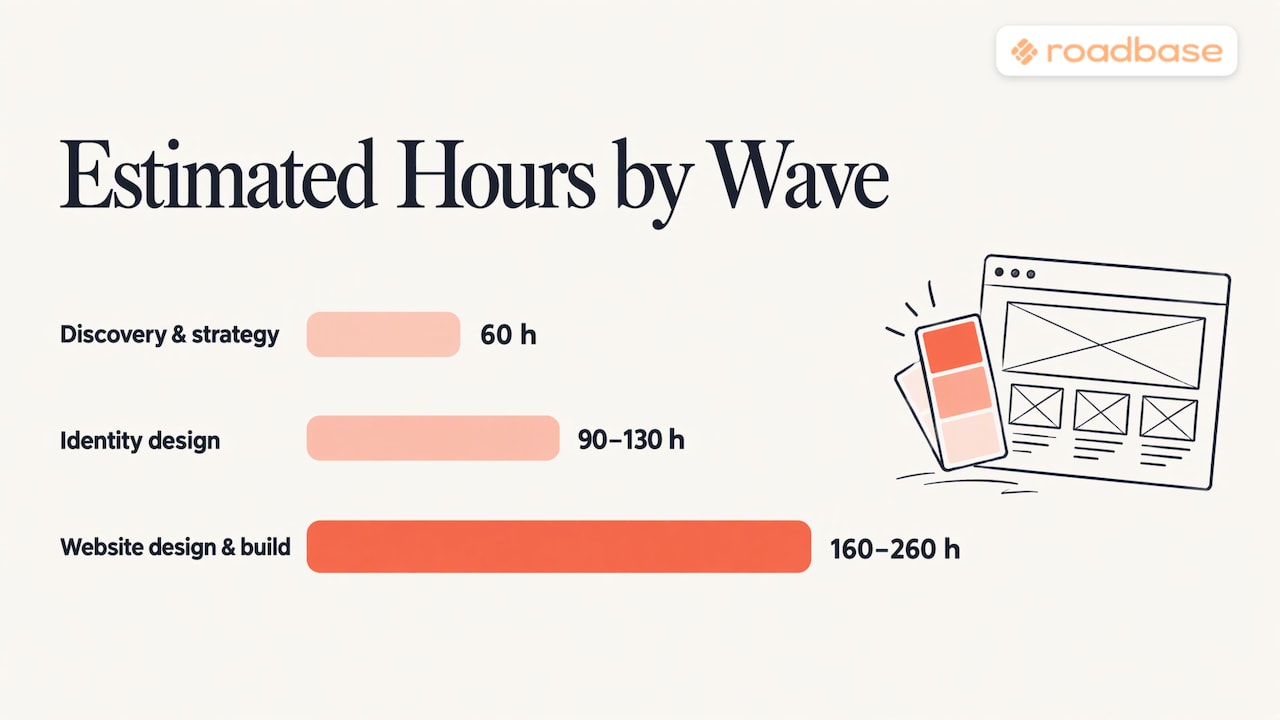
| 1. Discovery and strategy | Full task, role and hour detail | Stakeholder interviews, audit, positioning, two feedback rounds | 60 hours, basis for a fixed quote |
| 2. Identity design | Moderate | Logo concepts, palette, typography; depends on approved positioning | 90 to 130 hours, range |
| 3. Website design and build | High level | Page templates, content migration, launch; depends on approved identity and delivered copy | 160 to 260 hours, range |
These figures are effort estimates, not prices or calendar durations. The studio uses the detailed 60-hour estimate to prepare a firm wave-1 quote. Waves 2 and 3 appear as ranges with written assumptions: number of concepts, number of templates, who supplies the copy. Each range is reviewed for a firm quote at its agreed trigger: positioning approved for wave 2, identity approved and copy delivered for wave 3. The client approves the next phase's scope and fee before work starts.
When wave 1 finishes, the studio finds the client wants three audience segments instead of one. That changes the identity work and the template count. Under the agreed phased-quote arrangement, the studio revises the later estimates with that new information and seeks approval for the next scope and fee.
Turning waves into quotes clients accept
Clients often hear "we will price it later" as "we do not know what this costs." Present it the other way around: you are giving them a firm price for what is knowable and a bounded range for what is not.
For this phased-quote arrangement, the proposal can contain:
- A phase-by-phase overview so the whole project is visible.
- A fixed price for the first wave, with the tasks and roles behind it.
- Ranges for later waves, each with the assumptions that would move it up or down.
- The re-plan trigger for each range.
- A change process for requests that fall outside a wave. Our guides on preventing scope creep in creative projects and change request templates with scoped estimates cover this.
If you want a view of how budgets break down before you set those ranges, see this project budget breakdown. For ranges built from historical data, parametric estimating is a useful companion method.
Risk, buffers and the limits of the method
Rolling wave planning is sometimes read as permission to avoid hard planning. Oltmann's article argues the opposite: sequencing, risk analysis and buffers remain necessary even for high-level future phases. He also warns that shallow long-term plans can be overly optimistic and miss time-consuming problems, which is why he recommends buffers and explicit risk analysis.
In practice, that means for each later phase you should write down:
- The assumptions the range depends on.
- The two or three things most likely to push it to the top of the range.
- An explicit time or cost contingency sized to those risks, reviewed alongside your target margin.
- The decision or delivery from the client that the phase depends on.
The handoff between phases deserves attention to scope and risks. For optional related reading, this piece on the handoff between strategy and execution discusses briefs, approval rights and dependencies.
Common mistakes to avoid
- Re-planning without reviewing evidence. Actual hours, approved decisions and new requirements help you test the next wave's assumptions.
- Hiding the ranges. Clients who first see a later-phase number at invoice time lose trust. Show the range at the start.
- No stopping rule. Reevaluation is a means, not a ritual. When scope is clear and you have enough information, stop the repeated detail cycles while continuing normal tracking and change control.
- Letting later waves absorb earlier overruns. Keep a clean record of each wave so you can see where the hours went.
- Skipping dependencies. A later wave that depends on client content needs that dependency written down, with a date or event attached.
How Roadbase supports phased planning
Phased planning needs a structured breakdown, estimates by role, a margin view, and a way to revise the plan when facts change. In Roadbase, paste a brief or set of notes to generate an editable draft plan with phases, tasks and hours, then review and adjust it. Keep phases, tasks, role hours and the estimate together, and adjust the plan on a visual timeline.
Review costs, overhead, contingency and target margin as you prepare the quote, then export the reviewed plan and quote as a proposal PDF. Track time and compare actual hours with estimates to inform your next revision. Relevant tracked project history can also inform a later draft; you review it and set the price. Our six-step AI project scoping playbook shows the workflow end to end.
The plans are published on the Roadbase pricing page: Free at $0 per month, Pro at $10 per month and Studio at $22 per month, plus 50 AI tokens for a one-off $5.
Bring a live brief to roadbase.io, review and adjust a draft plan, and prepare the next phase's quote.
Our perspective
A common estimating problem in creative work is giving one precise number for a project whose shape is not yet known. Writing down the assumptions behind that number gives you something useful to revisit.
We built Roadbase around an editable plan. A brief becomes a draft roadmap of phases, tasks, roles and hours for you to review and adjust. For rolling wave work, you can detail the next phase and compare tracked hours with estimates before revising the plan and preparing the next quote.
Our view is that a complex project's quote deserves the same attention as its task list. Review costs, contingency and target margin alongside the work, make revision rounds explicit, and agree changes to scope and fees with the client before starting the next phase.
Nicolas Robertson
FAQ
What is a rolling wave plan?
A rolling wave plan is a project plan with two levels of detail. Near-term work is broken into tasks, owners and estimates, while later work stays at the phase level. The plan is revised at planned points as more becomes known, as PMI's guidance describes.
Is rolling wave planning the same as progressive elaboration?
Not exactly. Progressive elaboration is the broad principle that plans get more detailed as knowledge grows. Rolling wave planning is a form of it, applied to the schedule and work breakdown by detailing the nearest work first.
How far ahead should I plan in detail?
It depends on where your knowledge will change. Rothman's example uses three to four weeks. For client projects, a phase or a decision point, such as concept approval, is often a better horizon than a fixed number of days.
Can I use rolling wave planning for a fixed-price project?
Yes. Rolling wave planning can refine the work within a genuinely fixed total project price, which remains the agreed price unless a change is agreed through the contract's change process. A separate quoting option is a firm first wave and later ranges that become firm at agreed triggers. Write the assumptions and triggers into the proposal, and have the client approve each later phase's scope and fee before it starts.
When should I stop re-planning?
When the remaining scope is well-defined and you have enough information to estimate it. PMI's 1996 article says reevaluations can stop at that point. After that, deliver against the plan, track hours and use normal change control when needed.
Sources
- PMI, Q&As for the PMBOK Guide Sixth Edition, chapter 6
- Jeff Oltmann, Rolling Wave Planning: How to Plan Fuzzy Projects, PM World Journal
- PMI, Rolling Wave Project Planning (1998)
- PMI, Rolling wave approach to project management (1996)
- Johanna Rothman, Rolling Wave Planning, Predicting the Unpredictable
- University of Waterloo, Rolling Wave, VPAF Project Management Office
- Agile web development whitepaper
- Fix the handoff between strategy and execution