

Progress Billing: How It Works, With Formulas and Examples
Progress billing spreads payment across a project instead of leaving the entire fee until the end. The amount may follow measured work, agreed deliverables, or scheduled installments. For a creative studio or consultant, the useful starting point is a clear quote and a payment schedule both sides understand.
This guide covers the calculation, two worked examples, the overlap with milestone billing, and the terms to agree before sending an invoice.
TL;DR
- Progress billing means requesting payment in stages under an agreed schedule. The trigger may be measured completion, an accepted milestone, or a date.
- On a cumulative net basis, the current request is earned value to date less retainage held to date less previous net certified amounts.
- Milestone installments and percentage-of-completion requests are useful models that can overlap.
- Agree the trigger, amount, evidence, due date, and treatment of changes before work starts.
- A priced work breakdown helps both parties check the calculation; a short job may need only a deposit and final balance.
Table of Contents
- What progress billing means
- Who uses it
- How progress billing works, step by step
- How to calculate a progress billing invoice
- Progress billing vs. milestone billing
- What to put in the agreement and the invoice
- Benefits and risks
- Accounting note
- Where progress billing breaks down: scoping and tracking
- Perspective: bill from the quote, not from memory
- Setting up staged billing with Roadbase
- Practical tips for your first progress-billed project
- FAQ
- Sources
What progress billing means
Progress billing means billing at agreed points during a project rather than waiting to send one final invoice. Investopedia describes it in the context of longer contracts. The agreement sets what earns a payment: measured work, a deliverable, a date, or a combination.
Staging can reduce how long a provider carries project costs. Stripe notes the cash-flow issue in construction. The client gains defined checkpoints too; NetSuite makes that point in its overview. Neither benefit happens automatically: the terms and approval process matter.
You may also see progress invoicing, stage billing, or, in construction, draw billing. The names vary; the written payment trigger matters more.
Who uses it
Construction is a familiar case. Intuit lists engineering, software development, consulting, and creative work as other examples. A brand agency funding research and production, a video studio booking crew, or a consultant with several review phases may all find staged terms useful.
For a freelancer or small studio, ask when substantial work or outside costs arise and when the client can reasonably review what has been done. Those two timelines help shape a payment schedule.
Progress billing makes sense when:
- You incur crew, printing, licensing, research, or subcontractor costs before final delivery.
- Discovery, concept, production, and handoff each have a reviewable result.
- Several teams or approvals make a single end-of-project invoice hard to manage.
A short, simple job may be easier to handle with a deposit and final balance. Choose the terms that fit the work and the agreement.
How progress billing works, step by step
- Price the work breakdown. Give phases or deliverables values that add to the agreed price. In commercial construction, that detail is a schedule of values; AIA explains how it supports a payment application. A creative quote can use a simpler breakdown.
- Agree the trigger and timing. State whether a request follows measured work, acceptance of a deliverable, a calendar date, or a combination. Include the payment due date and who approves the evidence.
- Record the evidence. A delivery record, signed acceptance, or documented assessment can support the request. Tracked hours show effort, but hours alone do not prove a percentage of the contracted result is complete.
- Calculate the current request. Use the same gross or net basis for the current and earlier amounts, and state how any retainage works.
- Send the invoice and supporting detail. Show what has been earned to date, what was previously certified or paid, and the balance now requested. Reconcile changes before the next cycle.
Construction contracts may use AIA G702 and G703 payment applications with a schedule of values, completed or stored work, retainage, and prior payments. Procore adds other construction form examples. A creative engagement usually needs a simpler invoice and supporting record, following its own agreement.
How to calculate a progress billing invoice
Start with cumulative earned value. BQE lays out the broad calculation, but the labels on prior billings and retainage need care. A previous gross amount and a previous net amount are not interchangeable.
For a priced breakdown, add the earned value across the lines. In construction, Built describes completed work, eligible stored materials, and retainage in a payment application. Retainage means an agreed amount is withheld for later release; Stripe describes it as a construction payment mechanic. Whether it applies, and how it is released, depends on the contract and jurisdiction.
In plain terms:
Current net request = cumulative earned value - cumulative retainage held - previous net certified amounts.
Without retainage, the middle term is zero. If the contract releases earlier retainage, show that release separately in the current request. Changes, stored materials, taxes, and other adjustments may need their own lines under the agreement.
Worked example with retainage
Suppose a construction contract is $400,000, cumulative work is 45% complete, and the contract holds 10% retainage on earned work. Earlier certified gross work was $100,000, with $10,000 held, so the earlier net certified amount was $90,000. This is an arithmetic illustration, not a payment-application template.
| Step | Calculation | Amount |
|---|---|---|
| Cumulative earned value | $400,000 x 45% | $180,000 |
| Cumulative retainage held | $180,000 x 10% | -$18,000 |
| Cumulative net earned | $180,000 - $18,000 | $162,000 |
| Less previous net certified amount | $100,000 gross - $10,000 earlier retainage | -$90,000 |
| Current net request | $162,000 - $90,000 | $72,000 |
The same result comes from $80,000 earned this period less $8,000 current-period retainage. Don't subtract the full $18,000 cumulative holdback from $80,000: that would deduct the earlier $10,000 twice. Check the actual contract for stored materials, changes, and retainage release.
Worked example without retainage: a brand project
Say a studio quotes a $12,000 brand identity and packaging project in four priced lines, without retainage:
| Line item | Scheduled value | % complete at invoice 2 | Earned |
|---|---|---|---|
| Discovery and strategy | $2,000 | 100% | $2,000 |
| Identity design | $4,000 | 75% | $3,000 |
| Packaging concepts | $4,000 | 25% | $1,000 |
| Production handoff | $2,000 | 0% | $0 |
| Total | $12,000 | $6,000 |
If the earlier net certified amount was $2,000 for discovery, the current request is $6,000 - $2,000 = $4,000. The agreement should say how those completion percentages are assessed; the table alone doesn't establish client acceptance.
Progress billing vs. milestone billing
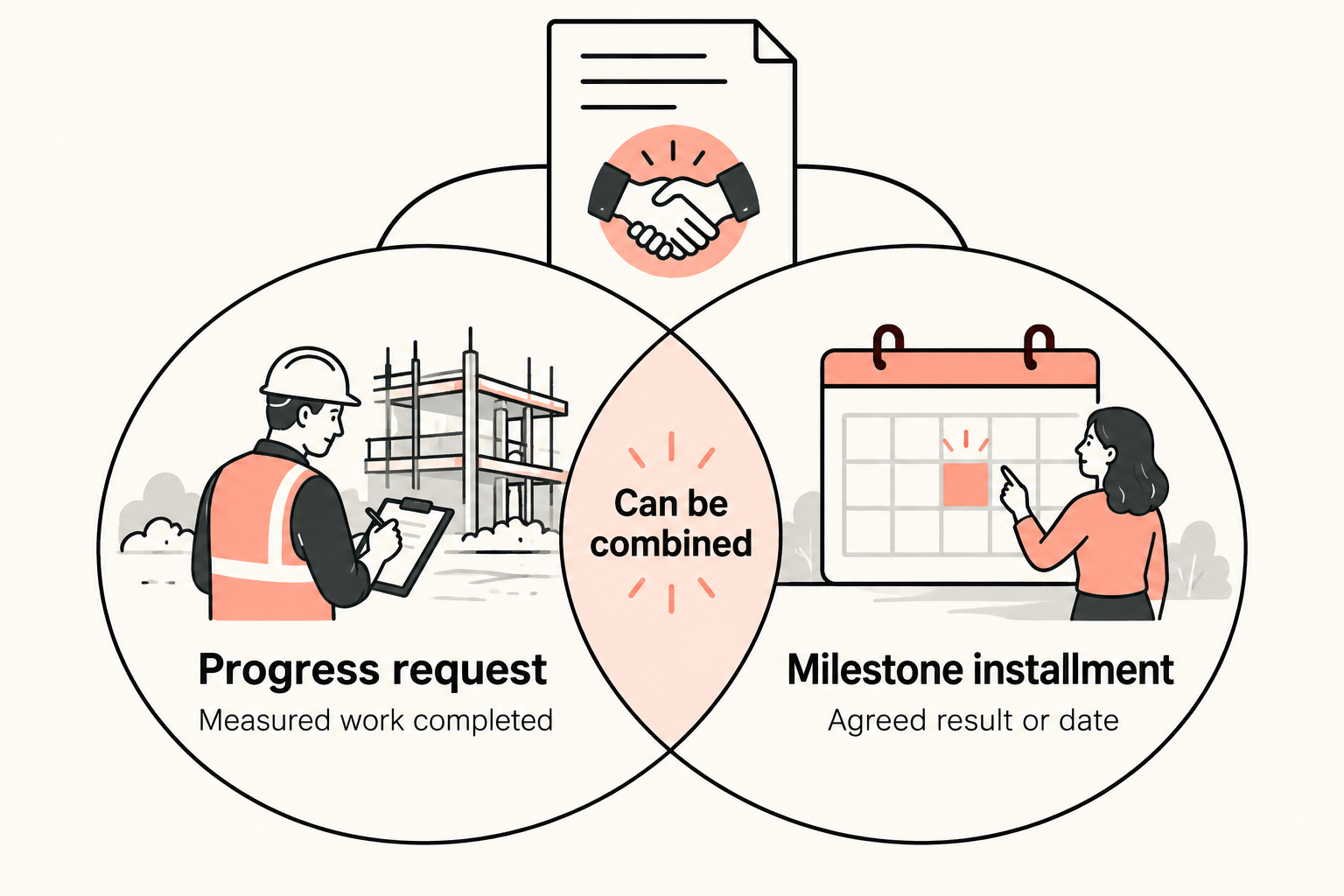
These terms describe models that can overlap. A percentage-of-completion request measures earned value against priced work. A milestone installment becomes due when an agreed result or date is reached. Government contractor guidance treats milestone or result payments and date-based installments as forms of progress payment. Procore discusses the percentage model in construction; it is not a universal definition for every creative contract.
| Progress billing | Milestone billing | |
|---|---|---|
| Typical trigger | Assessed earned value at an agreed interval | An agreed result, acceptance, or date |
| Typical amount | Calculated from the value earned, so it can vary | Agreed installment, which may be fixed or calculated |
| Useful evidence | Priced breakdown and assessed completion | Delivery, acceptance, or date record |
| Main question to settle | How is completion assessed? | What exactly releases payment? |
For example, a studio might agree a fixed payment at concept approval, then calculate the next request from completed production lines. The agreement, not the label, determines what is due.
For a creative engagement, a kickoff, concept approval, and handoff can be clear payment checkpoints. When phases overlap, a priced breakdown can show earned value between those checkpoints. Agree any partial payment explicitly; reaching 60% of a phase does not automatically make 60% of a milestone payable. Our guide to milestones and deliverables can help name the checkpoints.
What to put in the agreement and the invoice
Put the payment terms in the agreement before work begins. The important questions are concrete:
- What is being priced? Intuit lists the work breakdown and tracking as core components. Identify the phases, deliverables, and values that make up the quoted sum.
- What triggers each request? Specify an assessed percentage, a deliverable and acceptance process, a date, or a combination. Say who reviews the supporting evidence.
- When is payment due? State the invoice timing, due date, and process for questions or late payment under the agreed terms.
- Does retainage apply? If so, record the amount or calculation, what it applies to, and the release trigger. This needs contract and jurisdiction review.
- What happens when work changes? Record the revised scope, price, schedule, and payment effect before relying on the old breakdown.
- What does each phase include? Define review and revision limits where relevant, so the parties have a shared basis for acceptance.
On the invoice, Stripe recommends describing the project and phase, the amount now requested, earlier amounts, the remaining balance, and payment terms. If the amount is percentage-based, include the priced lines and assessed completion. Make the calculation easy to check.
Manual entry can introduce errors. Built discusses that risk for construction applications. Check that priced lines sum to the contract amount, the current and prior figures use the same gross or net basis, and any approved change appears once.
Benefits and risks
For the provider
- Staged requests can shorten the period spent carrying production and subcontractor costs, the cash-flow benefit Investopedia explains.
- Checkpoints create a reason to review what has been delivered and what remains.
For the client
- A written schedule makes payment expectations clearer.
- Supporting detail helps the client compare the request with agreed work and approvals.
Risks to manage
- Disagreement about completion. Specify evidence and acceptance before the first request. Tracked hours may be useful context, but they are not approval by themselves.
- Retainage pressure. A held amount delays cash receipt; define the release trigger in the agreement.
- Uneven values. A price schedule that doesn't reflect the work can make requests difficult to explain.
- Administrative work. Each cycle requires a current record of earned value, prior requests, changes, and payments. Use a repeatable check rather than rebuilding the calculation from memory.
Accounting note
Sending a staged invoice and recognizing book or taxable revenue are separate decisions. The IRS's 2007 construction fact sheet discusses a percentage-of-completion tax method, but it does not establish current rules for a creative firm. Ask an accountant how your contracts and jurisdiction should be treated. For an example of a trade-focused invoicing and bookkeeping connection, see this QuickBooks Online integrations for trades article; it is a product resource, not tax guidance.
Where progress billing breaks down: scoping and tracking
The calculation works only when the price basis and progress record are clear.
Before: build a quote with phases or deliverables that can be priced and reviewed. A single total makes it harder to explain a partial request. Our project budget breakdown shows how to organize cost and price assumptions before quoting.
During: record approvals and delivery evidence for payment. Tracked time shows effort and can reveal an estimate variance; it does not certify percent complete. Our guides to time tracking for creative teams and project margin cover those related measures.
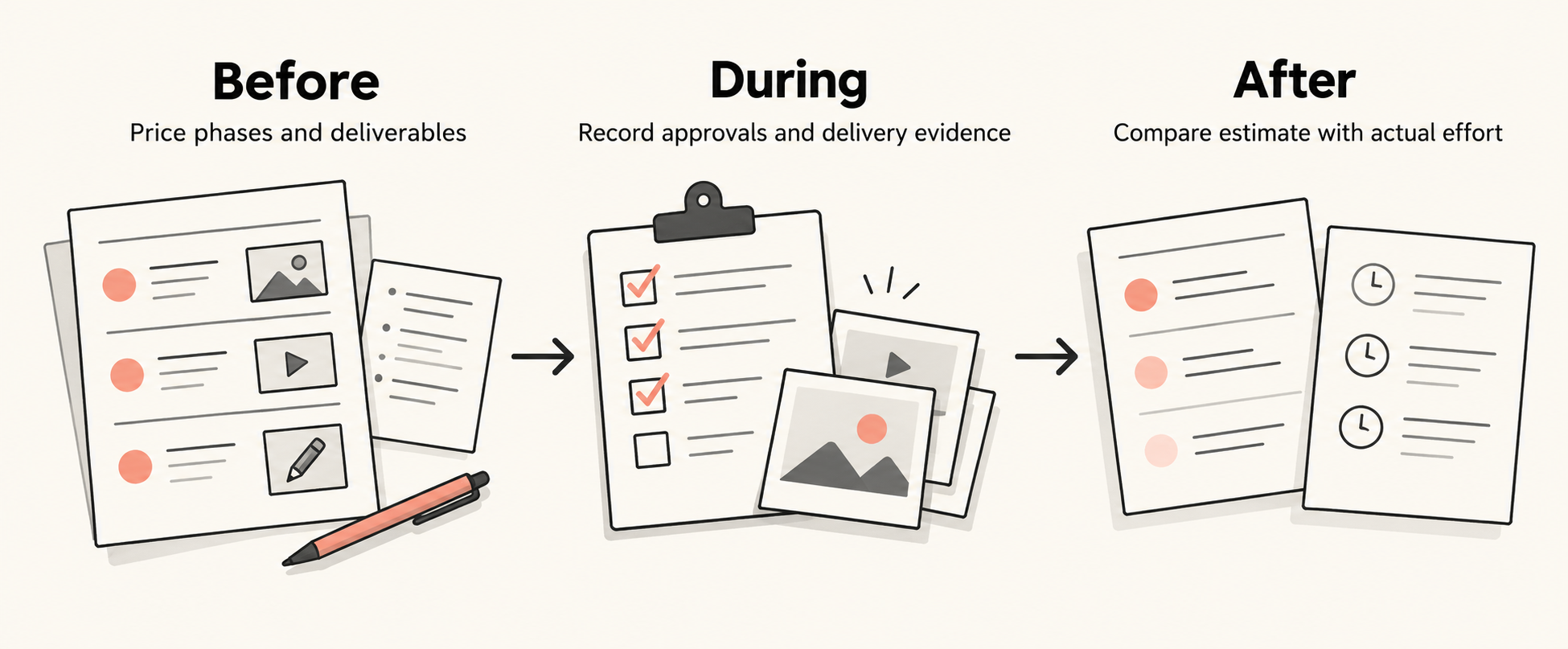
After: compare quoted assumptions with recorded effort and costs. Tracking project profitability can help identify which assumptions deserve revision next time.
Perspective: bill from the quote, not from memory
A staged payment schedule is easier to discuss when the quote names the work behind the price. Imagine a packaging studio quoting research, concept design, artwork production, and handoff. Those phases give the client a useful basis for discussing payment checkpoints before production begins.
A proposal can show phases, deliverables, roles, estimated hours, and a reviewed quote. The parties can then agree a payment schedule that uses that breakdown. Put acceptance terms and invoice details in the client agreement and billing process.
For a short job, a simple written schedule may be enough. As phases and roles multiply, keep the quoted plan and actual effort together so the next estimate can draw on what happened. Keep the payment record equally clear, whether it lives in an invoice system or a spreadsheet.
Setting up staged billing with Roadbase
Bring a real brief, notes, or PDF into Roadbase to create an editable first draft of phases, tasks, roles, estimated hours, and timing. Review and adjust that plan, then use your own role costs and rates, expenses, overhead, contingency, and margin target to review a quote. Export the reviewed plan and quote as a proposal PDF. This gives you a concrete breakdown to discuss when agreeing payment terms with the client.
After approval, the same project can continue with task statuses and tracked time, so you can compare actual hours with the estimate as the work progresses. Visit Roadbase to start the plan, see the Roadbase pricing page for current options, and explore the software consultants page if that is your field.
Practical tips for your first progress-billed project
- Agree the payment schedule alongside the proposal and record it in the client agreement.
- Use enough priced lines to explain the work without losing the reader in detail.
- Set a billing date or trigger, a due date, and an approval contact.
- Attach a short progress note or acceptance record showing what the request covers.
- Document approved scope and price changes before calculating from the revised amount.
- After the project, compare the quoted effort and costs with the actuals to improve the next quote.
FAQ
What do you mean by progress billing?
It means billing at agreed stages during a project rather than only at the end. A stage may be measured work, an accepted result, or a scheduled installment under the contract.
What is an example of a progress payment?
In the $12,000 brand and packaging example above, $6,000 has been earned across the priced lines. With $2,000 previously certified and no retainage, the current request is $4,000. The agreed method for assessing completion determines when that amount may be billed.
How is progress billing different from milestone billing?
A milestone installment is tied to an agreed result, acceptance, or date. A percentage-of-completion request calculates earned value from the priced breakdown. Both can be forms of progress payment, and a contract can combine them. The payment terms decide what is due.
Should freelancers use progress billing?
Consider it when work or outside costs build up well before final delivery and the client can review meaningful stages. A short, simple job may be clearer with a deposit and final balance. Agree the schedule before work starts.
Sources
- Understanding Progress Billings: Key Concepts and Benefits, Investopedia
- Construction Payment Process Explained for Contractors, AIA Contracts
- Progress billing: How it works and tips for project success, Intuit
- Progress Billing: Invoice Formats, Samples, Calculator, BQE
- Progress Billing in Construction, Built
- Construction Progress Billing: Keeping the Cash Flowing, Procore
- Guide to Progress Payments on Construction Projects, Procore
- What is progress invoicing?, Stripe
- Construction payment processing: A guide, Stripe
- Progress Payments Defined, NetSuite
- The Construction Industry and the Tax Gap, IRS (2007)